The keenest eyes of the Argonauts.
Pulling the faint and the hidden out of the James Webb deep sky.
Machine learning on JWST deep-field galaxies, all live in your browser: a Vision Transformer that learns what galaxies look like, a self-supervised atlas of ~10,000 galaxies you can fly through, an anomaly hunt that rediscovers the mysterious Little Red Dots and a neural photo-z dropout hunter for galaxies at the cosmic frontier. Self-contained, no build step: the methods, in the open.
Galaxy morphology
A ViT-Small in ONNX classifies a real JWST galaxy cutout in your browser as featured, smooth or merger (real Galaxy Zoo labels), with attention heatmaps and honest, cross-validated metrics.
Open demo →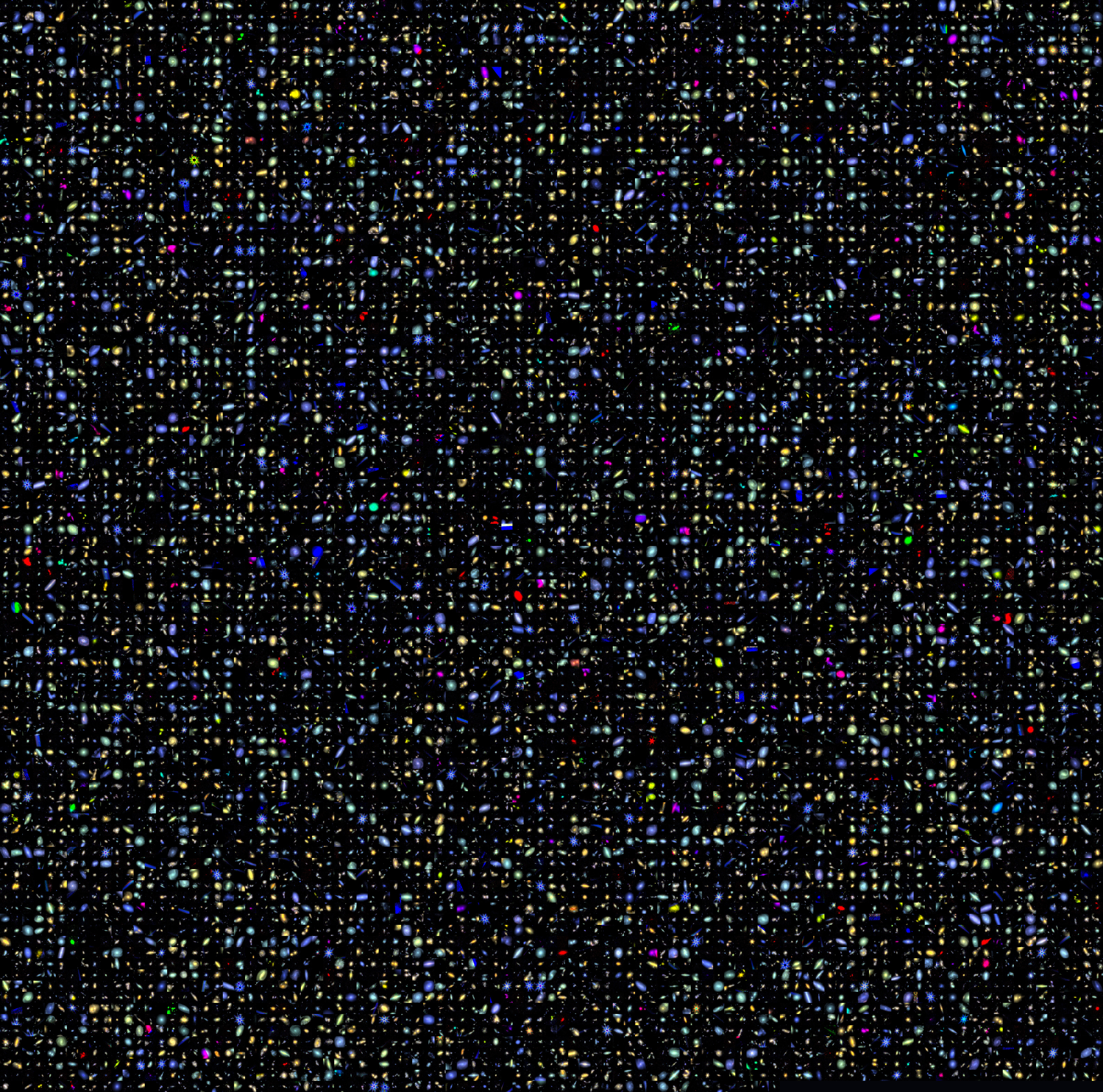
The embedding atlas
A self-supervised encoder (SimCLR) maps thousands of real JWST galaxies into a 2-D atlas you fly through; colour it by morphology and watch the encoder's own structure emerge.
Open demo →The anomaly hunt
Score every galaxy by how unusual it is in latent space, and watch 216 real Little Red Dots (Kokorev+24) land where the encoder, with no labels, flagged the weird ones. Colour by anomaly in the atlas.
Open atlas →The dropout hunter
Watch a galaxy at z > 10 vanish from the bluer filters as the Lyman break sweeps through them, and read its redshift from a neural net running live in your browser, at the heart of the "too many bright early galaxies" tension that has JWST rewriting galaxy formation.
Open demo →Why "Lynceus"
Lynceus sailed with the Argonauts and had the sharpest sight of any mortal; he could pick out a ship on the horizon, find what others missed and even see through earth and water. That is the whole task here: the faintest galaxies in James Webb's deepest images sit at the edge of the noise, and the most interesting objects are the ones that don't look like anything else. Lynceus learns to see them.
Where this goes next
The anomaly hunt rediscovers known Little Red Dots but surfaces no genuinely new one here: an honest, validated method rather than a discovery claim. That result points the way forward: rebuild the atlas from a fainter, JWST-native source list (rather than bright, human-catalogued galaxies) so it can reach the population where new dots hide, then align the image embeddings with NIRSpec spectra (contrastive image and spectrum learning) so the map inherits redshift and emission-line structure with no labels. Public spectra, released steadily, are a standing confirmation test along the way.