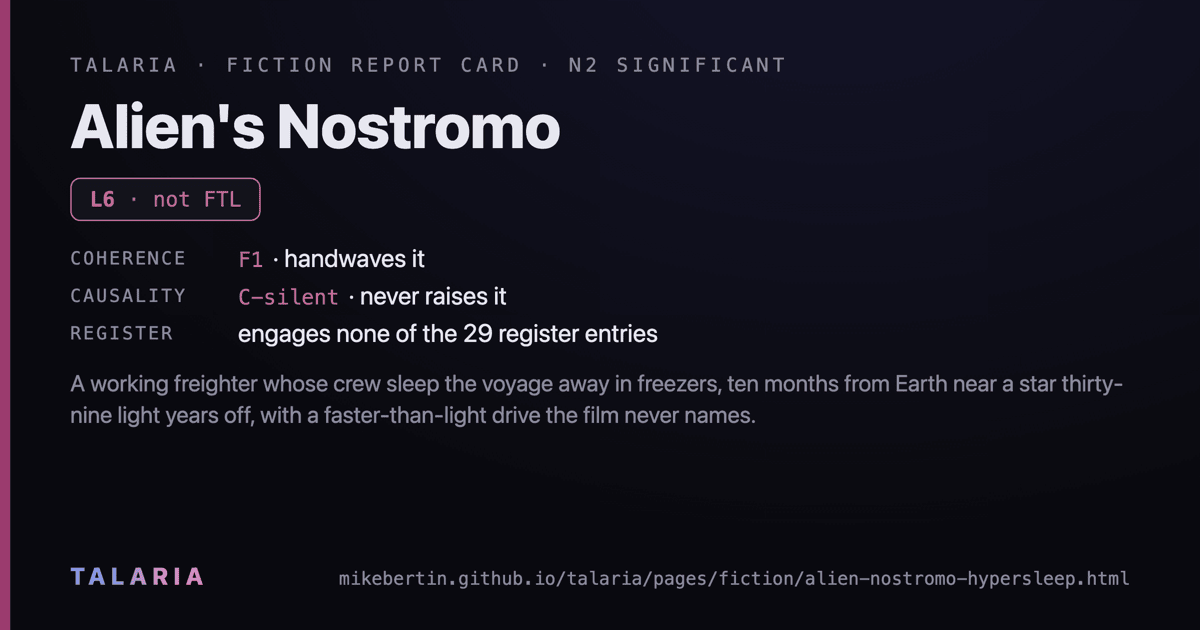
Alien's Nostromo
A working freighter whose crew sleep the voyage away in freezers, ten months from Earth near a star thirty-nine light years off, with a faster-than-light drive the film never names.
Kind: fiction · Loophole: L6 · Notability: N2 · Coherence: F1 · Causality: C-silent · Last reviewed: 2026-09-12
The drive as depicted
Alien (20th Century Fox, 1979) opens on text: commercial towing vehicle Nostromo, crew seven, cargo a refinery processing twenty million tons of mineral ore, course returning to Earth [HIGH] S4 (AFI Catalog transcription). The crew wake from freezers; the film's dialogue never uses the word "hypersleep", only Parker's "Back to the old freezerinos!" and the question of whether to "freeze" the injured Kane, though the shooting script's slug lines and dialogue use "hypersleep" throughout [HIGH] S1. The ship's computer is Mother, and Mother has "interrupted our journey course" to answer a signal [HIGH] S1. Where they are is stated: Lambert, "I've found it, just short of Zeta II Reticuli. We haven't reached the outer rim yet.", and Ripley, "It's not our system." [HIGH] S1. How far home is stated once. Dallas: "Give me the short version. How far to Earth?" Lambert: "Ten months." [HIGH] S1. Ripley's closing log gives the other figure: "I should reach the frontier in about six weeks." and "With a little luck, the network will pick me up." [HIGH] S1.
Zeta Reticuli is a real binary at 39.3 light years by Gaia parallax [HIGH] S3. Ten months to Earth from its neighbourhood is an average of roughly forty-seven times the speed of light, and the film does not do the sum, name a drive, or say the word "light". The only engine line is the landing order "Kill drive engines" [HIGH] S1. The June 1978 shooting script had the drive on the page: Dallas orders "Set our course and get us up to light plus four", a stage direction has "The Nostromo now at light speed" with the stars ahead turning blue, and the engine room runs "on automatic hyper-drive"; none of it survives in the film [HIGH] S1. The sequel Aliens (1986) keeps the pattern: Ripley drifted "57 years" in stasis, "right through the core systems"; rescue after being declared overdue takes "17 days"; a colony administrator says "it takes two weeks to get an answer out here"; the script's slug line between Earth and the colony reads "THREE WEEKS LATER" [HIGH] S1. Neither film mentions relativity, dilation or the speed of light [HIGH] S1 (transcripts and scripts searched).
Origin and lineage
Dan O'Bannon wrote the story and screenplay, Walter Hill and David Giler revised it, and Ridley Scott directed; the film was released in May 1979 [HIGH] S3. The design intent was a truck, not a starship: Scott said he "wanted to do the truck driver version" and did not design the Nostromo "to look like a hotel"; Ron Cobb's stated approach was to design a spaceship "as though it was absolutely real, right down to the fuel tolerances" [MED] S3 (period interviews quoted on design blogs). The realism is in the plumbing and the pay dispute, not the drive. The later companions do not fill the gap: Alien: The Weyland-Yutani Report (2014) is reported to give the ship's registration, length and a 2101 build as an interstellar cruiser refitted in 2116, and the Colonial Marines Technical Manual (2012) gives sublight thrust engines and a manufacturer for the FTL drive, but no source fetched names the drive's principle [LOW] S3 (companions cited via the franchise wiki, not opened). No real physics proposal is named anywhere in the franchise and none was fed.
Which loophole, and why
L6 by the catalogue's habit, because the entry is here for the hypersleep, which is the sublight answer to a long voyage and is the cousin's own device; the relativistic rocket dossier is the physics of a crew that sleeps because the trip is long. But the Nostromo is not a relativistic rocket. Ten months across thirty-nine light years is FTL, unexplained, and if it were explained it would have to be L2, L3 or L4 and pay the corresponding bill: negative energy for a bubble or a throat (ENE-2), or a second space with no counterpart in physics (MAN-1). The film's refusal to say is the finding, and it is scored below as silence rather than as a rule.
The rules it keeps
- The crew sleep and the ship runs itself. Freezers, Mother, a fixed course, wake on arrival: consistent across both films and the franchise [HIGH] S1.
- Distances are long enough to matter. Ten months home, six weeks to the frontier, fifty-seven years adrift, two weeks for an answer at the colony: the numbers are always big and never contradicted within a film [HIGH] S1.
- The drive is never explained. The script's "light plus four" was cut and nothing replaced it.
F1: the FTL works when the plot needs it and is not otherwise present. This is not a low mark in disgrace; it is the correct description of a film that spends its realism elsewhere and leaves the drive as a truck's engine, assumed and unseen.
What it ignores
Everything the register would ask of an FTL ship. The Nostromo crosses tens of light years in months, and neither film nor script asks what that costs, in whose frame, or what it does to a distress beacon or a reply. The franchise's communications lag at the colony, two weeks for an answer, is the one gesture at a signal limit and it is not tied to any distance [HIGH] S1. Ripley's fifty-seven years are elapsed time in a freezer, not dilation, and no source treats them otherwise [HIGH] S3. C-silent: never addressed in any instalment as of 2026-09-12. The catalogue's description, an FTL drive present but never explained, is confirmed by the script's cut lines.
Constraint scoring
Filed with the control group for its hypersleep, but the ship is FTL, so the four rows the control group must answer are answered here as silence rather than as rules.
| Constraint | Verdict | Note |
|---|---|---|
| CAU-1 | SILENT | An FTL freighter of unstated mechanism, ten months for thirty-nine light years, with a distress beacon and a "network" to pick up a lifeboat; no instalment raises the frame or the reply |
| CAU-2 | N/A | No closed timelike curves are proposed; nothing is proposed |
| CAU-3 | N/A | No wormhole or warp bubble is named, so none can be carried on a round trip |
| CAU-4 | N/A | No frame is named because no mechanism is |
| CAU-5 | N/A | No entanglement |
| ENE-1 | N/A | Nothing exotic is claimed |
| ENE-2 | SILENT | The ship beats light through flat space, which the theorems price in negative energy; the film names no mechanism and pays no bill |
| ENE-3 | N/A | No negative energy is claimed |
| ENE-4 | N/A | Warp-class |
| ENE-5 | N/A | Warp-class |
| ENE-6 | N/A | Casimir not invoked |
| ENE-7 | N/A | No shortcut is named |
| CON-1 | N/A | No horizon is described; the crew sleep and Mother flies |
| CON-2 | N/A | Nothing laid along the route |
| CON-3 | N/A | No tube |
| STA-1 | N/A | No bubble |
| STA-2 | N/A | No throat |
| STA-3 | N/A | No chronology horizon |
| HAZ-1 | N/A | No superluminal wall is described |
| HAZ-2 | N/A | No horizon |
| HAZ-3 | N/A | No throat |
| LOR-1 | SILENT | The ship exceeds c by the film's own numbers and the film never says how; the light barrier applies and is not mentioned |
| LOR-2 | N/A | No tachyon |
| LOR-3 | SILENT | The distress beacon, Ripley's log and the colony's two-week answer are signals with no stated speed; a signal limit applies and is never addressed |
| LOR-4 | N/A | Neither Scharnhorst nor OPERA |
| WRP-1 | N/A | Not stated to be a warp drive |
| WRP-2 | N/A | Not a warp shell |
| WRP-3 | N/A | Not in the warp class |
| MAN-1 | N/A | The script's cut "hyper-drive" is the only hint of another space and it is not in the film; nothing on screen to score |
Sources
- S1 Alien (1979), transcript (springfieldspringfield). Read.
- S1 Hill, W. and Giler, D., Alien, revised final shooting script, June 1978, and the October 1978 revision. Read (text extracted from scanned PDFs).
- S1 Aliens (1986), transcript (springfieldspringfield) and script (IMSDb). Read.
- S3 Wikipedia, "Alien (film)" and "Zeta Reticuli" (Gaia DR3 distance). Read.
- S3 Xenopedia (Fandom), "USCSS Nostromo", "Stasis", "Yutani Corporation", "Alien: The Weyland-Yutani Report". Read via browser; companion citations second-hand.
- S3 Strange Shapes, "Space Truckin': The Nostromo" (2012), quoting Fantastic Films (1979); Alien Explorations, "Ron Cobb's design philosophy", quoting The Book of Alien (1979). Read.
- S4 AFI Catalog, "Alien" (1979), for the opening text. Read.