Andromeda: the slipstream
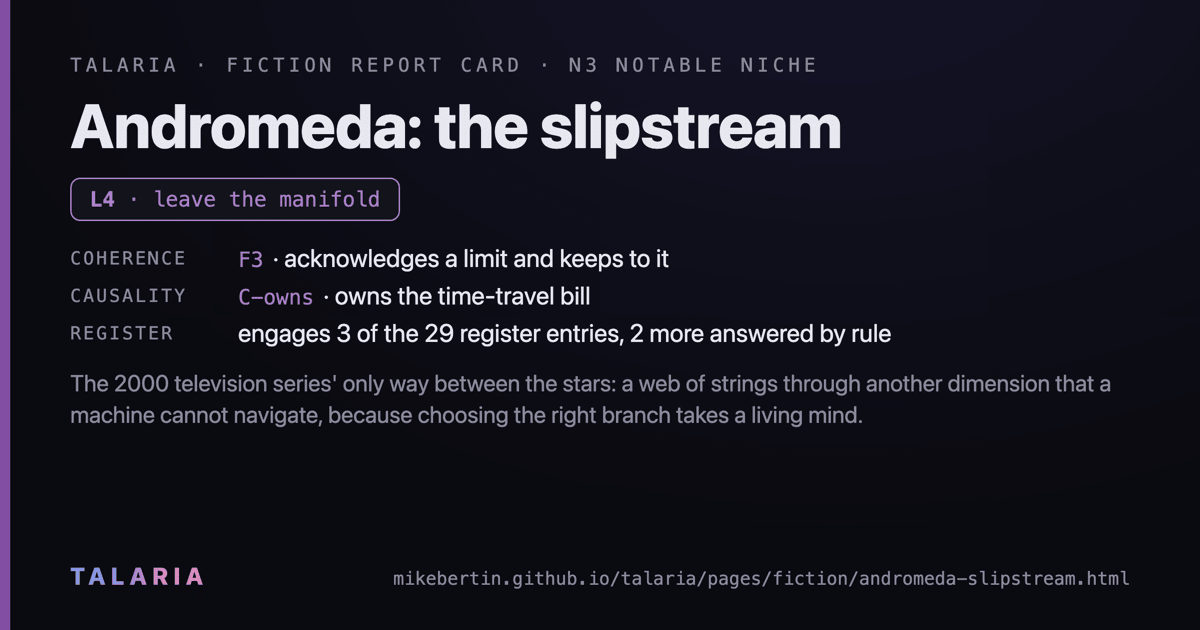
The 2000 television series' only way between the stars: a web of strings through another dimension that a machine cannot navigate, because choosing the right branch takes a living mind.
Kind: fiction · Loophole: L4 · Notability: N3 · Coherence: F3 · Causality: C-owns · Last reviewed: 2026-09-12
The drive as depicted
Andromeda premiered in syndication on 2 October 2000 with "Under the Night", written by Robert Hewitt Wolfe from unused Gene Roddenberry material [HIGH] S3. The pilot establishes the drive by using it and by losing it. The Andromeda Ascendant, a High Guard warship, transits to slipstream on a countdown ("Brace for slipstream") and transits back to normal space at the Hephaestus system, where a black hole of three times ten to the thirty-first kilograms sits in the outer system [HIGH] S1. Ambushed there, the ship cannot escape by the drive: asked whether they can transit to slipstream, the pilot answers "Not here", because the gravitational pull of the black hole is too strong [HIGH] S1. The ship is frozen at the event horizon, and when a salvage crew pulls it free 303 years later the first question asked of the ship's time is "What's the time dilation look like?" [HIGH] S1. Slipstream, then, has a stated precondition, distance from strong gravity, and the series' premise rests on general relativity's own time dilation rather than on the drive.
The drive's central rule is given in the sixth episode, "Angel Dark, Demon Bright" (2000), when Beka Valentine teaches Trance Gemini to pilot. The slipstream is not alive but "it feels like it is": it changes and shifts, and the pilot's job is to anticipate the shifts. Asked why the ship's own artificial intelligence cannot do it, Beka answers that Andromeda may be sentient but is still technically a machine, and "machines and slipstream don't get along"; when an organic sentient makes a choice about their course in the slipstream they most often choose correctly, and "early Vedran physicists" believed it had to do with the interaction of an organic observer with collapsing probability waves [HIGH] S1. The series' promotional material, quoted in the reference literature from the show's All Systems University site, gives the numbers: an artificial intelligence has a fifty percent chance of choosing the right route at each branching, an organic pilot better than ninety-nine percent, so every large ship carries an AI and needs a living pilot regardless; a gravity field generator reduces the ship's mass, a slippoint is opened, and the pilot rides the strings that connect concentrations of matter through an additional dimension [MED] S3. Travel time bears little relation to distance: a well-flown route between galaxies can take minutes and a badly flown one weeks, and much-used routes become faster and more predictable [MED] S3.
The scale of the network is stated on screen. In the second-season opener "The Widening Gyre" the ship follows slipstream routes, "large and well-traveled", to M86 in the Virgo cluster, over sixty-six million light-years away, and the dialogue draws the consequence that light from M86 is sixty-six million years old [HIGH] S1. The same sixth episode that gives the piloting rule also gives the causal one: a slipstream transit throws the Andromeda three hundred years into its own past, into the Battle of Witchhead, where the ship's actions turn out to be what history already recorded; on return the ship's AI confirms from star positions and galactic expansion that the date is CY 10087, "back where we started", and the crew argue over whether the outcome was predestined [HIGH] S1.
Origin and lineage
The series was developed by Robert Hewitt Wolfe, previously of Star Trek: Deep Space Nine, from notes Roddenberry left, and produced by Tribune Entertainment with Majel Barrett Roddenberry as executive producer; it ran five seasons to 2005 [HIGH] S3. Wolfe's writers' bible and the All Systems University website supplied a worked-out setting in which slipstream is the only FTL and its organic-pilot rule is the reason a galactic civilisation still needs people [MED] S3. The "collapsing probability waves" gloss borrows the language of the observer in quantum measurement, the idea, popular since the 1930s and disowned by most physicists, that a conscious observer collapses the wavefunction; no paper is named and this dossier asserts no source beyond the popular idea. The show's slipstream shares only its name with the "quantum slipstream" of Star Trek: Voyager (1998), which was on air two years earlier; no statement by either production connecting them has been found, and none is claimed.
Which loophole, and why
L4, leave the manifold. The ship transits out of normal space into a stream with its own structure, strings through an additional dimension, and transits back somewhere else; while in it the ship is not in our space, and the time spent bears no fixed relation to the distance covered. It is not fast (L1), does not carry a bubble (L2) and, though the strings connect fixed concentrations of matter and behave like a network of routes, they are not tunnels with two ends in our spacetime (L3); the show's own account keeps them in another dimension. The network character gives the drive a secondary L3 flavour, noted below under CON-2.
The physics cousins are the extra-dimension dossiers. The Kaluza-Klein hyperspace reading is the negative finding: extra dimensions in physics are compact or warped, share our light cone and contain no strings to ride; the bill of the class is B-new. Brane-bulk shortcuts is the nearest real relative, and the closest in spirit to slipstream's "strings between concentrations of matter": matter on a brane bends it into the bulk, and a signal cutting through the bulk arrives before light along the brane, by one part in $10^{58}$, at a bill of B-new, B-mass and B-caus, with the arrival still a message to the past for everyone on the brane. The register entry for the class is MAN-1. The black hole that frames the premise is plain general relativity and has no bill; the series keeps it as its L6 baseline.
The rules it keeps
The Coherence mark is F3, acknowledges: the work states limitations and applies them consistently, and it engages one real constraint at the level of the premise. The stated limitations are that slipstream needs an organic pilot, cannot be entered inside a strong gravity well, follows routes that must be found and can be lost, and delivers a ship after a time that depends on the pilot rather than the map. The organic-pilot rule holds for the whole run: the ship's avatar never pilots interstellar transits, and episodes turn on who is at the controls. The gravity rule is used in the pilot to trap the ship and later to deny escapes. The route rule gives the setting its geography, with the Magog coming from a known direction and the Commonwealth's worlds linked by mapped streams.
The real constraint kept is time dilation at an event horizon, which is the premise: the crew of the Andromeda have lost three centuries because the ship was frozen at the edge of a black hole, and the first-season plot is the consequence. That is general relativity used as a story engine, and it earns the "acknowledges" mark even though the drive itself has no physical content. The mark stops at F3 because the drive's limitations are story rules, and the probability-wave explanation of the pilot requirement is a borrowed phrase rather than a constraint.
What it ignores
The register's questions about the stream are never answered. No episode says what the additional dimension is, what a slippoint costs in energy beyond the gravity field generator's reduction of mass, why the strings connect masses or what "riding" one means physically. The dangers shown are collision, misnavigation and getting lost, never anything about the stream itself.
Causality is C-owns. The series admits that its FTL is a time machine and uses it: "Angel Dark, Demon Bright" sends the ship three centuries into its own past by slipstream, has it fulfil recorded history and brings it home to the same date it left, and the episode's argument is about predestination, which is a causal-loop argument. Later seasons return to the theme. What the show never does is pick a frame or state a rule that prevents the loop; it accepts the loop and tells a self-consistent story inside it. Last checked 2026-09-12: no episode states a mechanism that would confine slipstream to the future.
Constraint scoring
Every entry in the register, one row each, verdict from the fiction vocabulary, with a note that says where in the work the engagement or rule occurs.
| Constraint | Verdict | Note |
|---|---|---|
| CAU-1 | ENGAGES | "Angel Dark, Demon Bright" (2000) has the drive deliver the ship into its own past and the crew argue about it; the antitelephone's consequence is shown rather than avoided. |
| CAU-2 | SILENT | No chronology protection; the loop of the sixth episode is self-consistent by construction; nothing in the setting enforces it. |
| CAU-3 | ENGAGES | One drive, one transit, one time machine: the sixth episode does with a single slipstream jump what CAU-3 needs two devices for, and the work accepts the result. |
| CAU-4 | SILENT | No preferred frame is ever stated; the setting's Commonwealth Year calendar is used across galaxies without anyone asking how it is synchronised. |
| CAU-5 | N/A | No entanglement signalling; the "collapsing probability waves" gloss concerns the pilot's choice, not communication. |
| ENE-1 | SILENT | The gravity field generator reduces the ship's mass to open a slippoint, per the setting material, and nothing says what sign of energy that takes; the energy conditions are never mentioned. |
| ENE-2 | SILENT | A ship reaches M86 in a stream and no episode prices the time advance; Olum's negative energy is never invoked. |
| ENE-3 | SILENT | No negative energy, so no inequality. |
| ENE-4 | N/A | No bubble. |
| ENE-5 | N/A | Not a warp metric; mass reduction is not a shift vector. |
| ENE-6 | N/A | No Casimir energy. |
| ENE-7 | SILENT | The strings connect fixed masses like handles would, and if they were tunnels in our spacetime topological censorship would apply; the show places them in another dimension and never says which, so the row is neither answered nor excluded. |
| CON-1 | N/A | No warp wall, no horizon; the control problem is the pilot's judgement, and the show makes that the point. |
| CON-2 | RULE | Slipstream is a network of routes that exist independently of the ship, must be found, and improve with use ("The Widening Gyre" follows routes "large and well-traveled"). That is infrastructure rather than a drive built from a standing start, which is the shape Krasnikov's bootstrap requires; the show does not name the row, but the rule answers it. |
| CON-3 | N/A | No tube laid by the traveller; the routes pre-exist. |
| STA-1 | N/A | No superluminal bubble. |
| STA-2 | N/A | No throat held open by the ship. |
| STA-3 | N/A | No chronology horizon is built, though the sixth episode passes through one without noticing. |
| HAZ-1 | N/A | Nothing swept up; the ship is not pushing a wall through a medium. |
| HAZ-2 | SILENT | The crew are never harmed by the stream itself; the hazard is a wrong turn. Nothing says what the stream does to a body, so the row is silent rather than excluded. |
| HAZ-3 | N/A | No throat. |
| LOR-1 | RULE | The ship transits out of normal space rather than accelerating; the stated rule is that slipstream is the only FTL and ordinary drives are sublight ("We're at 25 PSL" in the pilot's escape run, a percentage of light speed). |
| LOR-2 | N/A | No tachyons. |
| LOR-3 | N/A | No wave in a medium. |
| LOR-4 | N/A | Neither Scharnhorst nor OPERA bears on it. |
| WRP-1 | N/A | Not a warp drive. |
| WRP-2 | N/A | Not a shell moving inertially. |
| WRP-3 | N/A | No positive-energy warp claim. |
| MAN-1 | ENGAGES | The setting states the other space and its rules on screen: strings through an additional dimension, unnavigable by machines, with travel time unrelated to distance. MAN-1 says physics supplies no such space; the show's answer is the organic-observer rule, which is the laxer rule named. |
Sources
- S1 Andromeda, "Under the Night" (season 1, episode 1), first aired 2 October 2000, written by Robert Hewitt Wolfe. Dialogue checked against the episode transcript at springfieldspringfield.co.uk.
- S1 Andromeda, "Angel Dark, Demon Bright" (season 1, episode 6), first aired November 2000. Dialogue checked against the same transcript site.
- S1 Andromeda, "The Widening Gyre" (season 2, episode 1), first aired 2001. Dialogue checked against the same transcript site.
- S3 Wikipedia, "Andromeda (TV series)", for the premiere date, creators, premise and the organic-pilot summary.
- S3 Wikipedia (archived copy at en-academic.com), "Slipstream (science fiction)", for the All Systems University description of the drive, the fifty and ninety-nine percent figures and the gravity field generator.
- S3 The New Systems Commonwealth wiki (andromeda.fandom.com), "Slipstream", consulted via search excerpts only.