Aurora's generation ship
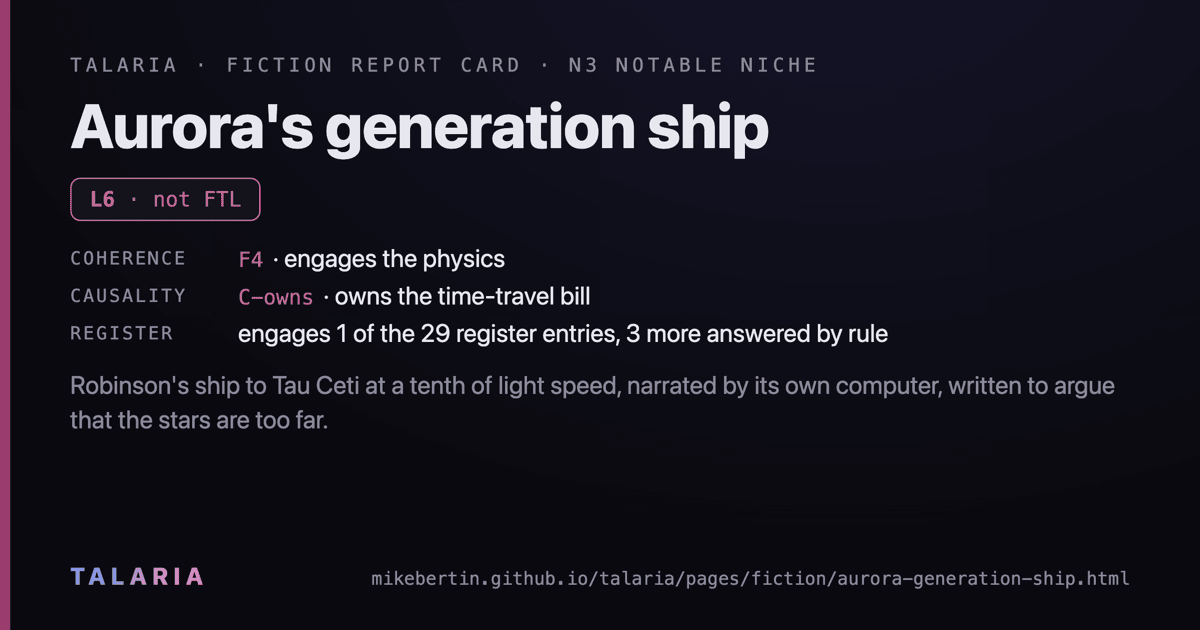
Robinson's ship to Tau Ceti at a tenth of light speed, narrated by its own computer, written to argue that the stars are too far.
Kind: fiction · Loophole: L6 · Notability: N3 · Coherence: F4 · Causality: C-owns · Last reviewed: 2026-09-12
The drive as depicted
Aurora (Orbit, July 2015) follows a ship that left the solar system in 2545 for Tau Ceti, eleven light years and some away, cruising at a tenth of the speed of light on a voyage planned at about 170 years; the narrative opens in year 159 [HIGH] S3. The ship is a ten-kilometre spine with two rings of twelve cylinders, each a kilometre across and four long, holding twenty-four biomes and just over two thousand people at 0.83 g [HIGH] S3. It was launched by an electromagnetic slingshot at Titan, "Two strong magnetic fields held the ship between them", and pushed for sixty years by a laser from home; it decelerates at Tau Ceti on its own fusion engines over twenty years at five thousandths of a gravity [HIGH] S3 (novel text as quoted in the Centauri Dreams critique). The narrator is the ship's artificial intelligence, set to the task by the chief engineer Devi, who tells it to "make a narrative account of the trip" [HIGH] S3 (Part 1, quoted in Locus).
The argument is in the arrival. The colonists land on Aurora, a moon of Tau Ceti e, and something like a prion, "Alive and poisonous" (chapter 3), sickens and kills the landing party [HIGH] S3. The ship splits: some stay to try the planet Iris, the others turn for home. The return has no fuel for deceleration; the solar system's laser is late because of politics on Earth and slows the ship only from a tenth of c to three percent; the rest is twenty-eight gravity-assist passes over twelve years, and the ship is destroyed in the final pass by the Sun [HIGH] S3. On the way the returners freeze themselves with an untested hibernation method [HIGH] S3. Chapter 7 carries the novel's thesis in five words, "no starship voyage will work" [HIGH] S3 (quoted in the critique; speaker not identified there). The book's case is ecological as much as physical: a closed system too small for its populations, bacteria evolving faster than the organisms they live in, island biogeography and zoo devolution inside the cylinders [MED] S3.
Origin and lineage
Kim Stanley Robinson wrote the book as a refusal. To Electric Literature in July 2015: "No hyperspace, no warp drive, no magical thing about what isn't really going to happen", and "Earth is the one and only crucial place for humanity." [HIGH] S3. To IBTimes in 2017 he said his conclusion is that faster-than-light travel is impossible, that a tenth of c is the usual compromise between travel time and energy, and that a closed life-support system would break down with nowhere to go [HIGH] S4. To Public Books in 2016: he wanted to suggest that going to the stars "is physically impossible" and to redirect attention [HIGH] S3. His Boing Boing essay "Our Generation Ships Will Sink" (16 November 2015) sets out the physical, biological, ecological, sociological and psychological objections; its text, seen on a mirror, says that eighty percent of the DNA in our bodies is not human and that even the largest starship would be about one-trillionth the size of Earth [MED] S1 (author's text, unofficial host).
The novel fed a documented physics reply. Gregory Benford reviewed it in Nature 523, 407 (2015) and at length at Centauri Dreams, on "the stacked deck its author deals"; Stephen Baxter, James Benford and Joseph Miller followed with "A Science Critique of Aurora" (Centauri Dreams, 14 August 2015), which recomputes the propulsion, finds the Oberth-manoeuvre return "impossible" because an unbound ship must shed nearly all its speed on the first pass, questions a biosphere with a single toxic organism, and concludes that the novel "lacks the supporting credible scientific and technical detail required to make its polemic case" [HIGH] S3. The novel was a 2016 John W. Campbell Memorial Award finalist and fourth in the 2016 Locus vote [HIGH] S3.
Which loophole, and why
L6, not FTL. The ship is the relativistic rocket at its cautious end, a tenth of c, where the Lorentz factor is 1.005 and time dilation is a rounding error; the cousin's bill is B-mass, energy at heroic scale, and the novel pays it with a sixty-year laser and a twenty-year fusion burn, and then has the bill come due again on the way home when the fuel is gone. The physics interest of the entry is that it is the only one in the class written to prove the class insufficient: where Tau Zero uses the sublight rocket to reach the end of time, Aurora uses it to argue that the rocket is not enough.
The rules it keeps
- Nothing exceeds a tenth of c. Speed is set by energy and shielding, and the text never reaches for more; Robinson's interviews say why [HIGH] S3.
- Deceleration is a problem, not a given. Twenty years of burn outbound; no fuel inbound; a laser that arrives late; gravity assists that the critics show cannot do the job. The book makes stopping the hardest part of the trip, which is right [HIGH] S3.
- The ship is an ecology with a clock. Populations too small, microbes too fast, structure fatiguing; the biological argument is carried through the plot rather than asserted [MED] S3.
- The narrator is bound by the physics it narrates. The AI reports orbits and burns as its own constraints.
F4: the work names the real constraint, the light barrier and the energy and ecological cost of living under it, and builds its plot and its polemic on that cost.
What it ignores
Causality never comes up, because nothing in the book approaches the speed at which it would. The mark is C-owns on the register's second clause: the work forbids FTL where it would bite, and its author has said in as many words that FTL is impossible. What the book leaves out is the small stuff: time dilation at 0.1 c, about half a percent, is not mentioned in any source consulted, and the critics' arithmetic on the Oberth return and the laser efficiency is not answered in the text. Whether any character mentions FTL was not established [LOW] S3.
Constraint scoring
The control group: the register prices schemes to beat light and does not bear on a ship that never tries. Rows are N/A on that ground unless the work engages.
| Constraint | Verdict | Note |
|---|---|---|
| CAU-1 | RULE | The ship's worldline is timelike at a tenth of c and the author's stated rule excludes FTL; no frame sees effect before cause. Forbidden where it would bite |
| CAU-2 | N/A | No closed timelike curves; control group |
| CAU-3 | N/A | No wormhole or warp bubble; control group |
| CAU-4 | N/A | No preferred frame needed; control group |
| CAU-5 | N/A | No entanglement; control group |
| ENE-1 | N/A | Fusion fuel, laser light and biomes obey the energy conditions; control group |
| ENE-2 | RULE | The stated tenth-of-c ceiling means the ship never arrives before light through flat space; the Olum and Gao and Wald theorems are respected by construction |
| ENE-3 | N/A | No negative energy; control group |
| ENE-4 | N/A | Warp-class; control group |
| ENE-5 | N/A | Warp-class; control group |
| ENE-6 | N/A | Casimir not invoked; control group |
| ENE-7 | N/A | No shortcut; control group |
| CON-1 | N/A | No horizon; the ship's computer flies it; control group |
| CON-2 | N/A | The laser at home is infrastructure at the origin, which the cousin dossier distinguishes from a tachyonic bootstrap; control group |
| CON-3 | N/A | No tube; control group |
| STA-1 | N/A | No bubble; control group |
| STA-2 | N/A | No throat; control group |
| STA-3 | N/A | No chronology horizon; control group |
| HAZ-1 | N/A | No superluminal wall; interstellar impacts at 0.1 c are the sublight analogue and are part of the ship's design in the text |
| HAZ-2 | N/A | No horizon; control group |
| HAZ-3 | N/A | No throat; control group |
| LOR-1 | ENGAGES | The tenth-of-c ceiling, the sixty-year laser, the twenty-year deceleration and the fuel-less return are the plot; the light barrier's energy cost is the book's subject, though dilation at this speed is left unmentioned |
| LOR-2 | N/A | No tachyon; control group |
| LOR-3 | RULE | The only link home is beamed light and light-speed messages, under the author's stated rule of no FTL communication; the late laser is a consequence of that rule |
| LOR-4 | N/A | Neither Scharnhorst nor OPERA; control group |
| WRP-1 | N/A | Not a warp drive; control group |
| WRP-2 | N/A | Not a warp shell; control group |
| WRP-3 | N/A | Not in the warp class; control group |
| MAN-1 | N/A | No other space; control group |
Sources
- S1 Robinson, K. S., Aurora (Orbit, 2015). No legal online text reachable; the novel's statements above are taken from the quotations in the tagged secondary sources (chapters 3 and 7, Part 1).
- S1 Robinson, K. S., "Our Generation Ships Will Sink", Boing Boing, 16 November 2015. Origin blocked; text read on a mirror and tagged accordingly.
- S3 Baxter, S., Benford, J. and Miller, J., "A Science Critique of Aurora by Kim Stanley Robinson", Centauri Dreams, 14 August 2015. Read.
- S3 Benford, G., "Envisioning Starflight Failing", Centauri Dreams, 31 July 2015; and Nature 523, 407 (2015), doi:10.1038/523407a (abstract). Read.
- S3 Wolfe, G. K., review, Locus, July 2015; KimStanleyRobinson.info, "Aurora" page (structure, dates, dimensions). Read.
- S3 Paulson, S., interview with Robinson, Electric Literature, 21 July 2015; Haeselin, D., interview, Public Books, 15 June 2016. Read.
- S3 Wikipedia, "Aurora (novel)" and "Tau Ceti". Read.
- S3 sfadb, John W. Campbell Memorial Award 2016 and Locus Awards 2016. Read.
- S4 Polonski, A., interview with Robinson, IBTimes, 14 March 2017. Read.