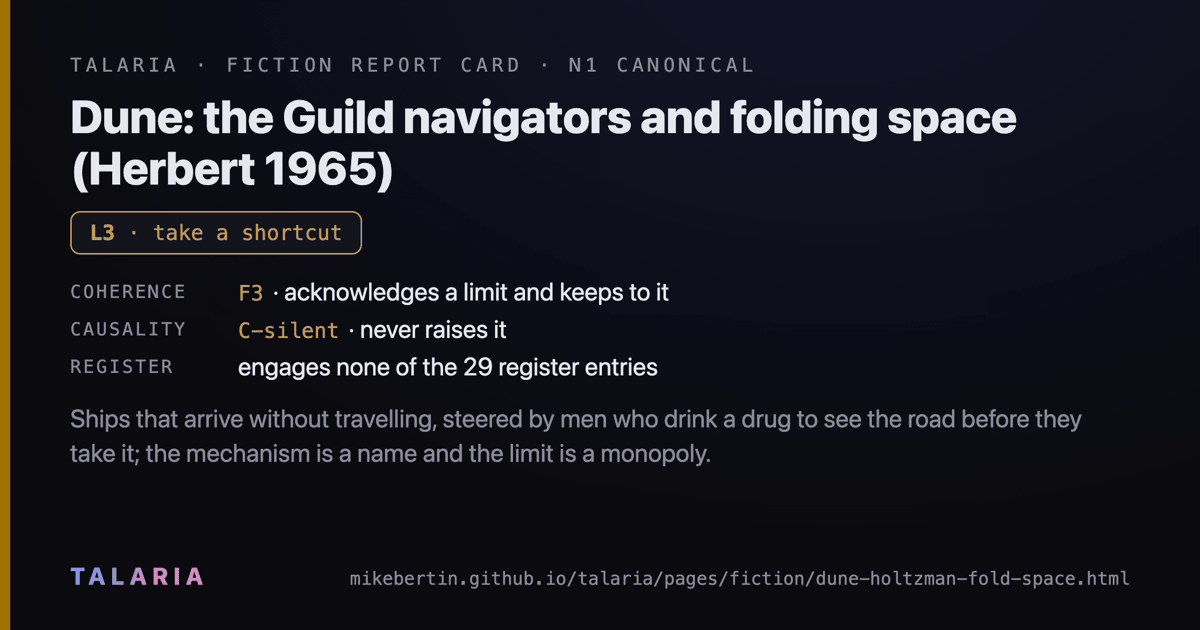
Dune: the Guild navigators and folding space (Herbert 1965)
Ships that arrive without travelling, steered by men who drink a drug to see the road before they take it; the mechanism is a name and the limit is a monopoly.
Kind: fiction · Loophole: L3 · Notability: N1 · Coherence: F3 · Causality: C-silent · Last reviewed: 2026-09-12
The drive as depicted
Frank Herbert's Dune (Chilton, 1965) never shows the inside of a starship in flight and never explains how one moves [HIGH] S1. What the novel gives is the institution around the drive. Interstellar transport is a monopoly of the Spacing Guild, whose heighliners are ships so large that Duke Leto, in Book One, tells Paul that all the Atreides frigates and transports will fit into a corner of the hold [HIGH] S1 (the passage is quoted on the Wikipedia technology page; S3 transcription). The Guild's navigators are the point. In Book Three, "The Prophet", Herbert writes that "The Guild navigators, gifted with limited prescience", had chosen the safe course that leads to stagnation, and at the climax Paul tells the Guild's representatives that the eye that looks ahead to the safe course is closed forever [HIGH] S1 (Wikiquote, S3 transcription). Prescience is a product of the spice melange, which only Arrakis produces, and Paul's leverage over the Guild and the Emperor is that without spice the navigators cannot see, and without seeing they cannot fly [HIGH] S1. The novel's appendix, "Terminology of the Imperium", defines the Holtzman effect only as the negative repelling effect of a shield generator, and defines the heighliner as the major cargo carrier of the Guild's transport system; neither entry says how the ship crosses space [HIGH] S1 (the glossary entries are reproduced verbatim on several reference sites, S3).
The phrase most people attach to the drive comes from the 1984 film, not the book. David Lynch's Dune opens with Princess Irulan's narration that the Guild's navigators use the spice gas, which gives them the ability to fold space, that is, to "travel to any part of the universe without moving" [HIGH] S1 (Wikiquote, S3 transcription). The film shows a navigator in a tank of orange gas and has the Guild threaten the Emperor over spice production [HIGH] S3. This catalogue could not verify that the 1965 text uses the words "fold space" at all; the reference pages that say it does give no chapter, and the terminology appendix does not contain it [LOW] S3. The later novels are where "foldspace" and the Holtzman engine become standard vocabulary, and the prequel trilogy of 2002 to 2004 invents the discovery of the effect; none of that is Herbert's 1965 text and none of it is scored here [MED] S3.
So the drive as depicted in the primary work is this: a ship enters a heighliner, the heighliner goes somewhere, and it gets there because a navigator saw the way. Whether the ship crosses the intervening space, tunnels under it or folds it is not stated in the 1965 book. The one physical property Herbert commits to is that the passage is dangerous enough that a machine cannot be trusted to steer it and a human with foresight can.
Origin and lineage
Herbert wrote Dune from 1959 to 1965, serialised it in Analog in 1963 and 1965 and published it with Chilton in 1965 [HIGH] S3. The Guild and its navigators are his invention, and the novel's ban on thinking machines (the Butlerian Jihad, in the appendices) is the reason a prescient pilot is needed instead of a computer [HIGH] S1. No real physics proposal is named or borrowed: the Holtzman effect is a name with a one-line glossary entry, and Herbert's interest is in the politics of a monopoly on the one substance that makes travel possible, which is the novel's oil analogy. The "fold space" image, from the 1984 film onward, is the everyday picture of a wormhole: bring two distant points together and step across. That picture is the same one Romilly draws with a folded sheet of paper in Interstellar, and its physics is Morris and Thorne 1988. There is no evidence Herbert was reading any relativity, and no physics paper cites Dune; the lineage is downstream and cinematic. Denis Villeneuve's films (2021, 2024) keep the Guild offstage and the drive unexplained [MED] S3.
Which loophole, and why
L3, a shortcut, with the caveat that the 1965 text does not say so; the class is assigned from the film's "without moving" and from the later novels' foldspace, which describe two points brought together rather than a ship outrunning light. The alternative reading, L4, would take "folding" as passage through a higher dimension, and the 1984 narration's wording could be read either way; L3 is the primary class because the result the work cares about is arrival without transit, not a different space with its own rules. The cousin is Morris and Thorne 1988, with its bill of negative energy at the throat, mass beyond engineering, a route that must be laid in advance and a time machine once one mouth is moved. Dune pays none of it and names none of it; its navigators are an answer to a different problem, which is the risk of the passage, and that problem has a cousin too: CON-1 and CON-2 say the pilot of a superluminal geometry cannot see or shape what is ahead, and a navigator who sees the future is a fictional answer to precisely that.
The rules it keeps
- No navigator, no flight. Every reference to Guild travel in the novel routes through prescient navigators fed on spice; Paul's threat to destroy the spice is a threat to end interstellar travel, and the Guild folds [HIGH] S1. GRADING.md names "navigators" as its own example of an F3 limitation.
- The Guild carries everyone and fights nobody. Transport is a monopoly held by a neutral party, and no house has ships of its own that can cross between stars; the rule is never broken in the novel [HIGH] S1.
- The passage is unsafe without foresight. The reason a human is needed is stated as prescience, and the ban on machines is given in the appendices; the danger itself is never described [HIGH] S1.
- Nothing is said about the mechanism, and that is applied consistently: no character in the 1965 book explains the drive, no glossary entry describes it and the film adds one sentence [HIGH] S1.
F3: a limitation, the navigator, stated and applied without exception, with no physical content behind it. Not F2, because the limitation is not a cooldown or a lane but a claim about who can steer and why, and the whole plot turns on it. Not F4, because no real constraint is named and the cost the story is built on is political, not physical.
What it ignores
Everything the register would ask. The novel never says whether the passage takes time, whether the clocks of the traveller and the destination agree, or what happens to the order of events when a heighliner arrives before its own light. There is no preferred frame, no rule of simultaneity and no time loop anywhere in the 1965 book; the later novels add prescience across time as a theme but never connect it to the drive [MED] S3. The film's "without moving" makes the arrival instantaneous and then says nothing else. That is C-silent, dated: as of 2026-09-12 no Herbert novel and no adaptation addresses what a shortcut between stars does to causality. The energy, stability and tidal entries are likewise untouched, because the work does not describe a throat, a fold or a field, only a pilot.
Constraint scoring
Every entry in the register, one row each, verdict from the fiction vocabulary in GRADING.md, with a note that says where in the work the engagement or rule occurs.
| Constraint | Verdict | Note |
|---|---|---|
| CAU-1 | SILENT | A heighliner arrives across interstellar distance in no stated time; the novel never asks in which frame it arrived before it left. |
| CAU-2 | SILENT | No chronology protection; there is no time loop in the 1965 book to protect against. |
| CAU-3 | SILENT | The work does not describe a wormhole with mouths, so nothing is said about moving one; the time-machine construction is never in view. |
| CAU-4 | SILENT | No preferred frame is stated for Guild travel; the film's "without moving" implies simultaneity in some frame and names none. |
| CAU-5 | N/A | No entanglement signalling; Dune has no ansible of any kind and messages travel with the ships. |
| ENE-1 | SILENT | The Holtzman effect is defined only as the repelling effect of a shield; the novel never says what the drive's energy budget is or in what currency. |
| ENE-2 | SILENT | That arriving before light needs negative energy somewhere is never raised. |
| ENE-3 | SILENT | The quantum inequalities would price a fold large enough for a heighliner; the work has no such calculation and no mechanism to apply it to. |
| ENE-4 | N/A | Warp-bubble pocket geometry; no bubble here. |
| ENE-5 | N/A | Not a Natário-class warp metric. |
| ENE-6 | SILENT | No source of negative energy is named; the Casimir effect does not appear. |
| ENE-7 | SILENT | If folding space means a shortcut visible from outside, topological censorship applies; the work has nothing to say about it. |
| CON-1 | N/A | The bubble horizon is a warp-drive property, and Dune's drive is not a bubble. The navigator problem rhymes with CON-1 (the pilot cannot see ahead) but the register entry does not bear on a fold. |
| CON-2 | SILENT | Guild ships go where they are asked without any pre-laid route; the novel never addresses whether the far end must be prepared, and the navigator's foresight is the only stated prerequisite. |
| CON-3 | N/A | No Krasnikov tube. |
| STA-1 | N/A | Warp-bubble instability. |
| STA-2 | SILENT | A fold that joins two points is a wormhole with the throat unstated; what holds it open is never described. |
| STA-3 | N/A | No wormhole is converted into a time machine, and the geometry is unstated, so no chronology horizon can be identified. |
| HAZ-1 | N/A | Warp deceleration burst. |
| HAZ-2 | N/A | Warp-bubble Hawking flux. |
| HAZ-3 | SILENT | The passage is called dangerous, which is why a navigator is needed, but no tidal force, throat size or physical hazard is ever named. |
| LOR-1 | SILENT | The novel never says the ship moves fast or slow; the film's "without moving" avoids the question by removing motion. |
| LOR-2 | N/A | No tachyons. |
| LOR-3 | N/A | No signal in a medium. |
| LOR-4 | N/A | Neither the Scharnhorst effect nor the OPERA anomaly bears on a fold. |
| WRP-1 | N/A | Not a warp metric. |
| WRP-2 | N/A | Not a moving shell. |
| WRP-3 | N/A | No positive-energy warp claim. |
| MAN-1 | SILENT | "Folding space" could be read as passage through a higher dimension and the 1984 narration does not say; the 1965 text says nothing at all about dimensions. |
Sources
- S1 Herbert, F., Dune (Chilton, 1965): Book One for Leto on the heighliner's hold; Book Three, "The Prophet", for "gifted with limited prescience" and Paul's confrontation with the Guild; Appendix "Terminology of the Imperium" for the Holtzman effect and heighliner entries. Passages verified via the S3 transcriptions below; the book was not re-read in full for this dossier.
- S1 Dune (1984), directed by David Lynch, Universal. Princess Irulan's opening narration for "fold space" and "without moving".
- S3 Wikiquote, "Dune (novel)" and "Dune (1984 film)", for the quoted lines.
- S3 Wikipedia, "Spacing Guild" and "Technology of the Dune universe", for the glossary definitions, the Leto passage and the account of foldspace in the later novels.
- S3 glossaria.net, "Holtzman effect", reproducing the Terminology of the Imperium entry.