Elite Dangerous: the frame shift drive (Frontier Developments, 2014)
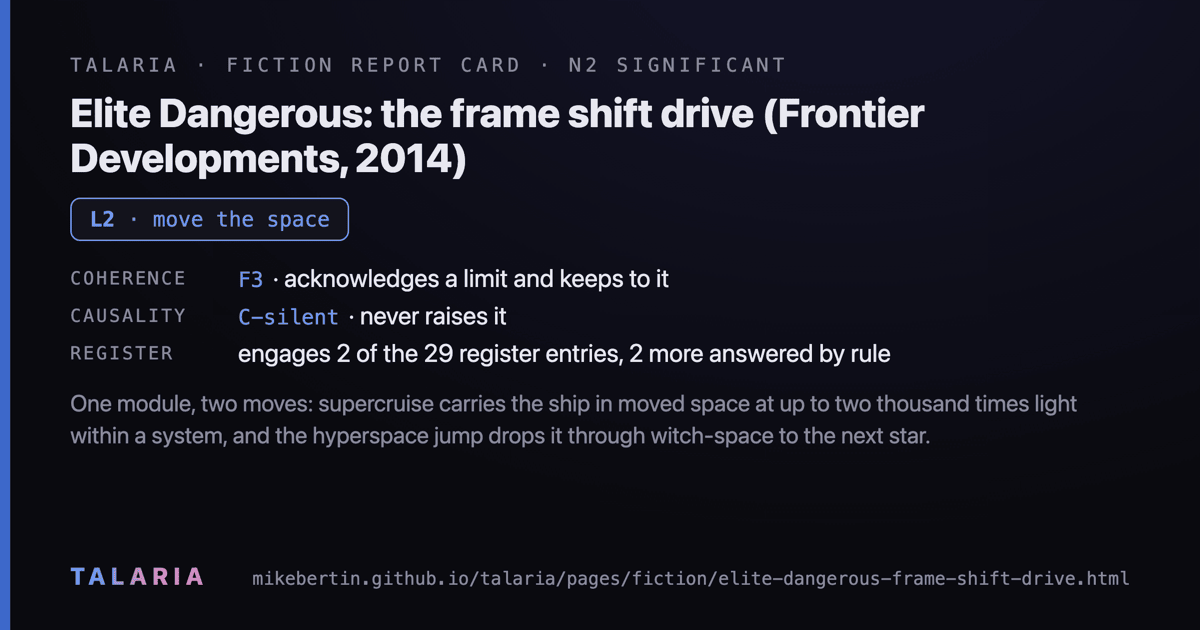
One module, two moves: supercruise carries the ship in moved space at up to two thousand times light within a system, and the hyperspace jump drops it through witch-space to the next star.
Kind: fiction · Loophole: L2 · Notability: N2 · Coherence: F3 · Causality: C-silent · Last reviewed: 2026-09-12
The drive as depicted
Elite Dangerous defines its drive in the outfitting screen, the flight model and the on-screen behaviour of every ship. The module's in-game description is one line: a device that allows supercruise travel and hyperspace jumps between star systems [HIGH] S1. The two modes are the whole of the game's interstellar and interplanetary transport.
Supercruise is faster-than-light flight inside a star system. Speed runs from about thirty kilometres per second at minimum throttle to a ceiling of 2001 c, and the ceiling is set by the nearest mass: close to a star or planet the drive is throttled to a crawl, and the full 2001 c is reached only far from any body, after the better part of an hour heading outward [HIGH] S1 for the flight model as played, [HIGH] S3 for the figures as tabulated by the community wiki. Speed is displayed in multiples of c and in megametres per second. Dropping out of supercruise is a safe disengage below a threshold speed with a target locked, or an emergency drop that damages the hull and modules and imposes a cooldown; crossing the impact surface of a body drops the ship regardless [HIGH] S1. Other ships in supercruise can be interdicted by a dedicated module that tears both ships into normal space. A 2024 update added supercruise overcharge, a boost that multiplies speed at the cost of fuel and heat [MED] S3.
The hyperspace jump takes the ship from one system to another through "witch-space", a corridor shown as a tunnel of light with the destination star at its end; a jump takes a fixed few tens of seconds regardless of distance, deposits the ship beside the destination's primary star and leaves a wake that other ships can scan and follow [HIGH] S1. Jump range is a number on the outfitting screen and depends on the drive's class and rating, the ship's total mass including cargo and the fuel available; a heavier ship jumps shorter, fuel is consumed per jump on a curve the community has reverse-engineered, and fuel is replenished by scooping it from the outer layers of suitable stars [HIGH] S1 for the mechanics, [MED] S3 for the fuel equation. Neither mode can be engaged under "mass lock": close to a station, a capital ship or a planet the drive will not charge, and near a very massive ship it charges slowly [HIGH] S1. A jump can be supercharged, at the cost of damage, by flying through the polar jets of a white dwarf or neutron star [HIGH] S3.
The game's own text does not say how any of this works. The clock is universal: every player in every system shares one galactic date, currently in the thirty-fourth century and advancing with real time, and no jump or supercruise flight ever moves a ship in that calendar [HIGH] S1.
Origin and lineage
Elite Dangerous was developed by Frontier Developments under David Braben and released in December 2014, the fourth game in a series that began with Elite (Acornsoft, 1984), whose hyperspace jumps and mis-jumps into "witch-space" it inherits [MED] S3. In the game's lore, drawn from the licensed novels and reference books rather than from the game screens, the frame shift drive was brought to market by Sirius Corporation in 3297 after decades of secret development and made all previous hyperdrives obsolete, and the name refers to shifting the ship's frame of reference between normal space, supercruise and hyperspace [MED] S3 (Elite Dangerous Wiki, citing Drew Wagar's Elite: Premonition and the Elite Encounters role-playing book). Drew Wagar's lore essay for the Canonn research group traces "witch-space" to the early days of hyperspace in the 2200s, when ships that entered the corridor sometimes did not come out [MED] S3.
The Alcubierre connection is a community and developer commonplace but not, as far as this dossier could establish, an in-game statement. The community wiki says supercruise moves space around the ship rather than accelerating it, "similar in principle to the Alcubierre drive design", and that the drive therefore involves no time distortion [MED] S3; the flight model supports the reading, since the main engines never fire in supercruise, the ship can drop from many times c to rest without harm and cannot fly backwards [HIGH] S1. A Frontier newsletter or developer interview naming Alcubierre was not located as of 2026-09-12, and the claim is recorded at the tier it has. The catalogue's lineage page star-trek-alcubierre-outward is planned to run Star Trek, Alcubierre 1994, this game and The Orville; for Elite the link is sourced only to secondary material.
Lineage: Star Trek to Alcubierre and back out.
Which loophole, and why
L2 primary, for supercruise; L4 secondary, for the jump. In supercruise nothing about the ship changes, its engines are idle, and it is carried at a speed set by the surrounding gravitational environment, which is the picture of a bubble moved through space. The physics cousin is Alcubierre 1994 and the bill is the register's: negative energy in the wall of order $10^{62}$ kg for a ship-sized bubble under the quantum inequalities (ENE-3), reducible to solar masses by the Van Den Broeck 1999 pocket; a horizon at the wall above c, so the pilot's throttle is decorative (CON-1); a route laid in advance (CON-2); and time machines from bubble pairs (CAU-3). The game's rule that mass slows supercruise is the one place its fiction touches the physics, since a bubble near a gravitating body would indeed have a different energy budget, though nothing in the register makes it slower.
The jump is witch-space: another space entered and left, with its own duration and its own hazards, which is L4 and is priced against Kaluza-Klein hyperspace and brane-bulk shortcuts. Their bill is MAN-1: extra dimensions in physics are compact or warped and share the ordinary light cone, so there is no corridor with a different clock. The community wiki's phrase that the jump opens a wormhole would make it L3 and price it against Morris and Thorne 1988; the game itself says hyperspace.
The rules it keeps
Elite Dangerous is a flight simulator and its rules are the game, applied without exception to every ship and every player.
- Mass limits speed. Supercruise speed is capped by proximity to bodies, and the cap is a smooth function of distance that every pilot learns to fly around [HIGH] S1.
- Mass limits jumps. Range falls with ship mass and rises with drive class; the numbers are shown and are honoured [HIGH] S1.
- Fuel is finite and scooped. Every jump burns fuel; running dry between stars strands the ship, and a volunteer rescue organisation exists in the player community for exactly that failure [HIGH] S1.
- Mass lock. Neither mode engages close to a large mass [HIGH] S1.
- Drops are dangerous. Emergency drops damage the ship; interdiction forces them [HIGH] S1.
- No dilation. The single galactic clock is respected by every flight [HIGH] S1.
Stated limitations with physical vocabulary, applied consistently, with no engagement with a real constraint: F3. The gravity-well rule is the most physical thing in the game and it is still a rule rather than a mechanism.
What it ignores
The register's question is answered by the calendar and by nothing else. Every ship in the galaxy shares one date and every jump lands on it; that is a preferred frame in all but name, and the game never names it, never states it as a rule and never lets a player ask what a jump does to the order of events. The lore books are silent too. There is no antitelephone in Elite Dangerous because there is no way to write one into a shared real-time server, and that is a fact about the medium, not a statement of the fiction. C-silent, dated 2026-09-12.
Constraint scoring
| Constraint | Verdict | Note |
|---|---|---|
| CAU-1 | SILENT | Supercruise and jumps both beat light through flat space; the game never considers the frame-dependence of arrival order. |
| CAU-2 | SILENT | No causal loops are built; the conjecture is not engaged. |
| CAU-3 | SILENT | Thousands of player bubbles in motion at once is the many-bubble case in which Everett's construction gives closed loops; never considered. |
| CAU-4 | SILENT | The universal galactic clock is the preferred frame in all but name; the game never states it as a rule of its physics. |
| CAU-5 | N/A | No entanglement; in-game communication is by an unexplained galaxy-wide network. |
| ENE-1 | SILENT | What the drive is made of or fuelled by beyond hydrogen is never stated; the energy conditions are not mentioned. |
| ENE-2 | SILENT | Olum's theorem says supercruise needs negative energy somewhere; the module burns scooped hydrogen. |
| ENE-3 | SILENT | A ship-sized bubble is the case priced at universe-scale negative energy; never addressed. |
| ENE-4 | N/A | No pocket geometry. |
| ENE-5 | SILENT | Supercruise is Natário-class in everything but name; the NEC theorem is never touched. |
| ENE-6 | N/A | Casimir energy not invoked. |
| ENE-7 | SILENT | If the jump is read as a wormhole, as the community wiki reads it, topological censorship forbids the shortcut without achronal ANEC violation; the game never addresses it. |
| CON-1 | SILENT | The pilot throttles and steers in supercruise at 2001 c; the horizon at the wall of a superluminal bubble is never mentioned. |
| CON-2 | SILENT | Supercruise and jumps work on first arrival in unexplored systems, which the game rewards; nothing is laid ahead and the bootstrap problem never arises. |
| CON-3 | N/A | No tube, though the wakes left by jumping ships are scanned and followed; a wake is not a pre-laid route. |
| STA-1 | SILENT | Supercruise fails only by emergency drop and interdiction; the semiclassical divergence at the wall is not engaged. |
| STA-2 | SILENT | If witch-space is a corridor with an aperture, something holds it open; the game does not say what. |
| STA-3 | N/A | No chronology horizon. |
| HAZ-1 | ENGAGES | Dropping out of supercruise at speed is depicted as hazardous: emergency drops damage hull and modules, crossing an impact surface at speed forces one, and the safe disengage requires slowing first. The mechanism is not the McMonigal burst, but the constraint's shape is in the flight model. |
| HAZ-2 | SILENT | The pilot sits at the centre of a superluminal bubble with no Hawking flux; wall thickness is never a concept. |
| HAZ-3 | N/A | No throat tides; witch-space has no depicted interior structure. |
| LOR-1 | RULE | Supercruise is described by the community and implied by the flight model as moving space rather than the ship, and the ship's engines never fire; the barrier is honoured by the design rather than pushed through. |
| LOR-2 | N/A | Nothing is a particle above c. |
| LOR-3 | N/A | No wave in a medium. |
| LOR-4 | N/A | Neither the Scharnhorst effect nor OPERA bears on the drive. |
| WRP-1 | RULE | A ship carried at rest inside a region of moved space, throttled by its environment, matches the class definition as a stated rule of the flight model. |
| WRP-2 | SILENT | Bobrick and Martire's classification puts superluminal warp in exotic matter; the game's module burns hydrogen and says nothing. |
| WRP-3 | SILENT | The game assumes a working superluminal bubble; the absence WRP-3 records is never engaged. |
| MAN-1 | ENGAGES | Witch-space is another space with its own rules, entered and left on screen on every jump; the 1984 original's mis-jumps into it are part of the series' identity. Engaged as a premise, never as physics. |
Sources
- S1 Elite Dangerous (Frontier Developments, 2014; Horizons 2015; Odyssey 2021; supercruise overcharge 2024): the outfitting description of the frame shift drive module, the supercruise and hyperspace flight model, the galactic clock. Played and observed; the module description quoted from the outfitting screen as transcribed by the community wiki.
- S3 Elite Dangerous Wiki (elite-dangerous.fandom.com), "Frame Shift Drive" and "Supercruise", read 2026-09-12, for the numerical tables, the Sirius Corporation lore (citing Wagar, Elite: Premonition, and the Elite Encounters role-playing book) and the Alcubierre comparison.
- S3 Wagar, D., "Lore: Hyperspace", Canonn Research Group (canonn.science), for the witch-space etymology and the 2200s dating.
- S3 Frontier Forums thread "The Frame Shift Drive is a modified form of the Alcubierre Drive design" (forums.frontier.co.uk, thread 512962), player discussion; could not be opened for this dossier.
- S3 Wikipedia, "Elite Dangerous", for release history and credits.