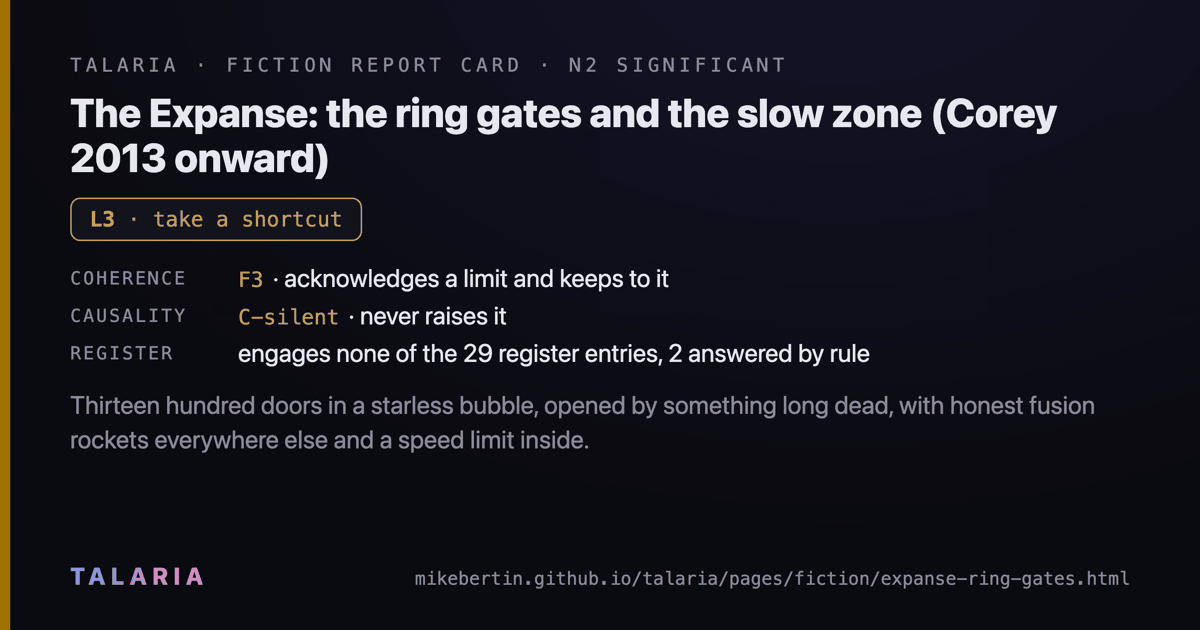
The Expanse: the ring gates and the slow zone (Corey 2013 onward)
Thirteen hundred doors in a starless bubble, opened by something long dead, with fusion rockets everywhere else and a speed limit inside.
Kind: fiction · Loophole: L3 · Notability: N2 · Coherence: F3 · Causality: C-silent · Last reviewed: 2026-09-12
The drive as depicted
For two novels and two television seasons there is no faster-than-light travel in the Expanse at all. James S. A. Corey's Leviathan Wakes (Orbit, 2011) gives humanity the Epstein drive, a fusion rocket capable of continuous acceleration, invented by Solomon Epstein, who died testing it because it could not be shut down and carried him out of the system; the short story "Drive" (2012) tells that death [HIGH] S3. Everything in the setting follows from a rocket that burns for days: crews strapped in for high-g burns, communication delayed by light lag, a Belt that is weeks from anywhere. The gate arrives in the third novel, Abaddon's Gate (Orbit, 4 June 2013), when the protomolecule, having built something on Venus, launches it out of the system, where it becomes the Ring, a structure about a thousand kilometres across, two astronomical units beyond the orbit of Uranus [HIGH] S3. A Belter's racing ship goes through it at speed and vanishes, and the authorities conclude the structure is a wormhole [HIGH] S3.
What is on the other side is not a star system. It is a starless volume roughly a million kilometres across with a spherical station at its centre and, around its edge, more than thirteen hundred other rings, each leading to a different planetary system [HIGH] S3. The novel names the volume for its one physical law: any object moving faster than a threshold is seized and stopped. In the book the limit is six hundred metres per second, and the crews call the place the slow zone; the television adaptation raised the figure to eighteen thousand kilometres per hour [HIGH] S3. When a Martian marine's grenade goes off near the station, the station lowers the limit to walking pace and every ship inside is stopped from thousands of metres per second to almost nothing, killing thousands [HIGH] S3. The station and the network are the tools of an extinct civilisation, the gate builders, who were killed by something else; Holden, guided by the protomolecule's copy of Miller, gets the ships released by having every reactor shut down, and the station then opens the dormant gates [HIGH] S3. Later novels add that ships passing through a gate when too much energy has recently gone through it disappear, "going dutchman", and that the things that killed the builders are behind that; in Leviathan Falls (2021) Holden joins with the station and shuts the whole network down [HIGH] S3. The epilogue, a thousand years on, has humanity invent its own FTL, unspecified [HIGH] S3.
The rules of gate travel are therefore: a ring leads to the hub, the hub leads to every other ring, transit through a ring is instantaneous, nothing in the hub may go fast, the network belongs to somebody else and using it too hard is fatal.
Origin and lineage
Corey is Daniel Abraham and Ty Franck, and the setting began as Franck's tabletop game; its physics of rockets, delta-v and light lag is deliberately conventional, with the Epstein drive as the single generous assumption [MED] S3. The gates are the setting's alien intrusion and are never explained in the vocabulary of general relativity; the word wormhole is used once the racing ship vanishes and is not developed [HIGH] S3. No real proposal is named. The design decision that matters for this catalogue is the same one Sagan made in Contact and Nolan in Interstellar: the shortcut is inherited, built by someone gone, and the humans build only rockets. The gate's physics cousin is Morris and Thorne 1988; the sublight everywhere else has its own cousin, the relativistic rocket, against which the Epstein drive should be read (the novels keep speeds low enough that dilation never features). The slow zone's law, that the fast are stopped, is not a physics result; the closest register item is the observation in Gao, Jafferis and Wall and Maldacena, Milekhin and Popov that real traversable wormholes are slower inside than the road outside, which the Expanse turns into a rule of the hub.
Which loophole, and why
L3, a shortcut with fixed endpoints, twice over: from a system to the hub and from the hub to another system. No ship exceeds light speed anywhere; the Epstein drive is a rocket and the gates are portals. The cousin is Morris and Thorne 1988, whose bill is negative energy at the throat scaling with its radius, a mass beyond engineering, a route laid in advance and a time machine on assembly. The Expanse pays the third by making the network a ruin, pays a version of the second by making the rings and station structures no human could build, and never mentions the first or fourth.
The rules it keeps
- No FTL but the gates. Stated by omission for two books and by rule thereafter; the epilogue's human FTL is a thousand years off [HIGH] S3.
- Gates only where gates are. Every new system is reached through its ring; there is no jump to an arbitrary point [HIGH] S3.
- The speed limit in the hub. Six hundred metres per second in the book, lowered on provocation; ships that exceed it are stopped [HIGH] S3.
- Light lag everywhere else. Communication between systems goes by ship through the gates or by repeater stations; nothing in the setting talks across a gate faster than a ship can carry it [HIGH] S3.
- Use it too hard and you vanish. The dutchman rule of the later books ties transit to a recent energy budget through the gate [HIGH] S3.
- Someone else built it. The builders are dead, the station is autonomous, and the humans neither understand nor control the network until the last novel [HIGH] S3.
F3: limitations stated and applied without exception, of the "relays only between relays" kind that GRADING.md gives as its F3 example, with the sublight physics elsewhere kept consistent throughout. Not F4, because the gate's own cost is never a real constraint named in the text; the speed limit and the dutchman rule are invented laws, and the real cost the series is built on (delta-v, burn time, light lag) belongs to the rockets, not to the shortcut.
What it ignores
A ring two astronomical units from the Sun connects instantaneously to systems hundreds or thousands of light years away, and a ship can go through, turn round and come back with news. The novels never ask in which frame the return preceded the departure, never state a preferred frame and never construct or forbid a loop; the hub, a pocket outside any system, would be the natural place to plant a preferred frame and the text does not. Absence dated: as of 2026-09-12 nine novels, several novellas and six television seasons are silent on the causality of the gates. C-silent. The register's energy and stability entries are equally untouched: the rings are made of something the protomolecule builds and nothing is said of what holds a gate open.
Constraint scoring
Every entry in the register, one row each, verdict from the fiction vocabulary in GRADING.md, with a note that says where in the work the engagement or rule occurs.
| Constraint | Verdict | Note |
|---|---|---|
| CAU-1 | SILENT | Ships and news pass through the gates instantly between systems hundreds of light years apart; no novel or episode asks about the frame in which that is a message into the past. |
| CAU-2 | SILENT | No chronology protection; no time loop exists to be protected against. |
| CAU-3 | SILENT | The rings are fixed at their systems and the hub is fixed, but no rule says a ring cannot be moved and the time-machine construction is never raised. |
| CAU-4 | SILENT | The hub is a pocket outside ordinary space and would serve as a preferred frame; the text never uses it that way or names any frame. |
| CAU-5 | N/A | No entanglement signalling; the setting has no ansible and messages travel by ship or by light-lagged radio. |
| ENE-1 | SILENT | Nothing is said of what holds a ring open or in what currency; the rings are protomolecule structures and the novels leave it there. |
| ENE-2 | SILENT | That a shortcut beating light needs negative energy somewhere is never raised. |
| ENE-3 | SILENT | A ring a thousand kilometres across, open for years, is priced by the quantum inequalities; the work has no such calculation. |
| ENE-4 | N/A | Warp-bubble pocket geometry. |
| ENE-5 | N/A | Not a Natário-class warp metric. |
| ENE-6 | SILENT | No source of negative energy is named. |
| ENE-7 | SILENT | The rings are shortcuts visible from outside in flat space; topological censorship is never touched. |
| CON-1 | N/A | No warp bubble, so no bubble horizon. |
| CON-2 | RULE | The stated rule is that gates lead only to gates and the whole network was built by the gate builders; humans lay nothing and reach nothing without a ring. CON-2's escape hatch, infrastructure placed in advance, is the fiction's premise. |
| CON-3 | N/A | No Krasnikov tube. |
| STA-1 | N/A | Warp-bubble instability. |
| STA-2 | SILENT | What threads the throat of a ring is never described. |
| STA-3 | SILENT | No ring is converted into a time machine, so no chronology horizon is ever in view; the entry bears on the class and the work never approaches it. |
| HAZ-1 | N/A | Warp deceleration burst. The slow zone's deceleration is a rule of the hub, not a bubble wall shedding particles. |
| HAZ-2 | N/A | Warp-bubble Hawking flux. |
| HAZ-3 | SILENT | Ships pass through rings a thousand kilometres wide without tidal comment; a throat that large would be comfortably within Morris and Thorne's bound, and the novels never say so. |
| LOR-1 | RULE | The Epstein drive is a rocket and the setting keeps every ship below light speed; the rule that nothing accelerates past c is the foundation of the series and the gates are the only exception. |
| LOR-2 | N/A | No tachyons. |
| LOR-3 | N/A | No signal in a medium. |
| LOR-4 | N/A | Neither the Scharnhorst effect nor the OPERA anomaly bears on a ring. |
| WRP-1 | N/A | Not a warp metric. |
| WRP-2 | N/A | Not a moving shell. |
| WRP-3 | N/A | No positive-energy warp claim. |
| MAN-1 | SILENT | The hub is described as a space outside any system, starless and bounded, but the novels never say whether it is elsewhere in our manifold or outside it; the question is not raised. |
Sources
- S1 Corey, J. S. A., Abaddon's Gate (Orbit, 2013): the Ring, the slow zone, the station and the opening of the gates. Leviathan Wakes (Orbit, 2011) and "Drive" (2012) for the Epstein drive. Nemesis Games (2015), Persepolis Rising (2017), Tiamat's Wrath (2019) and Leviathan Falls (2021) for the dutchman rule, the builders' killers and the closing of the network. Plot facts verified against the S3 sources below, not by re-reading.
- S1 The Expanse (Syfy and Amazon, 2015 to 2022), season three for the Ring and the eighteen-thousand-kilometres-per-hour limit.
- S3 Wikipedia, "Abaddon's Gate" and "The Expanse (novel series)".
- S3 The Expanse Wiki (expanse.fandom.com), "Slow zone (Books)" and "Ring space (TV)", for the book and screen speed limits; consulted via search summaries.