Firefly's Verse
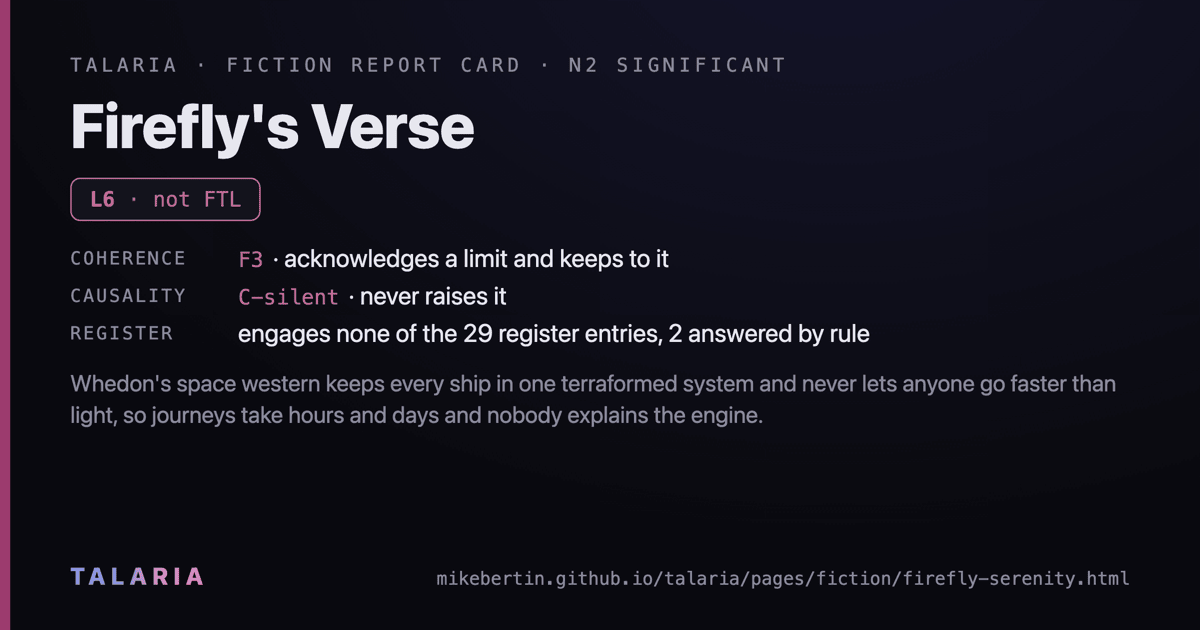
Whedon's space western keeps every ship in one terraformed system and never lets anyone go faster than light, so journeys take hours and days and nobody explains the engine.
Kind: fiction · Loophole: L6 · Notability: N2 · Coherence: F3 · Causality: C-silent · Last reviewed: 2026-09-12
The drive as depicted
The setting is defined in the opening lesson of Serenity (Universal, 2005): "Earth-That-Was" could no longer sustain our numbers; "We found a new solar system. Dozens of planets and hundreds of moons."; each one terraformed over decades to be new Earths; the central planets formed the Alliance [HIGH] S1 (film transcript). The narration says "a new solar system", singular, and says nothing about how the crossing was made or how long it took [HIGH] S1. The television series (Fox, 2002, fourteen episodes, eleven aired) never states a ship's speed, a distance in any unit, or a star count [HIGH] S1 (transcripts searched). What it states, repeatedly, is duration. In the pilot the crew are "down to the wire on fuel cells" and Persephone is "Three or four hours" away; in "Safe" the nearest Alliance cruiser is "Hours out from here"; in "Out of Gas" a detour means "an 18 hour trip's gonna take us the better part of a week"; in "The Message" St Albans "ain't but a two-day ride, if we burn hard enough"; in the film Beaumonde is ten hours away and home "about a day's ride" [HIGH] S1. Within the Verse a week is a long trip.
The engine is furniture. Serenity has a "compression coil" whose catalyzer blows in "Out of Gas", a "trace compression block" that Book asks Kaylee about, and a rotating section; the show explains none of it [MED] S3 (episode lines quoted on a fan wiki). Communication is by "wave" over the "Cortex": "Did you get my wave?", a warrant that "come up on the cortex"; waves are conversational and no line mentions lag [HIGH] S1. The licensed supplement The Verse in Numbers (Quantum Mechanix, 2009, revised 2014), issued with the official map and approved by Universal, makes the system a cluster of five stars around a central White Sun, gives most ships top speeds of three to five percent of c, describes the exodus as an ark fleet at about a third of light speed taking roughly 120 years over forty light years, and even computes the time dilation aboard; its own foreword calls the timeline "total and complete speculation" and says it is accurate "until Joss says it isn't" [HIGH] S2. None of that is on screen.
Origin and lineage
Joss Whedon created Firefly for Fox in 2002 and wrote and directed Serenity in 2005 [HIGH] S3. The no-aliens rule is his in his own words: "Aliens are something everyone else is doing", and five hundred years from now "we will still be the only sentient beings around" [HIGH] S3 (Post-Gazette, 22 July 2002, via Wikiquote). The no-FTL rule is documented, but not in a Whedon quotation: Wikipedia attributes it to production documents on the Serenity Blu-ray, and no verbatim Whedon line on faster-than-light travel or on silence in space was found for this dossier [MED] S3. No real physics proposal is named as a source and none was fed. The lineage of interest is negative: the show is the one widely known television space opera of its decade built without an FTL drive, and its solution, a single system dense enough to hold a frontier, is a setting choice rather than a physics one.
Which loophole, and why
L6, not FTL. Every ship is a sublight vessel in one gravitational neighbourhood, so the physics cousin is the relativistic rocket at the low end where the cousin's bill is small: hours and days between worlds at speeds far below c cost energy, not time dilation. The interesting join is with the exodus, which the film mentions and the supplement makes a generation-ship crossing at a third of c; that is the cousin's sublight route, and the supplement charges the dilation. On screen, the crossing is a sentence.
The rules it keeps
- One system, sublight ships. Never stated as a rule on screen, but never broken: every destination is hours to days away, and the film's narration is consistent with it [HIGH] S1.
- Space is silent, and ships need fuel. The pilot's fuel cells, the "Out of Gas" life-support clock, the drifting ship with a beacon [HIGH] S1.
- Nothing is explained. The compression coil is a part that can break, not a mechanism; the show's physics is in its budgets, not its dialogue.
F3: the work states a limitation, sublight travel within one system, and applies it consistently across fourteen episodes and a film; it does not build story on the physics of the limit, so it stops short of F4.
What it ignores
Everything the register would ask. No episode or the film mentions relativity, time dilation, the speed of light or the impossibility of FTL [HIGH] S1 (transcripts searched). Waves cross the system with no delay, which at the scale of a single stellar system would be minutes to hours, and the show does not raise it. The star count and the exodus are left to the licensed supplement, whose authors disclaim canon for their own numbers. C-silent: never addressed in any instalment as of 2026-09-12. The mark is not C-owns because the refusal of FTL is a production rule rather than anything the work says.
Constraint scoring
The control group: the register prices schemes to beat light and does not bear on a ship that never tries. Rows are N/A on that ground unless the work engages.
| Constraint | Verdict | Note |
|---|---|---|
| CAU-1 | RULE | The production's stated rule of no FTL keeps every worldline timelike; on screen the rule is visible only as journeys of hours and days within one system |
| CAU-2 | N/A | No closed timelike curves; control group |
| CAU-3 | N/A | No wormhole or warp bubble; control group |
| CAU-4 | N/A | No preferred frame needed; control group |
| CAU-5 | N/A | No entanglement; control group |
| ENE-1 | N/A | Fuel cells and compression coils are ordinary matter; control group |
| ENE-2 | RULE | Sublight by rule, so no ship arrives before light through flat space; the theorems are respected by construction |
| ENE-3 | N/A | No negative energy; control group |
| ENE-4 | N/A | Warp-class; control group |
| ENE-5 | N/A | Warp-class; control group |
| ENE-6 | N/A | Casimir not invoked; control group |
| ENE-7 | N/A | No shortcut; control group |
| CON-1 | N/A | No horizon; Wash flies the ship; control group |
| CON-2 | N/A | Nothing laid along the route; control group |
| CON-3 | N/A | No tube; control group |
| STA-1 | N/A | No bubble; control group |
| STA-2 | N/A | No throat; control group |
| STA-3 | N/A | No chronology horizon; control group |
| HAZ-1 | N/A | No superluminal wall; control group |
| HAZ-2 | N/A | No horizon; control group |
| HAZ-3 | N/A | No throat; control group |
| LOR-1 | SILENT | No speed, distance or dilation is ever stated on screen; the light barrier applies to every ship in the Verse and the show never mentions it. The licensed supplement supplies the numbers the show does not |
| LOR-2 | N/A | No tachyon; control group |
| LOR-3 | SILENT | Waves are conversational across the system with no stated delay; a signal-speed limit applies and is never addressed |
| LOR-4 | N/A | Neither Scharnhorst nor OPERA; control group |
| WRP-1 | N/A | Not a warp drive; control group |
| WRP-2 | N/A | Not a warp shell; control group |
| WRP-3 | N/A | Not in the warp class; control group |
| MAN-1 | N/A | No other space; control group |
Sources
- S1 Serenity (2005), transcript (springfieldspringfield; cross-checked against the myths.com script). Read.
- S1 Firefly (2002) episode transcripts: "Serenity" (pilot), "Bushwhacked", "Safe", "Out of Gas", "The Message". Read.
- S2 Bourdier, J. C., The Verse in Numbers v2.1 (Quantum Mechanix, 2009, rev. 2014), supplement to The Complete and Official Map of the Verse. Read in full.
- S3 Wikipedia, "Firefly (TV series)" and "Firefly (franchise)"; Wikiquote, "Joss Whedon" (Post-Gazette, 22 July 2002). Read.
- S3 fireflywiki.org, "TraceCompressionBlock", "CompressionCoil", "FasterThanLight", "TheVerse". Read; used for the engine lines only.