Flight of the Navigator (1986)
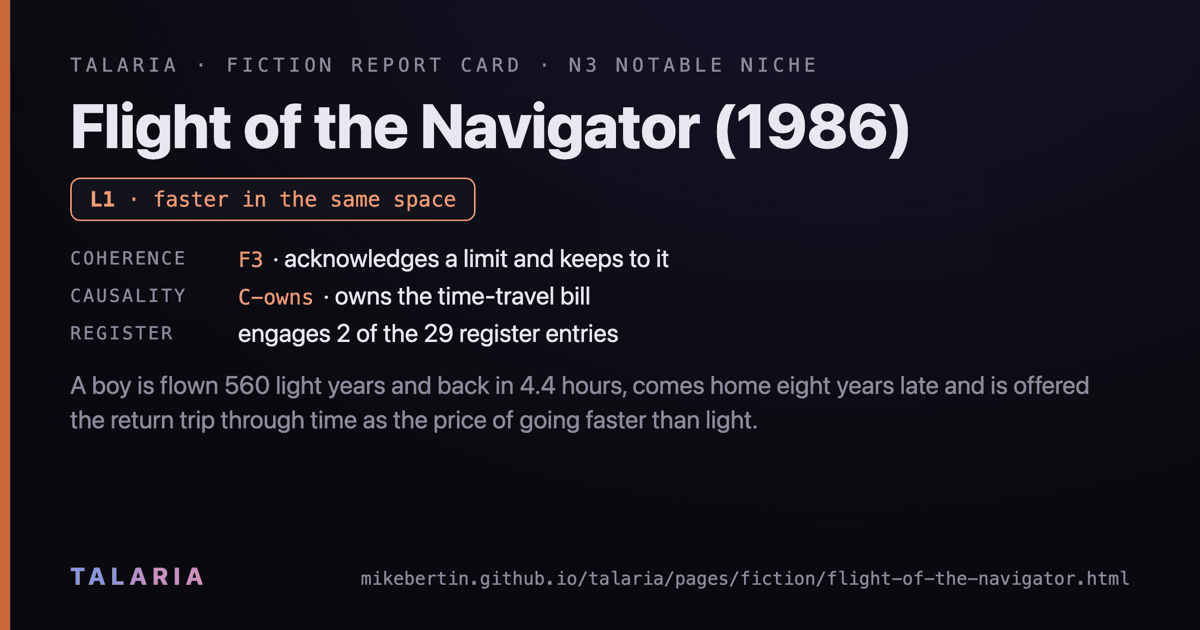
A boy is flown 560 light years and back in 4.4 hours, comes home eight years late and is offered the return trip through time as the price of going faster than light.
Kind: fiction · Loophole: L1 · Notability: N3 · Coherence: F3 · Causality: C-owns · Last reviewed: 2026-09-12
The drive as depicted
Twelve-year-old David Freeman vanishes from a Florida wood on 4 July 1978 and walks out of it in 1986, unaged, on the night NASA recovers a silver saucer from a set of power lines [HIGH] S1. At the NASA facility Dr Faraday finds David's mind full of star charts and technical data and works out where he has been: the planet Phaelon, 560 light years away, reached in 2.2 hours each way. He tells David that if he had been travelling beyond the speed of light he could have been gone only 4.4 hours while everyone on Earth aged eight years, and states the principle in one line: time slows down as you approach the speed of light [HIGH] S1. That is the film's explanation of the eight missing years, delivered as science by the scientist character, and it is the plot.
The ship's mind, a Trimaxion Drone Ship that David names Max, later confirms the itinerary and adds the second half of the physics. The aliens collected David as a specimen, meant to return him to his own time, and did not, because it was "too dangerous for your fragile human body to travel back in time" [HIGH] S1. The film therefore treats faster-than-light flight as two things at once: a trip that costs the traveller less time than the world (the dilation reading), and a vehicle that can be pointed into the past (the time-machine reading). In the climax David refuses the 1986 he has been dropped into, Max warns him that going back in time could vaporise him, David takes the chance, and the ship returns him to 4 July 1978 minutes after he left [HIGH] S1. No mechanism is ever described beyond the ship itself: no field, no engine, no jump; Max flies, and the ship's speed and time behaviour are simply what it does.
Origin and lineage
Directed by Randal Kleiser from a screenplay by Michael Burton and Phil Joanou, story by Mark H. Baker; produced by PSO and Viking Film, released by Disney's Buena Vista on 1 August 1986 [HIGH] S3 (Wikipedia, sourced to Variety and the BFI). The film names no real proposal and cites none. Its physics is the popular reading of relativity in two halves: the twin paradox, in which the fast traveller comes home younger, and the folk corollary, that going faster than light runs the clock backwards. The first is real for subluminal travel and is the subject of the relativistic rocket; the second is, in a precise sense, the content of CAU-1. The film applies the first to a superluminal trip, where it does not belong, and the second to a return journey, where the register says it does. Nothing in physics descends from it; in fiction it is the clean children's-film statement of fast means late, a decade before Interstellar computed the same effect.
Which loophole, and why
L1, faster in the same space. Faraday says "beyond the speed of light", Max never contradicts him, and nothing suggests a bubble, a wormhole or another space; the ship flies to Phaelon and back through ordinary space at about two million times c. The physics cousin is LOR-1, and the film's own arithmetic shows why the cousin bites: the dilation it invokes to explain the eight years is the Lorentz factor $\gamma$, which is finite only below c and undefined above it. A ship going 560 light years in 2.2 hours by Earth's clock does not experience dilation, it experiences a spacelike world line, which is the tachyon of Feinberg and the meta-relativity of Bilaniuk, Deshpande and Sudarshan; their bill is imaginary rest mass and the antitelephone. The film, to its credit, pays the second half of that bill on screen: its ship is a time machine.
The rules it keeps
- Time dilation is stated and used. The eight-year gap is the premise, the reason for the NASA investigation, the source of David's estrangement from a family that has aged and the reason the ending matters [HIGH] S1. It is misapplied to superluminal flight, but it is applied, consistently, and the whole story is built on its cost.
- Return through time is possible but dangerous. Stated twice, by Max as the reason he did not return David and again as a warning before the attempt [HIGH] S1. The film does not make it free.
- The ship's data is finite. The star charts were downloaded into David because the ship's memory was damaged and had to be recovered from him; the navigator of the title is needed because the ship cannot fly itself home without him [HIGH] S1.
This is F3: a limitation named and applied consistently, with the story built around it, but with the physics itself wrong in the specific way that keeps it from F4. Interstellar's dilation is computed; Flight of the Navigator's is asserted and then overloaded with a time machine.
What it ignores
Nothing the register asks, which is why the mark is C-owns. The film admits the implication that a faster-than-light vehicle is a time machine and uses it as the climax: the ship that went to Phaelon and back is the ship that takes David to 1978. It does not say why, does not mention frames, and mixes the subluminal twin effect into the superluminal trip, so the ownership is intuitive rather than argued. But the register's question, what happens to the order of events when you beat light, is answered on screen: you can go back, it is dangerous and the boy does it. Whether that creates a paradox is not examined; David returns minutes after he left and the 1986 timeline is simply not revisited.
Constraint scoring
| Constraint | Verdict | Note |
|---|---|---|
| CAU-1 | ENGAGES | The film's climax is the CAU-1 implication used as plot: the faster-than-light ship carries David to his own past. Not argued from frames, but owned on screen. |
| CAU-2 | SILENT | David lands minutes after he left, within his own past light cone; the film never asks whether the loop is consistent or protected. |
| CAU-3 | N/A | No wormholes or warp bubbles; the ship is an object in flat space and the two-device construction does not apply. |
| CAU-4 | SILENT | No preferred frame is stated; Faraday's Earth clock is treated as the clock, without saying so. |
| CAU-5 | N/A | No entanglement. |
| ENE-1 | N/A | No spacetime engineering. |
| ENE-2 | N/A | Olum's theorem prices curved spacetimes that deliver a signal early; the film's spacetime is flat. |
| ENE-3 | N/A | No negative energy. |
| ENE-4 | N/A | No bubble. |
| ENE-5 | N/A | Not a warp drive. |
| ENE-6 | N/A | No Casimir energy. |
| ENE-7 | N/A | Trivial topology. |
| CON-1 | N/A | No horizon; Max flies the ship directly. |
| CON-2 | N/A | Nothing laid along the route; the first flight to Phaelon was the aliens' own. |
| CON-3 | N/A | No tube. |
| STA-1 | N/A | No bubble to be unstable. |
| STA-2 | N/A | No throat. |
| STA-3 | SILENT | The ship builds a closed loop in David's history, which is where the Cauchy-horizon divergence would sit; the film gives the loop a cost, vaporisation, without a mechanism. |
| HAZ-1 | N/A | No bubble wall sweeps up matter; the ship's hazard is the time jump, not the deceleration. |
| HAZ-2 | N/A | No horizon to radiate. |
| HAZ-3 | N/A | No throat tides. |
| LOR-1 | ENGAGES | Faraday states the light barrier and the slowing of time near it; the film then goes beyond it and inherits the dilation as if it still applied. The constraint is named and built around, in the wrong way. |
| LOR-2 | SILENT | A ship that starts on a Florida lawn and reaches two million c has crossed the barrier, which tachyon kinematics forbids; the film never shows or discusses the crossing. |
| LOR-3 | N/A | No wave in a medium. |
| LOR-4 | N/A | Neither the Scharnhorst effect nor OPERA bears on the film. |
| WRP-1 | N/A | Not a warp drive. |
| WRP-2 | N/A | Not a shell moving inertially. |
| WRP-3 | N/A | No positive-energy warp claim. |
| MAN-1 | N/A | Four dimensions, no other space. |
Sources
- S1 Flight of the Navigator (PSO Productions and Viking Film, 1986), directed by Randal Kleiser, screenplay by Michael Burton and Phil Joanou. The NASA briefing (Faraday's 4.4 hours and eight years), Max's explanation of the failed return and the climax read in the transcript hosted at scripts.com, pages 3, 4 and 6; lines are as delivered in the film.
- S3 Wikipedia, "Flight of the Navigator", for credits, release date, the 560 light-year figure and the plot summary.