Homeworld: hyperspace cores and the Far Jumpers
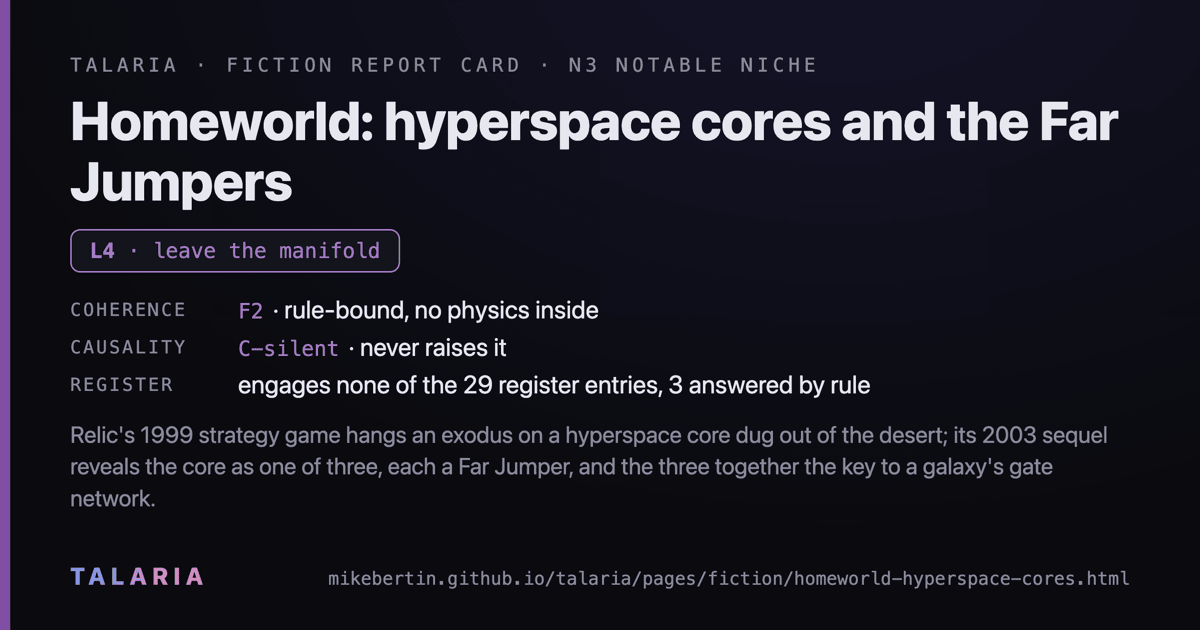
Relic's 1999 strategy game hangs an exodus on a hyperspace core dug out of the desert; its 2003 sequel reveals the core as one of three, each a Far Jumper, and the three together the key to a galaxy's gate network.
Kind: fiction · Loophole: L4 · Notability: N3 · Coherence: F2 · Causality: C-silent · Last reviewed: 2026-09-12
The drive as depicted
Homeworld was developed by Relic Entertainment and published by Sierra on 28 September 1999 [HIGH] S3. Its opening tells the drive's origin as history. A century before the game, the Kushan of the desert world Kharak found an ancient starship buried in the sand, the Khar-Toba, and in it a stone map, the Guidestone, marking Kharak and a world across the galaxy labelled Hiigara, "home", together with a hyperspace core the Kushan could not build but could use [HIGH] S3. They built a Mothership around it, carrying six hundred thousand colonists in cold sleep, with the scientist Karan S'jet integrated into the ship as its living core, and the game opens on the maiden voyage's hyperspace test [HIGH] S3. The jump works: the Mothership arrives at the test site to find a hostile carrier instead of its support ship, and on returning to Kharak finds the planet burned by the Taiidan Empire as punishment for developing hyperspace in violation of a treaty imposed four thousand years earlier [HIGH] S3. The game is the fleet's journey to Hiigara, mission by mission, with a hyperspace jump between each.
What a jump looks like is the game's signature image: a flat, glowing blue rectangle opens in space, the ship slides into it and is gone, and at the destination a matching window delivers it [HIGH] S1. In the single-player campaign the fleet jumps between missions and the player never controls the drive; in multiplayer the manual describes a command that lets capital ships perform hyperspace jumps to a chosen destination at a cost in resource units [HIGH] S2. Jumps are near-instantaneous within a mission and take unstated time between them; the fleet always arrives together, and the Bentusi, the traders who befriend the Kushan, arrive and leave by the same windows without warning [HIGH] S3.
Homeworld 2 (Relic and Sierra, 16 September 2003) reframes the core [HIGH] S3. The Khar-Toba core is the second of three hyperspace cores left in the galaxy by the Progenitors; the Bentusi hold the first, and the third is found by the Vaygr warlord Makaan a hundred years after the return to Hiigara, whose fleet's invasion of Hiigara drives the plot [HIGH] S3. Each core is a Far Jumper, a drive that moves a ship across the galaxy in almost no time, against which the ordinary hyperdrives of the setting's navies make short jumps and need time between them [MED] S3. The three cores are sockets for Sajuuk, a Progenitor ship the size of a Mothership that the setting's religions remember as a god; with all three fitted, Sajuuk becomes the key to a galaxy-wide network of hyperspace gates the Progenitors built, and the ending reactivates it [HIGH] S3. The last Bentusi ship destroys itself so that the Hiigarans can claim its core [HIGH] S3. In play the sequel adds hyperspace gates, which move ships between fixed points, and hyperspace inhibitors, which stop enemy jumps into a region, both as buildable structures [MED] S3.
Origin and lineage
Relic's founders Alex Garden and Luke Moloney designed Homeworld as a fully three-dimensional space strategy game and wrote its setting with a printed historical briefing in the box; the sequel was written after most of the original team had left, and its Progenitor mythology was a new layer on the first game's plainer story [MED] S3. The blue rectangular window has become the game's emblem and was carried into Homeworld: Deserts of Kharak (2016) and Homeworld 3 (2024) [MED] S3. No real proposal is named in any of the games or their manuals and none is claimed; the "core" that a civilisation finds and cannot reproduce is a Rendezvous with Rama and 2001 inheritance rather than a physics one, and this dossier asserts no source. The name "hyperspace" is the common property of the genre.
Which loophole, and why
L4, leave the manifold, for the drive; L3 for the gates, which are the sequel's secondary move. A ship with a core enters a window, is somewhere else, and the game never shows or states a path through space; the transit is a departure from the field of play and a re-entry. It is not a speed (L1) and no space is carried (L2). The Progenitor gate network of the sequel is a set of fixed tunnels with two ends, which is L3 and is noted here rather than given a second dossier because the games treat gates as the cores' application rather than as a separate physics.
The physics cousins are the extra-dimension dossiers and the two physics pages for pre-laid routes. The Kaluza-Klein hyperspace reading is the negative finding: no extra dimension physics knows is a place a ship can slide into through a window; the class bill is B-new. Brane-bulk shortcuts is the nearest real relative, a bulk route beating the brane by one part in $10^{58}$ at a bill of B-new, B-mass and B-caus. For the gate network the cousins are the Krasnikov tube, the metric laid along a route in advance so that later trips are fast, paid in Planck-thin negative energy and a two-tube time machine, and the Morris-Thorne traversable wormhole, the fixed tunnel with a throat held open by exotic matter. The join is exact in one respect: the sequel's premise is that the network was built long ago by someone else and can only be reactivated, which is the shape CON-2 says any real FTL infrastructure must have. The register entry for the drive's class is MAN-1.
The rules it keeps
The Coherence mark is F2, rule-bound. The drive's rules are consistent and without physical content. A jump needs a core or a hyperdrive; in the first game the fleet jumps as one between missions and the drive is never a tactical option in the campaign; in multiplayer a jump costs resources; in the sequel gates move ships between fixed points, inhibitors forbid jumps into their radius, and only the three cores can Far Jump. The scarcity of the cores is the setting's central rule and it holds across two games: the Kushan cannot build a second one, the Bentusi's core is theirs alone, and the sequel's war is a fight over three objects. The history is consistent with the rule, since the Kharak exodus is possible because one core was found and the empire's punishment is for using it.
The rules are not physics. The window is a picture, the core is a plot object with a socket, and nothing in either game says what a jump does to space, why a Far Jumper is faster or what an inhibitor inhibits. That is F2 exactly, and the games' strength is that they never pretend to more.
What it ignores
The register's questions. Neither game says what hyperspace is, what a jump costs the core in energy, how long a jump takes in the world's time, why the Progenitors needed three cores to run a gate network or what a gate is. The hazards of jumping are never shown; ships arrive intact.
Causality is C-silent. Fleets jump across the galaxy and communicate in real time, the setting has one calendar, and no game asks what a Far Jump does to the order of events for anyone left behind or what two cores in relative motion could do. There is no stated preferred frame. Last checked 2026-09-12 across the three main games: the causal cost of hyperspace is never raised.
Constraint scoring
Every entry in the register, one row each, verdict from the fiction vocabulary, with a note that says where in the work the engagement or rule occurs.
| Constraint | Verdict | Note |
|---|---|---|
| CAU-1 | SILENT | Jumps are effectively instantaneous and the setting has one clock; the antitelephone is never raised. |
| CAU-2 | SILENT | No chronology protection is stated. |
| CAU-3 | SILENT | Three cores in relative motion are the sequel's whole plot and the question of a time machine is not put. |
| CAU-4 | SILENT | A shared galactic calendar is used across both games and never named as a frame. |
| CAU-5 | N/A | No entanglement signalling; fleet communication is unexplained radio. |
| ENE-1 | SILENT | The core's power is never described; in multiplayer a jump costs resource units, which is an economy, not an energy. The energy conditions do not appear. |
| ENE-2 | SILENT | Fleets cross the galaxy before their light and nothing prices it; Olum's negative energy is never invoked. |
| ENE-3 | SILENT | No negative energy, so no inequality. |
| ENE-4 | N/A | No bubble. |
| ENE-5 | N/A | Not a warp metric. |
| ENE-6 | N/A | No Casimir energy. |
| ENE-7 | SILENT | The sequel's gates are fixed pairs of ends in the world, the handles topological censorship applies to; the games say nothing about them that answers or excludes the row. |
| CON-1 | N/A | No warp wall or horizon. |
| CON-2 | RULE | The sequel's stated rule is that the gate network was built by the Progenitors long ago and can only be reactivated with the three cores; the cores themselves cannot be built, only found. That is Krasnikov's and Coule's bootstrap as a plot: you need one to make one, and nobody living can make one. |
| CON-3 | N/A | Nothing is laid by the traveller; the network pre-exists. |
| STA-1 | N/A | No superluminal bubble. |
| STA-2 | SILENT | The gates are held open by nothing the games name; a throat's exotic matter is never mentioned. Applies through the gates and is never addressed. |
| STA-3 | N/A | No chronology horizon. |
| HAZ-1 | N/A | Nothing swept up; the window is a departure, not a wall through a medium. |
| HAZ-2 | N/A | The games have no medium in which the jump occurs and never show the crew during one; the row's question has nothing to attach to. |
| HAZ-3 | SILENT | The gates are traversed by capital ships without stated size limits or tidal effects; the row applies through the gates and is not addressed. |
| LOR-1 | RULE | Ships never accelerate to c; the stated rule is that engines move ships within a mission and only a core or hyperdrive moves them between systems. |
| LOR-2 | N/A | No tachyons. |
| LOR-3 | N/A | No wave in a medium. |
| LOR-4 | N/A | Neither Scharnhorst nor OPERA bears on it. |
| WRP-1 | N/A | Not a warp drive. |
| WRP-2 | N/A | Not a shell moving inertially. |
| WRP-3 | N/A | No positive-energy warp claim. |
| MAN-1 | RULE | The stated rule is that a core opens a window into hyperspace through which a ship leaves the field of play and re-enters elsewhere, with the Far Jumpers covering the galaxy in almost no time. MAN-1 says physics supplies no such window; the games' answer is a blue rectangle and a treaty forbidding its use. |
Sources
- S1 Homeworld (Relic Entertainment, Sierra Studios, 1999), opening cinematic and campaign; Homeworld 2 (Relic, Sierra, 2003), campaign and ending. From play; plot points confirmed against the Wikipedia articles below.
- S2 Homeworld manual (Sierra, 1999), §3.8 "Miscellaneous Commands" and §4.2.3 "Sensors Manager", for the multiplayer hyperspace command and its resource cost. Read at the Internet Archive.
- S3 Wikipedia, "Homeworld", for the release date, the Khar-Toba and Guidestone backstory, the Mothership and Karan S'jet, the hyperspace test and the burning of Kharak.
- S3 Wikipedia, "Homeworld 2", for the release date, the three cores, Makaan, Sajuuk, the Bentusi sacrifice and the gate network.
- S3 Encyclopedia Hiigara (homeworld.fandom.com), "Three Hyperspace Cores", "Hyperspace Core" and "Far Jump", consulted via search excerpts only, for the Far Jumper description and the order of discovery.