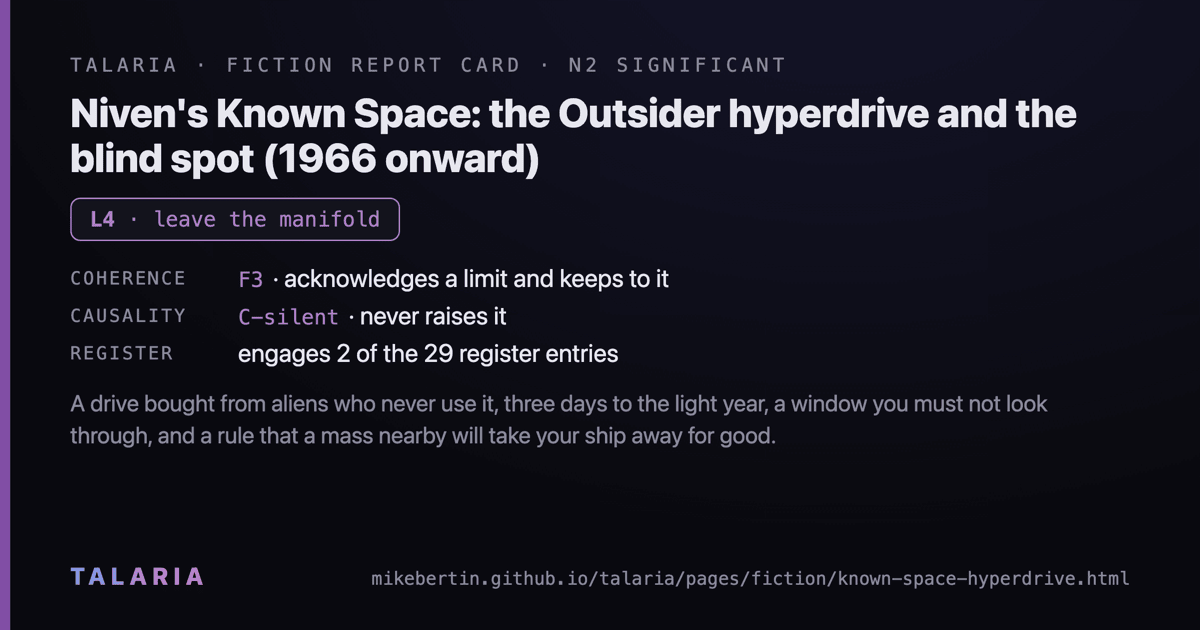
Niven's Known Space: the Outsider hyperdrive and the blind spot (1966 onward)
A drive bought from aliens who never use it, three days to the light year, a window you must not look through, and a rule that a mass nearby will take your ship away for good.
Kind: fiction · Loophole: L4 · Notability: N2 · Coherence: F3 · Causality: C-silent · Last reviewed: 2026-09-12
The drive as depicted
Larry Niven's Known Space stories (from 1964; the hyperdrive from 1966) define the drive piecemeal, and the rules are stable enough that Niven's fans have kept a concordance. The hyperdrive shunt was sold to humanity by the Outsiders, a species of cold, slow-moving beings who trade information and do not use the drive themselves, and the sale ended the First Man-Kzin War, since the Kzinti had no equivalent [HIGH] S3 (Wikipedia, "Known Space", technology and history; the stories "The Warriors" (1966) and the Man-Kzin Wars framing from memory). The standard drive, later called Quantum I, moves a ship one light year in three days, about 122 times the speed of light [HIGH] S3 (Wikipedia; the figure is stated in Ringworld, 1970, from memory). A single much faster ship exists: the Long Shot, a Puppeteer-built prototype whose drive covers a light year in about a minute and a quarter, some 420,000 c, flown by Beowulf Shaeffer to the galactic core in "At the Core" (1966) and given the name Quantum II in The Ringworld Engineers (1980) [MED] S3 (Wikipedia for the rate; the story and the naming from memory).
Two rules do most of the work. The first is the mass rule: a ship may only engage the hyperdrive well outside a star's gravity well, and a ship that enters hyperspace, or is in hyperspace, too near a large mass vanishes and is never seen again; the stories treat this as a law of nature, ships carry a mass sensor whose indicator swells toward nearby masses and the pilot's job in hyperspace is to watch it [HIGH] S3 (Wikipedia; the mass sensor in "Neutron Star" (1966) and Ringworld from memory). The second is the blind spot: a person who looks out of a port in hyperspace sees nothing, not darkness but an absence the eye cannot hold, the walls of the cabin seem to close over the port and a pilot who keeps looking risks madness; ships therefore shutter their ports in hyperspace [HIGH] S3 (Wikipedia; the effect is a fixture of the Shaeffer stories and of Ringworld from memory). Ringworld's Children (2004) reworks the mass rule from the inside: there is life in hyperspace, predators that live near gravity wells and eat ships that appear there, which is why ships near masses vanish, and the Ringworld itself is converted into a Quantum II hyperdrive at the novel's end [HIGH] S3 (Wikipedia).
The early rule that a ship needed to be moving at a large fraction of light speed before the drive would engage, stated in World of Ptavvs (1965 magazine, 1966 book), was dropped in later stories [MED] S3 (Wikipedia). Human space before the Outsiders' sale was a slower-than-light civilisation of ramrobots and colony slowboats, and the Outsiders themselves travel between stars at sublight speed on solar sails, which is the setting's standing reminder of what the drive replaced [HIGH] S1 (from memory; foundational to the series).
Origin and lineage
Niven began the series in 1964 and added the hyperdrive in 1966 across three stories: "The Warriors" (the sale), "Neutron Star" (the mass sensor) and "At the Core" (the Long Shot) [MED] S3. He has said in essays that he treats FTL as a story convenience with rules attached, and he wrote separately about time travel as a logical problem ("The Theory and Practice of Time Travel", 1971, in All the Myriad Ways), but that essay is about time machines and does not treat the hyperdrive as one [MED] S1 (the essay from memory). No physics proposal is named in the stories and none cites them. The mass rule became a genre convention (the Star Wars films show the same effect without the word) and Niven's version is one of its earliest clean statements.
Which loophole, and why
L4, leave the manifold. The ship is in another space, which has a look (the blind spot is what a human eye does with it), a speed of its own and inhabitants, and the ship returns from it. There is no L3 flavour: no routes, gates or lanes, and the drive goes anywhere the mass rule allows.
The physics cousin is Kaluza-Klein and the hyperspace reading, the register's MAN-1 worked through: extra dimensions in physics are compact or warped, share our light cone and confine ordinary matter to our brane, so a space with its own speed and its own predators has no counterpart. The mass rule is the one place Niven's fiction and the physics touch: in the brane-bulk shortcut, matter on the brane bends it into the bulk and it is exactly near masses that the bulk geometry differs from the brane's, though the physics makes the shortcut there rather than forbidding it; the bill for that real effect is a new warped dimension, early-universe energy densities to make it noticeable and the antitelephone unless the bulk fixes a frame. The relativistic rocket is the setting's own history before the sale.
The rules it keeps
- Fixed rate, three days to the light year, held across four decades of stories; the one exception (the Long Shot) is a named prototype [HIGH] S3.
- The mass rule: no drive inside a gravity well, and a ship near a mass in hyperspace is lost; the mass sensor is standard equipment [HIGH] S3.
- The blind spot: do not look, shutter the ports [HIGH] S3.
- The Outsiders sold it and do not use it, and the setting keeps them slow [HIGH] S3.
- Retcon by explanation, not by contradiction: Ringworld's Children keeps the mass rule and gives it a cause [HIGH] S3.
The mark is F3. The stories state limitations and apply them consistently for forty years, with the retcon of 2004 respecting the earlier rule rather than overriding it. The limitations are not drawn from physics, so F4 is not earned; but they are more than a rule set, since the blind spot and the mass rule are both about what the other space does to a human and a ship, which is closer to a stated cost than most hyperspaces come.
What it ignores
Causality is never raised in any Known Space story this catalogue knows of, as of 2026-09-12. Known Space runs on one clock, hyperwave communication is treated as instantaneous and no character receives a message before it was sent. Niven's essay on time travel does not touch the hyperdrive. No preferred frame is stated, so the mark is C-silent. Energy is never priced: the drive is a device with a switch. What the blind spot is, physically, is never explained; what hyperspace predators eat is not said.
Constraint scoring
Every entry in the register, one row each, verdict from the fiction vocabulary, with a note that says where in the work the engagement or rule occurs.
| Constraint | Verdict | Note |
|---|---|---|
| CAU-1 | SILENT | Instant hyperwave and three-day light years in one shared time; the antitelephone is never mentioned in the stories, and Niven's time-travel essay does not connect it to the hyperdrive. |
| CAU-2 | SILENT | No loop built, none forbidden. |
| CAU-3 | SILENT | Two hyperdrive ships are the register's time machine; Known Space has thousands and never assembles the loop. |
| CAU-4 | SILENT | No preferred frame is stated. |
| CAU-5 | N/A | No entanglement device; hyperwave is unexplained. |
| ENE-1 | SILENT | What the shunt spends is never given a sign or a size. |
| ENE-2 | SILENT | A trip that beats light through flat space needs negative energy somewhere; the stories price the drive in rate and risk, never in energy. |
| ENE-3 | N/A | No warp-bubble wall. |
| ENE-4 | N/A | No pocket geometry. |
| ENE-5 | N/A | Not in the Natário class; the ship is in another space. |
| ENE-6 | N/A | No negative energy claimed. |
| ENE-7 | N/A | No handle in our spacetime. |
| CON-1 | N/A | No bubble horizon; the pilot steers by the mass sensor and is not cut off from anything. |
| CON-2 | SILENT | The drive goes anywhere on a first flight and needs no route laid; the bootstrap is never raised. |
| CON-3 | N/A | No tube. |
| STA-1 | N/A | No bubble. |
| STA-2 | N/A | No throat. |
| STA-3 | N/A | No chronology horizon. |
| HAZ-1 | N/A | No wall sweeping up particles; a ship drops out of hyperspace with what it carried in. |
| HAZ-2 | N/A | No horizon flux. The stated crew hazard, the blind spot, is a perceptual effect of looking at the other space and is not what the entry prices. |
| HAZ-3 | N/A | No throat, no tidal bound. |
| LOR-1 | ENGAGES | The setting's history is built on the light barrier: ramrobots and slowboats settled the colonies, the Outsiders travel at sublight on sails and the hyperdrive is a purchase that ended that era. The constraint is on the page as the thing the drive replaced. |
| LOR-2 | N/A | No tachyons. |
| LOR-3 | N/A | No signal in a medium. |
| LOR-4 | N/A | Neither the Scharnhorst effect nor OPERA bears on the shunt. |
| WRP-1 | N/A | Not a warp drive. |
| WRP-2 | N/A | No moving shell. |
| WRP-3 | N/A | No positive-energy warp claim. |
| MAN-1 | ENGAGES | A separate space with its own speed, its own effect on the eye and its own inhabitants, entered at will away from masses: the entry's "separate space with laxer rules" as depicted, and the mass rule is the one feature that faintly echoes what brane physics says happens near matter. |
Sources
- S1 Niven, L., "The Warriors" (1966), "Neutron Star" (1966), "At the Core" (1966), collected in Neutron Star (1968); World of Ptavvs (1966); Ringworld (1970); The Ringworld Engineers (1980); Ringworld's Children (2004). All from memory; details as confirmed by the S3 below.
- S1 Niven, L., "The Theory and Practice of Time Travel", in All the Myriad Ways (1971). From memory.
- S3 Wikipedia, "Known Space", technology section: the Outsiders' sale, Quantum I and II rates, the mass rule, the blind spot, World of Ptavvs's early rule and Ringworld's Children. Read in full.
- S3 The Incompleat Known Space Concordance (larryniven.net), "Hyperspace"; Larry Niven Wiki (fandom), "Hyperdrive". Could not be opened this session (certificate and payment-required errors); rates cited from search summaries agree with Wikipedia.