Le Guin's ansible
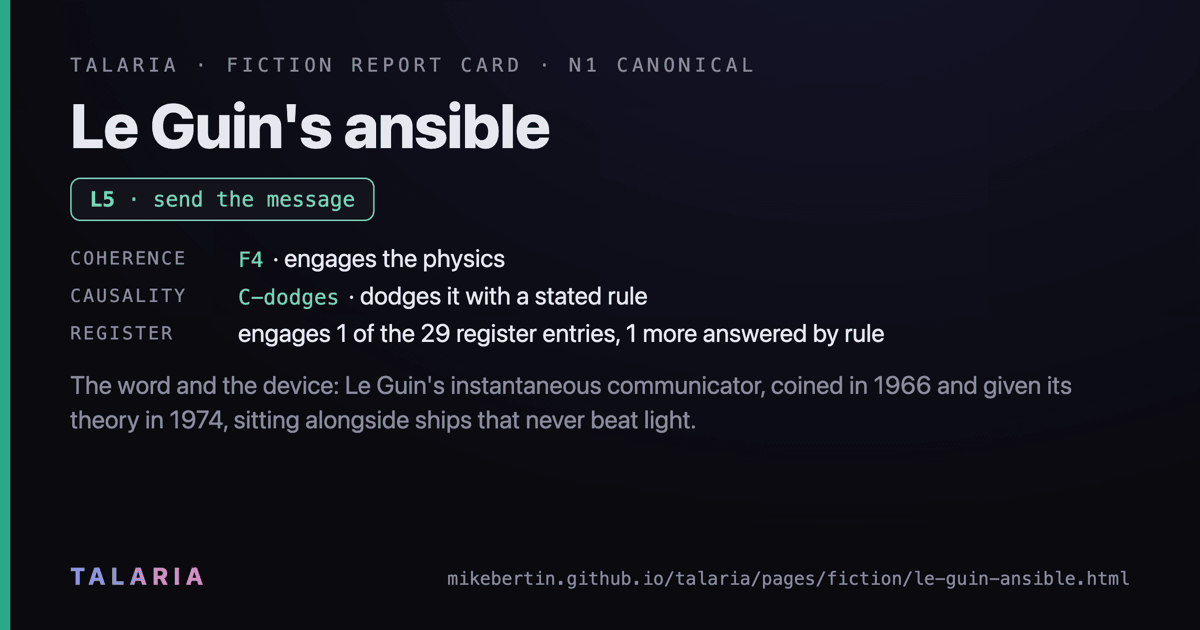
The word and the device: Le Guin's instantaneous communicator, coined in 1966 and given its theory in 1974, sitting alongside ships that never beat light.
Kind: fiction · Loophole: L5 · Notability: N1 · Coherence: F4 · Causality: C-dodges · Last reviewed: 2026-09-12
The drive as depicted
The ansible is a box that talks to another box on another world with no delay. In Rocannon's World (Ace, 1966) it is introduced in Part One, chapter I, when the ethnologist Rocannon explains to Mogien that news of the attack on his survey ship went out "on the ansible in the ship" and that the machine is one "which can speak instantly to other worlds, with no loss of years" [HIGH] S1. The same chapter contrasts it with radio: to reach the League by radio "it would take the words eight years to go there" and as many back [HIGH] S1. An older ship given to the Clayfolk seventy years earlier had no instantaneous transmitter, so within the story the ansible is a recent invention [HIGH] S1. The novel's climax, Part Two chapter IX, is an act of ansible operation: Rocannon finds the enemy's grounded FTL ship, resets the coordinates on its ansible sender, "set the machine to transmit and began to type", and sends the enemy base's position to the League, which destroys it from light years away [HIGH] S1. The word does not occur in the prologue; the prologue is about the cost of the ships, not the box [HIGH] S1.
The theory comes eight years later. In The Dispossessed (Harper and Row, 1974) the physicist Shevek works on a General Temporal Theory that would unify two views of time, Sequency and Simultaneity [HIGH] S1. In chapter 9 the Urrasti physicist Pae shows him newspaper plans for a device Shevek has not built: "It's what he's calling an instantaneous communication device" [HIGH] S1. In chapter 11, explaining the theory to the Terran ambassador Keng, Shevek says that with his equations "they can make the ansible", and describes it as a device permitting communication without any time interval between two points, then adds the line that is the whole of Le Guin's physics: "The device will not transmit messages, of course; simultaneity is identity." [HIGH] S1. Keng replies that it would make a league of worlds possible [HIGH] S1. Shevek's answer to who should build it is to broadcast the equations to every physicist on Urras and to the Hainish and the other worlds; the novel does not show anyone building one [HIGH] S1.
Two further Hainish books add operating rules that the two defining texts do not contain. In The Left Hand of Darkness (1969) Genly Ai tells the king of Karhide that the device "doesn't involve radio waves, or any form of energy", that it works on a constant of simultaneity analogous in some ways to gravity, and that one end has to be fixed on a planet of a certain mass while the other is portable [MED] S3 (quoted on secondary pages; full text not consulted). The Word for World Is Forest (1972) repeats the mass rule [MED] S3. Alongside the ansible, every crewed ship in the Hainish books is NAFAL, "nearly as fast as light", a term the Historical Dictionary of Science Fiction first records in Le Guin's 1969 story "Nine Lives" [HIGH] S3. Rocannon's World says only "lightspeed ships" and states that living things do not survive FTL, so the League's FTL vessels are unmanned [HIGH] S1.
Origin and lineage
Le Guin published the first half of Rocannon's World as "The Dowry of Angyar" in Amazing Stories, September 1964, and expanded it into the 1966 Ace Double, her first novel [HIGH] S1 (front matter and the estate's own site). The estate's site records that the novel "marks the first appearance of the word 'ansible'" [HIGH] S1. The Dispossessed won the 1974 Nebula, the 1975 Hugo and the 1975 Locus awards [HIGH] S1 (estate site; Wikipedia agrees).
The name comes from "answerable". Le Guin's own statement of this survives only at second hand: a 2001 Usenet post by Dave Goldman reports she told him so, the Oxford English Dictionary cites that post, and the SF Encyclopedia and Wiktionary repeat it [MED] S3. No text in Le Guin's own hand giving the derivation was found for this dossier. What is in her own hand is her attitude to the loan: in a 2010 Book View Café essay she wrote that she had been "happy to share the ansible with other science fiction writers", compared it to Heinlein's waldo, and added that the ansible is an Anarresti invention and anarchists share stuff [HIGH] S1.
The borrowers are the lineage. Orson Scott Card took the word for "Ender's Game" (Analog, August 1977; novel 1985), whose text says "somebody dredged the name ansible out of an old book somewhere", and Card has written that the word originated with Le Guin while the mechanism is his own (Ender's philotic ansible) [HIGH] S1. The SF Encyclopedia and the Historical Dictionary of SF list Vernor Vinge ("The Blabber", 1988), Elizabeth Moon (Winning Colors, 1995), Dan Simmons (Ilium, 2003), Terry Bisson, Paul Park, a 1996 Deep Space Nine novel and a 2013 Doctor Who episode by Neil Gaiman, and David Langford's newsletter Ansible, founded 1979 [HIGH] S3. No real physics proposal is named in any of the four Hainish texts, and none is claimed to have fed one. The one real-physics neighbour is retrospective: once quantum entanglement offered a non-local correlation to hang the wish on, "ansible" became the generic word for the entanglement radio, which is the proposal the no-communication theorem closes.
Lineage: Le Guin's ansible goes out into the field.
Which loophole, and why
L5, send the message. Nothing material crosses the gap; "simultaneity is identity" is a statement that the two ends are, in the relevant sense, one place, and the story's only cargo is text. The ships that carry people are plain L6 vessels, and the novels are unusually careful to keep the two apart: the ansible answers in an instant, the traveller pays in years.
The physics cousin is entanglement signalling and the no-communication theorem, because that is what every later reader has taken the ansible to be, and the bill there is the whole of the mechanism: a working instantaneous link needs quantum mechanics to be nonlinear, which no-signalling forbids, and its signal would be the antitelephone of CAU-1 unless something picks a frame. Le Guin's second cousin is the preferred-frame escape of CAU-4, surveyed in Lorentz-violating frameworks: a "constant of simultaneity" is a universal now, and a universal now is a frame. The register's price for that hatch is that special relativity stops being the whole story, and The Dispossessed pays it openly by making a new theory of time the subject of the book.
The rules it keeps
- Ships never beat light with people aboard. Semley's errand in the prologue to Rocannon's World costs her sixteen years at home for one night of her own; Rocannon's rescue takes nine years to arrive because rescuers travel below c; in The Dispossessed Keng speaks of those "who lived eleven years while I was traveling from Terra to Urras" in a nearly light-speed ship [HIGH] S1. The dilation is always charged and never waived.
- The ansible carries text, not people. Chapter 11 of The Dispossessed has the Urrasti wanting something more from Shevek's equations, "the instantaneous transferral of matter across space. Transilience", and Shevek denying that his equations give it [HIGH] S1. The line between message and matter is drawn in the text and held across the series.
- It has a theory, and the theory is the story. Shevek's unification of Sequency and Simultaneity is the plot of The Dispossessed, and the ansible is presented as its engineering consequence rather than as furniture [HIGH] S1.
- It has operating limits. One end on a massive body, the other portable; no radio waves and no energy in transit; a few hundred characters of text at a time [MED] S3 (Left Hand, Word for World).
That is the F4: the work names a real constraint, the light barrier for matter, builds its plots on the cost, and treats the exception it grants to information as a physics problem with a named theory and stated limits rather than as a convenience.
What it ignores
The message to the past. An ansible fixed on Hain and an ansible carried on a NAFAL ship in relative motion are the two transmitters of the Benford, Book and Newcomb exchange, and the League runs exactly that configuration for centuries. No Hainish text raises it. The nearest approach is Shevek's remark in chapter 9 that engineers are proof of causal reversibility, which is a joke about theory and practice, and his party speech in chapter 7 on the arrow and the circle of time, which is metaphysics [HIGH] S1. Le Guin's own non-fiction on the point was not found. The mark is C-dodges rather than C-silent because a stated rule does the work: a constant of simultaneity with one end anchored to a planet of a certain mass defines a preferred simultaneity, which is the register's CAU-4 escape, even though the work never says that is why. Never addressed in any Hainish instalment as of 2026-09-12.
Constraint scoring
| Constraint | Verdict | Note |
|---|---|---|
| CAU-1 | SILENT | A fixed ansible plus one aboard a NAFAL ship in relative motion is the two-transmitter antitelephone; the League runs that setup throughout the cycle and no instalment raises the backward-in-time reply. The ch. 9 causal-reversibility joke is the only brush with it |
| CAU-2 | N/A | No geometry is altered and no closed timelike curve of the metric is proposed; the loop would be one of signals |
| CAU-3 | N/A | No wormhole or warp bubble to carry on a round trip; the NAFAL voyages supply the relativistic leg but not the device the theorem needs |
| CAU-4 | RULE | The "constant of simultaneity" and the one-end-fixed-on-a-massive-planet rule (Left Hand, Word for World) together fix a frame for the signal, which is the register's escape hatch taken without being named |
| CAU-5 | SILENT | The texts name no quantum mechanism, so the theorem has nothing to close on the page; every later attempt to give the ansible one is the entanglement radio and is closed by it |
| ENE-1 | N/A | No stress-energy; Genly Ai says the device involves no form of energy |
| ENE-2 | N/A | No gravitational time advance is claimed; the signal is not a path through space |
| ENE-3 | N/A | No negative energy density for the inequalities to bound |
| ENE-4 | N/A | Warp-class pocket geometry; not a warp drive |
| ENE-5 | N/A | Warp-class result |
| ENE-6 | N/A | The Casimir effect is not invoked |
| ENE-7 | N/A | No topology, no shortcut through space; an information claim on flat spacetime |
| CON-1 | N/A | No horizon and nothing piloted |
| CON-2 | N/A | No route laid; the fixed end must be built on a planet, which is infrastructure at the endpoint, not along the way |
| CON-3 | N/A | No tube |
| STA-1 | N/A | No bubble |
| STA-2 | N/A | No throat |
| STA-3 | N/A | No chronology horizon in the spacetime sense |
| HAZ-1 | N/A | Nothing swept up |
| HAZ-2 | N/A | No horizon, no Hawking flux |
| HAZ-3 | N/A | No throat, no tides |
| LOR-1 | ENGAGES | NAFAL is the rule and its cost is the story: Semley's sixteen years, Rocannon's nine-year wait, Keng's eleven years. The unmanned FTL ships of Rocannon's World are the one exception and are stated as such |
| LOR-2 | N/A | No tachyon is named as the carrier |
| LOR-3 | N/A | No group-velocity or tunnelling-time claim; the device is stated to involve no waves at all |
| LOR-4 | N/A | Neither the Scharnhorst effect nor OPERA |
| WRP-1 | N/A | Not a warp drive |
| WRP-2 | N/A | Not a warp shell |
| WRP-3 | N/A | Not in the warp class |
| MAN-1 | N/A | No extra dimension; the ansible is "simultaneity is identity", not a passage through another space |
Sources
- S1 Le Guin, U. K., Rocannon's World (Ace, 1966), Part One ch. I and Part Two ch. IX. Text read in full from an unofficial online copy; page numbers not from a printed edition.
- S1 Le Guin, U. K., The Dispossessed (Harper and Row, 1974), chs. 3, 7, 9 and 11. Text read from the archive.org copy.
- S1 Le Guin, U. K., "Art, Information, Theft, and Confusion, part two", Book View Café, 1 August 2010, reproduced at ursulakleguin.com. Read in full.
- S1 The Ursula K. Le Guin estate site, pages for Rocannon's World and The Dispossessed (publication and awards). Read.
- S1 Card, O. S., "OSC Answers Questions", Hatrack River, question 4, on the origin of "ansible". Read.
- S3 SF Encyclopedia, "Ansible". Read.
- S3 Historical Dictionary of Science Fiction, entries "ansible" and "NAFAL". Read.
- S3 World Wide Words, "Ansible", on the Goldman Usenet post and the OED. Read.
- S3 Wikipedia, "Ansible", "The Dispossessed", "Rocannon's World" and "The Dowry of Angyar", for the Left Hand and Word for World quotations and for Semley's timeline. Read.
- S3 Wiktionary, "ansible", citing the rec.arts.sf.written post of 7 April 2001. Read.