Outer Wilds (2019): Nomai warp cores
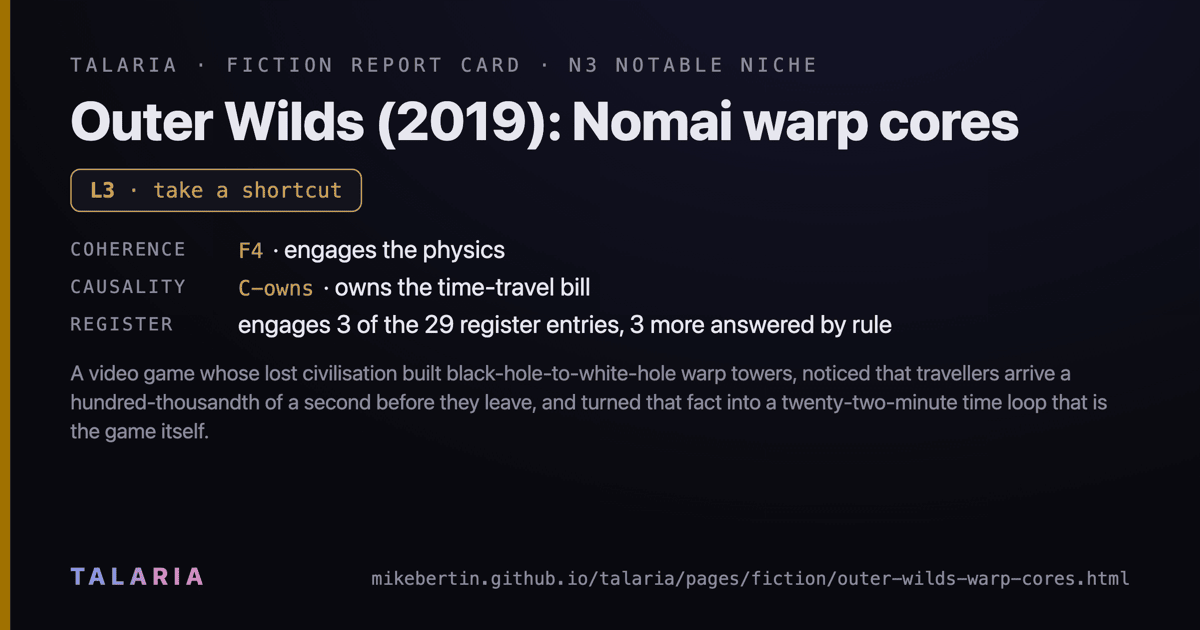
A video game whose lost civilisation built black-hole-to-white-hole warp towers, noticed that travellers arrive a hundred-thousandth of a second before they leave, and turned that fact into a twenty-two-minute time loop that is the game itself.
Kind: fiction · Loophole: L3 · Notability: N3 · Coherence: F4 · Causality: C-owns · Last reviewed: 2026-09-12
The drive as depicted
Outer Wilds (Mobius Digital, published by Annapurna Interactive, May 2019) is an exploration game set in a toy solar system whose sun explodes twenty-two minutes after the player wakes, after which the player wakes again. Its faster-than-light technology belongs to the Nomai, a species dead for a very long time, and is learned by reading their wall texts and walking through their machines. The dossier's primary material is those texts, which the game prints in full when a wall is scanned; the wiki citations below reproduce them [HIGH] S1.
A warp core is a pair: a black hole core and a white hole core. Whatever is warped enters the black hole and leaves the white hole, and the two can be far apart [HIGH] S1. The Nomai's first use is the White Hole Station, a platform hanging beside the white hole that is the far end of the natural black hole at the centre of the planet Brittle Hollow, built to return anyone who fell in [HIGH] S1. Every warp tower is tuned to one astral body and works only during the brief window when that body is directly overhead; Poke's welcome text at the station states the rule, and the player learns it by standing on the platform and waiting [HIGH] S1. On the planet Ash Twin a ring of such towers, one per planet, connects the whole system to a single place, and the player uses them as the Nomai did.
The physics is in the records of the High Energy Lab on Ember Twin. Reviewing the station's logs, Pye reports that Nomai are arriving at the receiver on Brittle Hollow "slightly before departing from the White Hole Station" (High Energy Lab wall text), an interval Ramie puts at roughly one hundred-thousandth of a second [HIGH] S1. Pye suspects equipment error; Ramie reproduces the anomaly in the lab with a scout that visibly exits the white hole before it enters the black hole, and records "Hypothesis confirmed!" [HIGH] S1. The next finding is the one that makes the game: the negative interval grows with the energy put into the core, and "the energy required to extend the interval increases at an exponential rate" (Ramie, High Energy Lab) [HIGH] S1. Pye's hypothesis is that a 22-minute interval is possible but needs a new way of making energy and an advanced core able to take it.
That is the Ash Twin Project. The Nomai excavate Ash Twin, forge an advanced warp core, build a Sun Station to trigger a supernova for power and a probe cannon on Giant's Deep, and plan a cycle: the cannon fires, the sun is detonated, the supernova powers the core, and the probe's data are sent 22 minutes into the past to the cannon, which fires again in a new direction; memory statues linked to living Nomai will carry their memories back the same way so that the cycle can be stopped once the probe finds the Eye of the Universe [HIGH] S1. The Sun Station fails, the Nomai are killed by an unrelated catastrophe, and the project sits idle until the sun dies of old age and triggers it, hundreds of thousands of years later, with the player's own memories caught in the loop [HIGH] S1. Every death the player experiences is the warp core sending 22 minutes of memory backwards. The game's last act is to remove the advanced core, which ends the loop, and carry it to a wrecked Nomai ship to warp to a destination the Nomai never reached.
Origin and lineage
The game began as Alex Beachum's graduate thesis project at the University of Southern California around 2012, was developed by Mobius Digital with Beachum as creative director and was released in 2019; an expansion, Echoes of the Eye, followed in 2021 [MED] S3. No physics paper is named in the game, and the studio has not, to this dossier's knowledge, cited one for the warp mechanics. What the game does is take two well-known pictures and use them straight: a black hole whose other end is a white hole, which is the maximally extended Schwarzschild geometry of the Einstein–Rosen bridge in cartoon form, and the rule that anything faster than light arrives before it leaves for somebody, which is the register's first entry (CAU-1). Rather than dodge the second, the game measures it, amplifies it and builds the whole design on it.
The lineage runs backward only in the sense that the game's black-hole-and-white-hole pair is the textbook picture; Brittle Hollow's hole leading to a white hole nearby is the Kruskal diagram made playable. No forward influence on physics is claimed. Its influence on game design has been large and is documented elsewhere.
Which loophole, and why
L3, take a shortcut. A warp is a passage from a black hole to a paired white hole with no transit through ordinary space; towers connect fixed points and work only at alignment; the advanced core opens a portal to given coordinates. This is a wormhole network, and the game's own vocabulary, black hole in and white hole out, says so.
The cousin by shape is the Einstein–Rosen bridge, whose bill is B-none because no signal crosses it: the throat pinches off before light gets through, and a Schwarzschild black hole's "other end" is not somewhere you can arrive. The Nomai's traversable pair is therefore a Morris and Thorne 1988 throat wearing a black hole's clothes, and that dossier's bill applies: negative energy at the throat, a far core placed in advance at ordinary speed (which the game states as a rule, see below) and a time machine on any use that beats light. The join between the game and the physics is that last item, and it is exact. A traversable wormhole that beats light is a time machine with an assembly step (CAU-3); the Nomai found the machine inside the shortcut, measured its size as a hundred-thousandth of a second, and paid a supernova to make it twenty-two minutes.
The rules it keeps
- A warp needs a core at each end; a standard core cannot reach a place where no core has been placed, and an advanced core is needed to open a portal to bare coordinates [HIGH] S1.
- A tower warps only during the window when its tuned body is directly overhead, stated by Poke and enforced by the game's clock and orrery [HIGH] S1.
- Arrival precedes departure by about one hundred-thousandth of a second, measured, doubted and confirmed in the High Energy Lab [HIGH] S1.
- The negative interval grows with energy, and the energy grows exponentially with the interval; a 22-minute interval needs a supernova [HIGH] S1.
- Sending information back creates a loop that repeats until stopped, and the loop ends when the core is removed; the game enforces this by ending the loop, and the save file, if the player dies with the core out [HIGH] S1.
- Only information and memory go back 22 minutes; bodies and ships warp in space but not in time by that interval. The memory statues carry minds, the probe cannon receives coordinates, and the player's body starts each loop where it began [HIGH] S1.
This is F4 by the grading scheme, and among the cleanest examples the catalogue has: the work names a real constraint, that faster-than-light arrival is arrival before departure, gives it a number, prices its extension in energy with a stated functional form and makes the story out of the cost. The rules are applied without exception across the whole game.
What it ignores
The mark is C-owns. The game admits the causal implication, measures it, uses it and forbids nothing. What it does not do is address frames: the negative interval is stated as a fact about departure and arrival with no observer named, there is no preferred frame and no discussion of what other observers would see. The loop is self-consistent by construction, in that the information sent back always produces the same 22 minutes up to the player's choices; the game treats each loop as replacing the last rather than as branching, and never says which. The grandfather question does not arise because only memory and data go back.
The register's other questions get partial answers. What a warp core is made of and what holds the throat open are never said. Energy is priced in shape, exponential in the interval, but never in units. The natural black hole at Brittle Hollow's core is treated as traversable to its white hole with no comment on tides or singularities, which is where the game's cartoon of a black hole departs most from the physics; the Einstein–Rosen throat would close on a traveller and Brittle Hollow's does not. Absence is confined to engineering and to the vacuum solution's inconvenient behaviour; on causality the game is the least silent entry in its class.
Constraint scoring
Every entry in the register, one row each, verdict from the fiction vocabulary, with a note that says where in the work the engagement or rule occurs.
| Constraint | Verdict | Note |
|---|---|---|
| CAU-1 | ENGAGES | High Energy Lab texts: warped Nomai arrive before they depart, by a hundred-thousandth of a second, measured and confirmed. The entry's content is the game's central discovery. |
| CAU-2 | SILENT | The Nomai build the closed loop and nothing in the physics of the game resists it; the loop fails for want of a supernova, not because timelike curves refuse to close. Chronology protection is not in the game's vocabulary. |
| CAU-3 | ENGAGES | The Ash Twin Project is the entry's construction, a wormhole converted into a time machine, built deliberately by amplifying the warp's negative interval with supernova energy; the assembly step is the plot. |
| CAU-4 | SILENT | No preferred frame is stated; the interval is a bare fact about departure and arrival with no observer named, and the game never asks what a moving observer would see. |
| CAU-5 | N/A | No entanglement or quantum signalling; the game's Quantum Moon is a separate mechanic and carries no messages. |
| ENE-1 | SILENT | What a warp core is made of, and what the energy conditions would say about its throat, is never stated; the cores are forged in the Black Hole Forge from unnamed materials. |
| ENE-2 | ENGAGES | The game states that the warp's time advance is bought with energy and that the price rises exponentially with the advance; it never names negative energy, but it is the only work in this class that prices the advance at all, and the sign of the price is the register's question. |
| ENE-3 | SILENT | No negative energy is admitted, so the quantum inequalities are not engaged. |
| ENE-4 | N/A | Warp-bubble pocket geometry; the Nomai warp is a wormhole pair, not a bubble. |
| ENE-5 | N/A | The Natário-class NEC result does not bear on a wormhole. |
| ENE-6 | SILENT | No source of negative energy is named; the supernova is positive energy, and the Casimir floor is not approached. |
| ENE-7 | SILENT | Brittle Hollow's black hole leads to a white hole elsewhere in the same system, a handle visible from outside that topological censorship forbids under the averaged null energy condition; the game does not address the theorem. |
| CON-1 | N/A | Warp-bubble horizons; no bubble. |
| CON-2 | RULE | A standard core cannot reach a place without a core already there, and the Ash Twin towers were connected by physically delivering a core to each planet from the forge; the entry's demand that the route be laid at ordinary speed in advance is a stated rule of the game. |
| CON-3 | N/A | No Krasnikov tube. |
| STA-1 | N/A | Semiclassical instability of warp bubbles; not applicable. |
| STA-2 | SILENT | What holds a warp throat open is never described; the cores are black boxes with a pairing rule. Brittle Hollow's natural hole is traversable without comment. |
| STA-3 | SILENT | The Nomai build a time machine and never ask whether it destroys itself; the divergence at a chronology horizon is not raised, and the loop runs cleanly for as long as the sun keeps exploding. |
| HAZ-1 | N/A | Warp-bubble particle sweep; no bubble. |
| HAZ-2 | N/A | Hawking flux inside a warp bubble; not applicable. |
| HAZ-3 | RULE | Living Nomai and the player fall through Brittle Hollow's black hole and warp through towers unharmed by rule; the game never mentions tides, and its natural black hole is survivable at its centre, which is a stated property of the world rather than an engagement with the bound. |
| LOR-1 | RULE | Nothing is accelerated to light speed; warps are passages and the Nomai's own ships fly at ordinary speed between them, which is the L3 answer to the entry. |
| LOR-2 | N/A | No tachyons. |
| LOR-3 | N/A | No wave in a medium. |
| LOR-4 | N/A | Neither the Scharnhorst effect nor OPERA bears on a wormhole pair. |
| WRP-1 | N/A | Not a warp drive in the register's sense; the game's word "warp" names a wormhole passage. |
| WRP-2 | N/A | The shell classification is for warp metrics. |
| WRP-3 | N/A | No positive-energy warp claim. |
| MAN-1 | N/A | Everything happens in one four-dimensional space; no extra dimension or bulk is invoked anywhere in the game. |
Sources
- S1 Outer Wilds (Mobius Digital and Annapurna Interactive, 2019). Nomai wall texts and projection stones at the White Hole Station, the High Energy Lab on Ember Twin, the Black Hole Forge on Brittle Hollow and the Ash Twin Project, all scannable in-game and quoted above; the ship log's summaries of the same.
- S3 Outer Wilds Wiki (outerwilds.fandom.com), articles "Warp Core", "Ash Twin Project" and "White Hole Station", consulted 2026-09-12; these transcribe the in-game texts verbatim and are used as the source of the quotations.
- S3 Wikipedia, "Outer Wilds", for development history, from working knowledge.