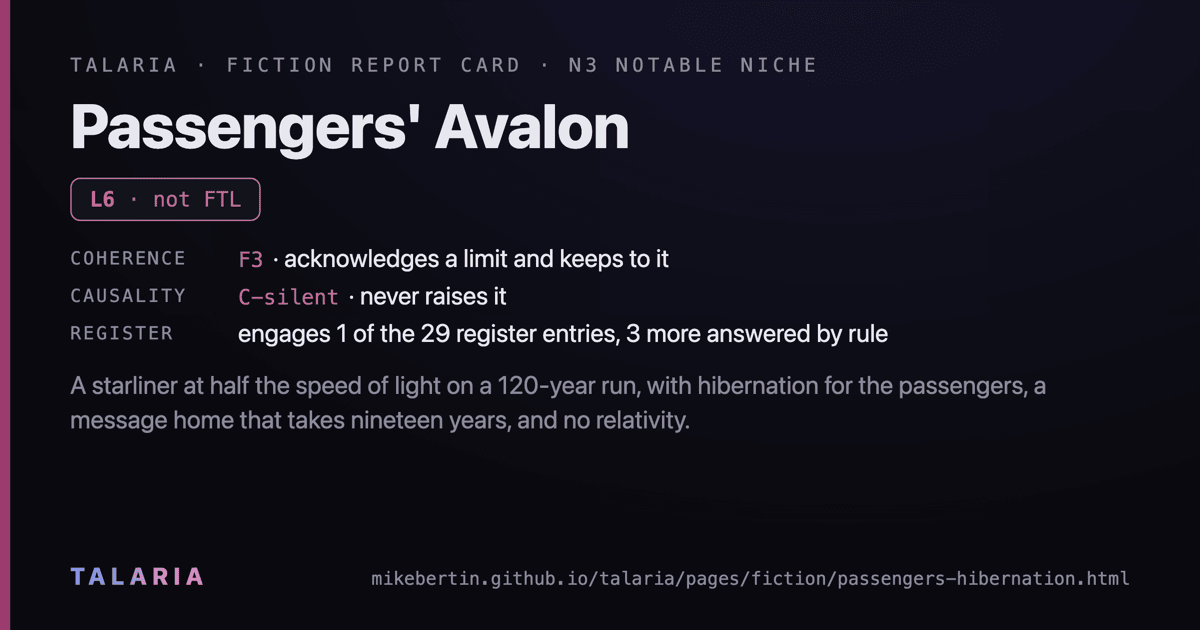
Passengers' Avalon
A starliner at half the speed of light on a 120-year run, with hibernation for the passengers, a message home that takes nineteen years, and no relativity.
Kind: fiction · Loophole: L6 · Notability: N3 · Coherence: F3 · Causality: C-silent · Last reviewed: 2026-09-12
The drive as depicted
Passengers (Sony, 21 December 2016; directed by Morten Tyldum, written by Jon Spaihts) states its numbers on screen. The Avalon is "the Homestead Company's premier interstellar starliner" bound for Homestead II; the ship's computer tells Jim Preston "There are 5,000 passengers and 258 crew members"; the welcome hologram tells him he has spent 120 years in suspended animation, which is the planned duration [HIGH] S1 (transcript). In the observatory he learns the ship left Earth "Approximately 30 years ago" and "We will arrive in approximately 90 years" [HIGH] S1. The speed is stated once, by the deck chief Gus after he too wakes: "No, we're doing 50% of light speed." [HIGH] S1. The bartender android Arthur states the ship's one rule: "Hibernation pods are fail-safe. They never malfunction." [HIGH] S1. The cause of Jim's waking is a meteor strike thirty years in, and someone protests that "The ship's supposed to be meteor-proof" [HIGH] S1. The ship spins for gravity, carries a fusion reactor that must be vented by hand in the climax, and swings past the star Arcturus on the way [HIGH] S1.
The one physics scene is the message. Jim records a distress call to the Homestead Company and the booth answers: "Message will arrive in 19 years." and then "Earliest reply in 55 years." [HIGH] S1. Those are the film's only statements of a signal limit, and they are honest: light-speed messages, a reply that cannot come in time.
Origin and lineage
Spaihts's screenplay was on the 2007 Black List; the 2007 draft that circulates online names the ship Excelsior, gives fifty-eight crew and a "gravity drive", and differs from the film in its numbers, so it is not used here except where noted [HIGH] S3. Spaihts has described his intent in interviews: he "studied fusion reactors" and "Bussard ramjets and other devices for harvesting propellant" and the rotation needed for one gravity; the ship "runs on fusion" and "is propelled by a constant thrust ion drive" with an electromagnetic meteor screen at the front; he called himself "a kind of guardian angel of rigorous science" on the production and admitted "Sometimes I succeeded, and sometimes I failed" [HIGH] S3 (Collider, GeekWire, CBR, December 2016). Production designer Guy Hendrix Dyas described a rotating wheel stretched into an elongated hull with the drive on the axis [HIGH] S3. No real interstellar proposal is named as a source beyond the generic ramjet, and no named science adviser was found [LOW] S3. Nothing in the film fed a physics proposal.
Which loophole, and why
L6, not FTL. Half the speed of light for 120 years is the relativistic rocket run at a modest Lorentz factor, 1.155, and the cousin's bill is B-mass: the kinetic energy of a kilometre-long liner at 0.5 c is a civilisation's output, paid on screen with the word "fusion" and an ion drive that is never shown. The entry earns its place in the class for the message scene, which is the cousin's rule for signals applied without a wink, and for hibernation as the sublight answer to a voyage longer than a life.
The rules it keeps
- Sublight, and stated. Half light speed, 120 years, ninety to go; the film keeps the arithmetic between its own numbers [HIGH] S1.
- Signals at light speed. Nineteen years out, fifty-five for a reply; the plot accepts that no help can come [HIGH] S1.
- Hibernation as the cost of distance. The premise is that nobody can live through the trip awake; the pods are the ship's promise, and the story is what happens when the promise breaks [HIGH] S1.
- Gravity by spin, power by fusion. Both stated on screen and both real answers [HIGH] S1.
F3: the work states its limitations and applies them consistently; it does not build story on the physics of the limit beyond the message scene, and it leaves out what a Lorentz factor of 1.155 does to its own clocks.
What it ignores
Time dilation. At half light speed 120 ship-years are about 139 Earth-years; the film's timekeeping is in one frame throughout and no line mentions relativity, dilation or Einstein [HIGH] S1 (transcripts searched). The 2007 draft had Gus lose part of his age "to hibernation or relativity", a line not confirmed in the film [LOW] S1. The message numbers do not fit the stated speed: thirty years at 0.5 c is fifteen light years from Earth, not nineteen, and the film does not reconcile the two [HIGH] S1. Causality never comes up, because nothing approaches the speed at which it would; C-silent, never addressed as of 2026-09-12. The mark is not C-owns because the work never says why there is no faster way.
Constraint scoring
The control group: the register prices schemes to beat light and does not bear on a ship that never tries. Rows are N/A on that ground unless the work engages.
| Constraint | Verdict | Note |
|---|---|---|
| CAU-1 | RULE | The stated half light speed keeps the ship's worldline timelike and every message slower than the ship's own light cone allows; no frame sees effect before cause |
| CAU-2 | N/A | No closed timelike curves; control group |
| CAU-3 | N/A | No wormhole or warp bubble; control group |
| CAU-4 | N/A | No preferred frame needed; control group |
| CAU-5 | N/A | No entanglement; control group |
| ENE-1 | N/A | Fusion fuel and hull obey the energy conditions; control group |
| ENE-2 | RULE | Sublight by the stated speed, so no arrival before light through flat space; the theorems are respected by construction |
| ENE-3 | N/A | No negative energy; control group |
| ENE-4 | N/A | Warp-class; control group |
| ENE-5 | N/A | Warp-class; control group |
| ENE-6 | N/A | Casimir not invoked; control group |
| ENE-7 | N/A | No shortcut; control group |
| CON-1 | N/A | No horizon; the autopilot flies the ship; control group |
| CON-2 | N/A | Nothing laid along the route; control group |
| CON-3 | N/A | No tube; control group |
| STA-1 | N/A | No bubble; control group |
| STA-2 | N/A | No throat; control group |
| STA-3 | N/A | No chronology horizon; control group |
| HAZ-1 | N/A | No superluminal wall; the meteor strike that starts the plot is the sublight analogue, a debris impact at 0.5 c, and the film makes it the inciting event |
| HAZ-2 | N/A | No horizon; control group |
| HAZ-3 | N/A | No throat; control group |
| LOR-1 | RULE | "50% of light speed" and 120 years are the stated rule of the ship, and the plot obeys them; the dilation that rule implies, about sixteen percent, is never mentioned |
| LOR-2 | N/A | No tachyon; control group |
| LOR-3 | ENGAGES | The message booth's nineteen years out and fifty-five for a reply is a light-speed signal limit stated on screen and accepted by the plot; the figures do not match the stated speed, and the film does not address the gap |
| LOR-4 | N/A | Neither Scharnhorst nor OPERA; control group |
| WRP-1 | N/A | Not a warp drive; control group |
| WRP-2 | N/A | Not a warp shell; control group |
| WRP-3 | N/A | Not in the warp class; control group |
| MAN-1 | N/A | No other space; control group |
Sources
- S1 Passengers (2016), transcripts (scripts.com; springfieldspringfield). Read.
- S1 Spaihts, J., Passengers, 2007 draft screenplay (scriptslug PDF). Read; pre-production, differs from the film, used only where tagged.
- S3 Spaihts interviews: Collider (Roberts, 20 December 2016); CBR (Huver, 23 December 2016); GeekWire (21 December 2016). Read.
- S3 Space.com: Pearlman, "Passengers movie NASA space influences", 21 December 2016; Pyle, Dyas Q&A, 5 December 2016; Weitering, 21 December 2016. Read.
- S3 fxguide, Seymour, "Passengers on MPC's Avalon", 8 January 2017. Read.
- S3 Wikipedia, "Passengers (2016 film)", "Guy Hendrix Dyas". Read.