Revelation Space lighthuggers
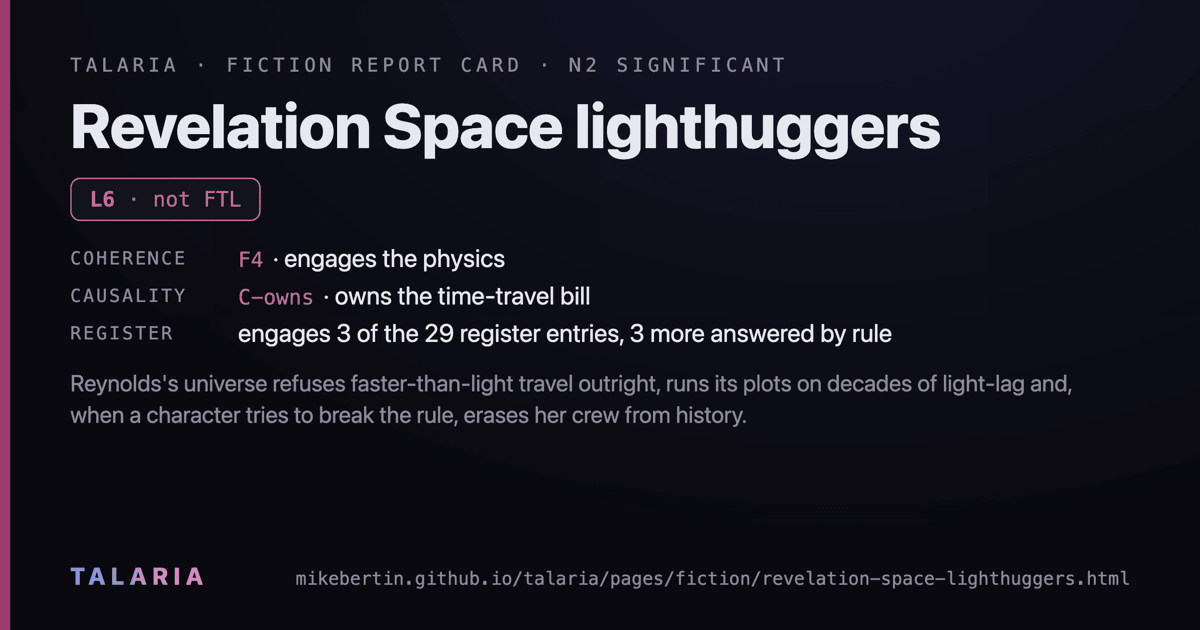
Reynolds's universe refuses faster-than-light travel outright, runs its plots on decades of light-lag and, when a character tries to break the rule, erases her crew from history.
Kind: fiction · Loophole: L6 · Notability: N2 · Coherence: F4 · Causality: C-owns · Last reviewed: 2026-09-12
The drive as depicted
The ships are lighthuggers. Reynolds's own glossary for the series defines one in a sentence: "Lighthugger: Any large space vehicle with a relativistic cruise ceiling." [HIGH] S1. His site adds that they "can get very close to the speed of light without ever exceeding it" [HIGH] S1. They are driven by Conjoiner drives, kilometres long, and crewed by Ultras who spend the voyages in reefersleep, the series' cryogenic freezing, and who are long-lived partly because of the time dilation of near-light travel [MED] S3. The series timeline places the first relativistic starship's launch from Mars orbit in 2205 [HIGH] S1. The fan wiki's figure of a one-gravity burn to about 99 percent of c in a year is not sourced to any novel and is recorded here as reconstruction [LOW] S3. Every plot in the sequence (Revelation Space, 2000; Chasm City, 2001; Redemption Ark, 2002; Absolution Gap, 2003; Galactic North, 2006; Inhibitor Phase, 2021) is shaped by the fact that crossing between systems costs years of world-time and that news arrives at light speed [MED] S3.
The instalment that defines the rule by breaking it is Redemption Ark (Gollancz, 27 June 2002). Racing Clavain to the cache weapons at Resurgam, the Conjoiner Skade pushes her prototype lighthugger Nightshade with inertia-suppressing machinery obtained through the Exordium, and attempts a jump to the machinery's "state four", a transition of the matter inside the field from tardyonic to tachyonic, that is, from slower than light to faster [MED] S3. The attempt cripples the ship, and two Conjoiners caught in the transition bubbles are not merely killed but "unravelled" backwards in time: recorded history afterwards shows them dying much earlier, and only observers near the field remember them [MED] S3. Wikipedia's summary is briefer and consistent: Skade's ship "is damaged in an attempt to exceed the speed of light" and she watches a crew member die in a collapsing bubble [HIGH] S3. The same secondary account adds that the Inhibitors refer to a similar effect erasing whole species, and that no species with the machinery uses it to go faster than light; that claim is wiki-only and unverified against the text [LOW] S3.
The Exordium is the series' one acausal channel. Reynolds's glossary: "Exordium: A secret project within Conjoiner society, concerned with acausal signalling." [HIGH] S1. The secondary account describes it as a link, through quantum superposition in Conjoiner implants, with past, future and alternate selves, each use adding static, with the implication that it cannot be used to violate causality directly because each use creates a new timeline in which the message is received [MED] S3. The Conjoiner drive and the forty cache weapons are both said to have been built on information received that way [MED] S3. Reynolds considered naming the whole setting the "Exordium universe" [HIGH] S3.
Origin and lineage
Alastair Reynolds worked for twelve years as an astronomer with the European Space Agency and left in 2004 [HIGH] S1. Revelation Space (Gollancz, 2000) was shortlisted for the Arthur C. Clarke and BSFA awards and for the Locus first-novel award and won none [HIGH] S1. He has traced the rule to an unfinished 1986 novel "set in a universe with no FTL travel" that "contained the seed of many of the ideas that ended up in RS" [HIGH] S1.
The refusal is deliberate and on the record in his own words, repeatedly. To the BBC in 2007: "I prioritise story over science but not at the expense of being really stupid about it", and he would allow FTL only for a story he could not otherwise tell, "even though I don't personally believe it is possible" [HIGH] S4. To Clarkesworld: "No faster than light travel is the obvious one. It's not nearly as restricting as might be thought." [HIGH] S3. To infinity plus: no faster than light travel or communication, and he finds this fun [HIGH] S3. To Lightspeed in 2012 he named Benford and Forward as the hard-SF influence and described writing space opera without FTL as a natural challenge [HIGH] S3. He has elsewhere put himself at 95 percent confident that FTL will turn out to be impossible [MED] S3. No statement by Reynolds on Alcubierre or any named warp proposal was found [LOW] S1 (blog search returned nothing). The series names no real proposal as the parent of its drives and fed none.
Which loophole, and why
L6, not FTL. The lighthuggers are the relativistic rocket with the engineering handwaved and the kinematics kept: near-light cruise, proper time short for the crew, world-time long for everyone else. The cousin's bill is the only one this class pays: energy on a heroic scale and the impossibility of coming home to the era you left. The series charges both without discount. The Nightshade episode is the one place the series reaches for L1, a tardyonic-to-tachyonic transition, and the catalogue's cousin there is Feinberg's tachyons, closed by LOR-2; the novel's answer to that reach is CAU-1 made literal. The Exordium is a second, quieter exception, a retrocausal signal, and its cousin is the family of retrocausal signalling proposals.
The rules it keeps
- Nothing crewed beats light. Stated as a definition (the "relativistic cruise ceiling") and held across seven novels and the short fiction [HIGH] S1.
- Time dilation is charged. Reefersleep, the Ultras' longevity, and the structure of every plot as a race between ships that cannot talk to each other except at light speed [MED] S3.
- Attempting FTL has a cost, and the cost is causal. The Nightshade attempt does not fail quietly; it removes people from history, which is the antitelephone paradox rendered as a consequence rather than a puzzle [MED] S3.
- The one acausal channel is quarantined. The Exordium is secret, noisy, dangerous and branch-creating, and the series treats it as a source of information rather than a means of travel [MED] S3.
That is F4: the work names the real constraint, the light barrier, builds its narrative architecture on the cost, and when it stages a violation it pays in the currency the register uses.
What it ignores
Very little, which is the finding. The mark is C-owns because the series both forbids FTL where it would bite and, in Redemption Ark, shows what happens when the prohibition is broken. What it does not do is say in whose frame the "unravelling" happens, or how the Exordium's new-timeline rule squares with the single history the rest of the series assumes; those are the register's CAU-4 and CAU-2 questions, and they are answered by fiat rather than by argument. No chapter number for the Nightshade attempt or the Exordium exposition was recovered for this dossier, and no novel text was quotable from a legal source; the operating claims above rest on the author's glossary and on secondary summaries as tagged.
Constraint scoring
The control group: most register entries price schemes to beat light and do not bear on a ship that never tries. Rows are N/A on that ground unless the work engages.
| Constraint | Verdict | Note |
|---|---|---|
| CAU-1 | ENGAGES | The Nightshade state-four attempt in Redemption Ark erases its victims backwards in time; the Exordium is defined by the author as acausal signalling. The series stages the antitelephone's consequence rather than ignoring it |
| CAU-2 | RULE | The in-story fact that a causality-breaking transition unwrites its own agents from history acts as a chronology-protection rule by fiat: the loop is not permitted to close |
| CAU-3 | N/A | No wormhole or warp bubble to convert; control group |
| CAU-4 | SILENT | The state-four transition and the Exordium are described without a frame; whether the unravelling is Lorentz-invariant is never asked |
| CAU-5 | SILENT | The Exordium is described as a quantum, superposition-based link to other selves; the no-communication theorem is not mentioned and the text does not say how the channel evades it |
| ENE-1 | N/A | Sublight ships of ordinary matter; control group |
| ENE-2 | RULE | The stated rule that no ship exceeds its relativistic ceiling means no gravitational time advance is ever claimed; the theorems are respected by construction |
| ENE-3 | N/A | No negative energy; control group |
| ENE-4 | N/A | Warp-class; control group |
| ENE-5 | N/A | Warp-class; control group |
| ENE-6 | N/A | Casimir not invoked; control group |
| ENE-7 | N/A | No shortcut through space; control group |
| CON-1 | N/A | No horizon; the pilot flies the ship; control group |
| CON-2 | N/A | Nothing laid along the route; control group |
| CON-3 | N/A | No tube; control group |
| STA-1 | N/A | No bubble; control group |
| STA-2 | N/A | No throat; control group |
| STA-3 | N/A | No chronology horizon of the metric; control group |
| HAZ-1 | N/A | No superluminal wall; the ships' ice-cap armour against impacts at near-c is the sublight analogue the cousin notes without a register entry |
| HAZ-2 | N/A | No horizon; control group |
| HAZ-3 | N/A | No throat; control group |
| LOR-1 | ENGAGES | The "relativistic cruise ceiling" is the definition of the ship; dilation, reefersleep and Ultra longevity are the texture of every voyage |
| LOR-2 | ENGAGES | The state-four "tardyonic to tachyonic" attempt is a tachyon drive in all but name, and it fails catastrophically; the series' verdict agrees with the register's |
| LOR-3 | RULE | The author's stated rule of no FTL travel or communication keeps every signal at or below c; the decades of light-lag that structure Redemption Ark follow from it |
| LOR-4 | N/A | Neither Scharnhorst nor OPERA; control group |
| WRP-1 | N/A | Not a warp drive; control group |
| WRP-2 | N/A | Not a warp shell; control group |
| WRP-3 | N/A | Not in the warp class; control group |
| MAN-1 | N/A | No other space is entered; control group |
Sources
- S1 Reynolds, A., "RS glossary", "Lighthuggers", "Revelation Space universe timeline", "About" and the Revelation Space release page, alastairreynolds.com. Read.
- S1 Reynolds, A., Approaching Pavonis blog, 22 April 2015 (on FTL in flap copy) and 23 September 2020 (on varying-speed-of-light physics). Read.
- S3 Reynolds, A., interviews: Clarkesworld; infinity plus; Lightspeed (November 2012); SFFWorld (March 2008); Vocal/Futurism. Read.
- S3 Wikipedia, "Revelation Space", "Redemption Ark", "Revelation Space series", "Galactic North", "Arthur C. Clarke Award", "Alastair Reynolds". Read.
- S3 Revelation Space Wiki (Fandom), "Lighthugger", "Inertia-suppression", "Exordium", "Nightshade", "Skade", "Conjoiner drive", "Cache Weapons", "Inhibitors", "Ultranauts". Wikitext read; used only where tagged.
- S3 SF Encyclopedia, "Reynolds, Alastair". Fetch refused; not relied on.
- S4 BBC News, "Call him Al not HAL", 30 April 2007 (Wayback copy). Read.