Star Trek subspace radio
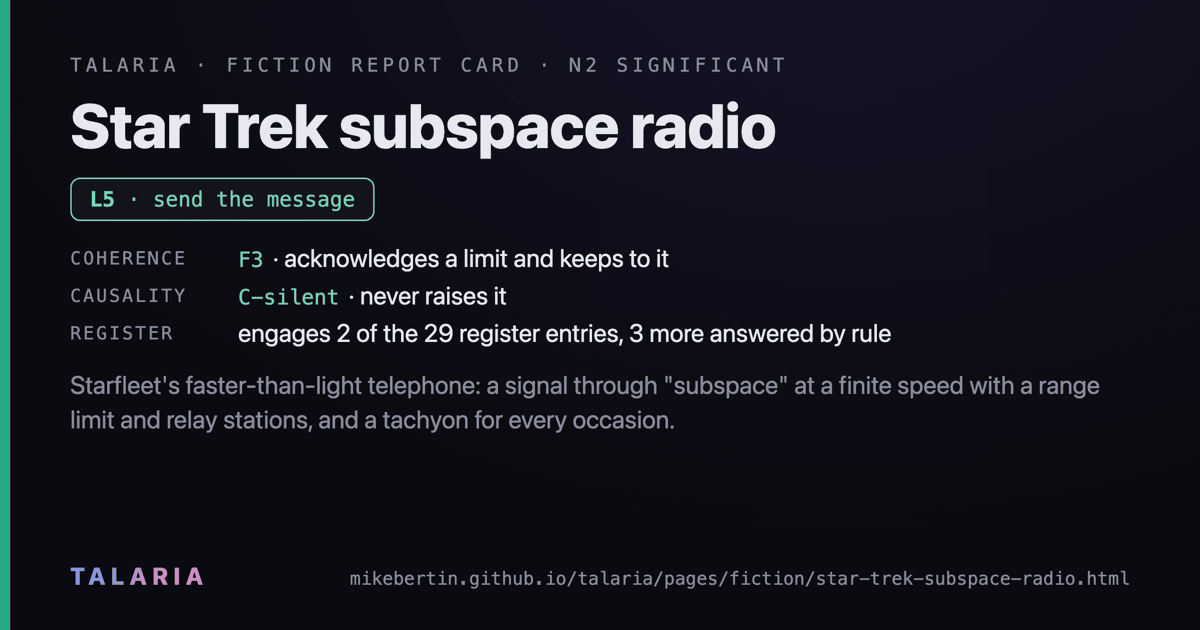
Starfleet's faster-than-light telephone: a signal through "subspace" at a finite speed with a range limit and relay stations, and a tachyon for every occasion.
Kind: fiction · Loophole: L5 · Notability: N2 · Coherence: F3 · Causality: C-silent · Last reviewed: 2026-09-12
The drive as depicted
Subspace radio is in the original series from its first weeks. "The Man Trap" has Spock correcting a "sub-space log"; "Charlie X" has Uhura "receiving a message on subspace frequency three"; "Mudd's Women" has a "Subspace radio marriage"; "Balance of Terror" has the Romulan treaty "set by sub-space radio" [HIGH] S1 (episode transcripts). What subspace is, the franchise never says on screen; Memory Alpha's own summary is that "Exactly what subspace is has never been revealed on screen", and the one gloss is La Forge's honeycomb of infinite cells in "Schisms" [MED] S3.
The rule that makes it a physics rather than a convenience is that it is finite. In "Where No One Has Gone Before" (TNG, 1987), flung 2.7 million light years, Data reports that the message to Starfleet, "traveling subspace, they should receive in fifty-one years, ten months" [HIGH] S1. That is about 52,000 c, the only number the franchise gives on screen [MED] S3. Voyager runs a whole series on the consequence: seventy thousand light years from home, the ship cannot call Starfleet at all. In "The 37's" Kim dismisses ordinary radio waves, which "only travel at the speed of light. Too slow for interstellar communications." [HIGH] S1. In "Message in a Bottle" (1998) Seven finds "a large network of relay stations. They're alien in origin, abandoned but still functioning", and Janeway sends the Doctor across "thousands of light years" through it [HIGH] S1. In "Pathfinder" (1999) Barclay's MIDAS array, the Mutara Interdimensional Deep Space Transponder Array, directs a tachyon beam at a pulsar to open "A micro-wormhole", so that a message which "would normally take years" can reach Voyager "in a matter of days" [HIGH] S1. "Life Line" adds that the alignment "only peaks every thirty two days", so "once a month" a short burst can be exchanged [HIGH] S1. Enterprise (2001) puts the infrastructure on screen: Archer deploying "the first subspace amplifier" in "Fortunate Son", and "Echo Two" launched to contact "Echo One" in "Silent Enemy" [HIGH] S1. Star Trek: The Next Generation Technical Manual (Sternbach and Okuda, 1991, chapter 8) is said to give the signal speed as warp 9.9997 and a range of about 22.65 light years before a relay is needed; the manual's text could not be opened for this dossier and those figures are recorded from press paraphrase [LOW] S4.
The tachyon is the franchise's all-purpose particle. In "Redemption II" (1991) Picard's blockade has each ship "send out an active tachyon beam to the other blockading ships" so that a cloaked vessel crossing the net is seen [HIGH] S1. In "All Good Things..." (1994) Data proposes "an inverse tachyon pulse, which could scan beyond the subspace barrier", the pulses in three eras create an "eruption of anti-time", and Picard concludes "We caused the anomaly with the tachyon pulse" [HIGH] S1. Deep Space Nine's "Explorers" has Sisko state the property outright, "since tachyons travel faster than light" [HIGH] S1. Across DS9 and Voyager tachyons detect cloaks, open Borg transwarp conduits, mark temporal rifts and, in "Pathfinder" and "Author, Author", carry the mail [HIGH] S1.
Origin and lineage
Subspace radio predates every physics in this catalogue: it is in the 1966 scripts as a working assumption, three years before Le Guin's ansible. No real proposal is named as its source, and the word "subspace" is a term of art in mathematics with no relation to the show's use. The tachyon is a real word for a real proposal: Feinberg coined it in 1967 for a Lorentz-invariant field theory of particles never below c, and the show adopted the name from the 1990s onward for anything faster than light [HIGH] S1 (see the cousin dossier). The lineage runs one way, from Feinberg's tachyons to the scripts, and the shows keep the name and drop the theory. Nothing in the franchise's communications fed a physics proposal.
Lineage: Feinberg's tachyon, outward.
Which loophole, and why
L5, send the message. The ships are the warp drive and are scored there; this dossier is the signal. Two moves are stacked. The first is subspace itself, another domain through which a signal goes faster than through ours, which is the register's MAN-1 case: a separate space with laxer rules has no counterpart in physics, and the bulk shortcuts that do exist look to a brane observer like FTL with all of CAU-1's consequences. The second, in Pathfinder and its sequels, is a wormhole carrying the signal, an L3 move whose cousin is Morris and Thorne, with its bill of exotic matter at the throat. The tachyon, where it is the carrier, is L1 and its cousin is Feinberg, whose bill is that the particle is an instability and, if it were not, a time machine. The physics cousin for the class as a whole is the entanglement radio: the same wish, an instantaneous link, in different costume, closed there by the no-communication theorem and priced by CAU-1.
The rules it keeps
- Finite speed. Data's figure; Voyager's isolation; the relay network; the monthly window. The signal is fast but not instantaneous, and the shows return to the limit whenever a plot needs it [HIGH] S1.
- Range and infrastructure. Amplifiers dropped behind the Enterprise, relay stations with a Starfleet specification, an alien network that works only while the Hirogen allow it, an array that needs a pulsar [HIGH] S1. The system is built, not assumed.
- Consistency is uneven. Memory Alpha notes that a 2260s Neutral Zone message is treated as slow while a century later the same distance is real time, and the TOS "three weeks" it cites was not found in the transcript [LOW] S3.
F3: the work states a limitation, finite speed with range, and applies it consistently enough to build a seven-season series on it; the tachyon episodes are F1 handwaves inside an F3 system.
What it ignores
For subspace radio proper, the message to the past never comes up; the signal has a speed but no one asks in whose frame, and ships at warp exchanging subspace messages are the two-transmitter configuration every week. C-silent. The franchise does own the implication for other channels: in "Eye of the Needle" a micro-wormhole delivers a transmission to a Romulan twenty years in the past and Tuvok spells out that the rift is "not just in space but in time", with the timeline consequences argued on screen; "Timeless" has a message "from the future" and Janeway's advice on paradoxes, "Don't even try"; "All Good Things..." calls its own tachyon loop a paradox [HIGH] S1. Those are wormhole and temporal-transmitter episodes, not the radio, and the mark follows the radio.
Constraint scoring
| Constraint | Verdict | Note |
|---|---|---|
| CAU-1 | ENGAGES | "Eye of the Needle" sends a subspace transmission through a micro-wormhole to twenty years in the past and argues the consequences; "Timeless" receives a message from the future; "All Good Things..." names its tachyon loop a paradox. Ordinary subspace radio is never asked the question |
| CAU-2 | SILENT | No rule of the fiction prevents the loops it stages; temporal paradoxes are resolved by plot, and Janeway's "Don't even try" is the nearest thing to a statement |
| CAU-3 | N/A | A communications device; the wormhole of "Pathfinder" is not carried on a round trip |
| CAU-4 | SILENT | A signal with a definite speed through a medium implies the medium's rest frame; the shows never say what it is or whether subspace has one |
| CAU-5 | N/A | No entanglement is claimed; subspace radio is treated as electromagnetic signalling in another domain |
| ENE-1 | N/A | No stress-energy is engineered for the radio |
| ENE-2 | N/A | No gravitational time advance is claimed for the signal; the micro-wormhole of "Pathfinder" is a plot device without a stated geometry |
| ENE-3 | N/A | No negative energy to bound |
| ENE-4 | N/A | Warp-class; scored in the warp dossier |
| ENE-5 | N/A | Warp-class |
| ENE-6 | N/A | Casimir not invoked |
| ENE-7 | N/A | The "Pathfinder" wormhole would need achronal ANEC violation to beat the outside route; the episode gives it no physics to score |
| CON-1 | N/A | No horizon for a signal |
| CON-2 | RULE | Amplifiers, relay stations and the MIDAS array are laid at sublight along the route before the signal can use them; the shows make communication an infrastructure problem, which is the shape of the bootstrap |
| CON-3 | N/A | No tube |
| STA-1 | N/A | No bubble |
| STA-2 | N/A | No throat is engineered on screen; the micro-wormhole appears and closes on cue |
| STA-3 | N/A | No chronology horizon of the metric |
| HAZ-1 | N/A | Nothing swept up by a signal |
| HAZ-2 | N/A | No horizon |
| HAZ-3 | N/A | No throat traversed by a person |
| LOR-1 | N/A | No massive body pushed to c by the radio; the ships are scored elsewhere |
| LOR-2 | ENGAGES | Tachyons are named and used weekly, and Sisko states their defining property on screen; the franchise asserts as a working tool the particle the register records as an instability |
| LOR-3 | RULE | The signal has a stated finite speed through a stated other medium, with range limits and relays; the rule answers the front-velocity constraint by leaving ordinary space rather than by beating it |
| LOR-4 | N/A | Neither Scharnhorst nor OPERA |
| WRP-1 | N/A | Not a warp drive; see the warp dossier |
| WRP-2 | N/A | Not a warp shell |
| WRP-3 | N/A | Not in the warp class |
| MAN-1 | RULE | Subspace is the stated separate domain that carries the signal; the register says such a space has no physical counterpart and that bulk shortcuts are FTL with CAU-1's consequences unless the bulk supplies a frame |
Sources
- S1 Episode transcripts at chakoteya.net, fetched and read: TOS "The Man Trap", "Charlie X", "Mudd's Women", "Balance of Terror", "Arena", "The Squire of Gothos"; TNG "Where No One Has Gone Before", "Redemption II", "All Good Things...", "Timescape", "Parallels", "The Pegasus"; DS9 "Explorers", "Apocalypse Rising", "The Sons of Mogh"; VOY "Eye of the Needle", "The 37's", "Message in a Bottle", "Hunters", "Timeless", "Pathfinder", "Life Line", "Inside Man", "Author, Author", "Endgame"; ENT "Fortunate Son", "Silent Enemy", "Regeneration".
- S2 Sternbach, R. and Okuda, M., Star Trek: The Next Generation Technical Manual (Pocket Books, 1991), chapter 8. Not opened; figures recorded from press paraphrase and tagged accordingly.
- S3 Memory Alpha, "Subspace communication", "Subspace", "Subspace relay station", "Tachyon", "Subspace amplifier", "Star Trek: The Next Generation Technical Manual". Wikitext read.
- S4 SlashFilm, "What Is Subspace Communication On Star Trek?", 14 June 2026, for the Technical Manual figures. Read.