Starfield (2023): the grav drive
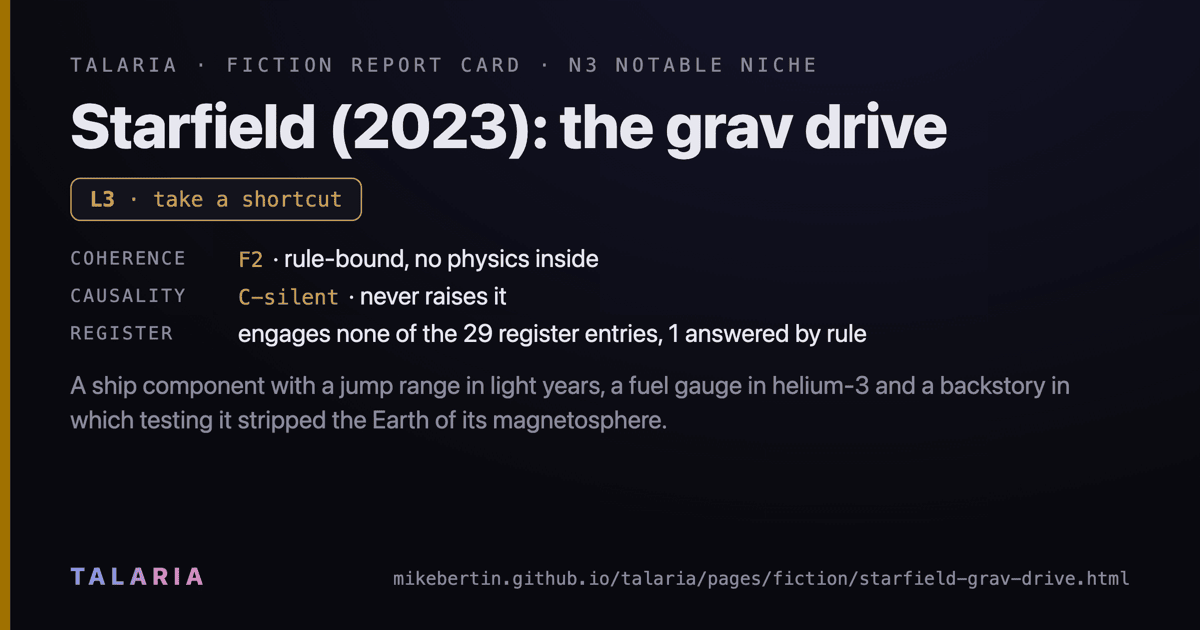
A ship component with a jump range in light years, a fuel gauge in helium-3 and a backstory in which testing it stripped the Earth of its magnetosphere.
Kind: fiction · Loophole: L3 · Notability: N3 · Coherence: F2 · Causality: C-silent · Last reviewed: 2026-09-12
The drive as depicted
Starfield (Bethesda Game Studios, directed by Todd Howard, released September 2023) is set in 2330 in the Settled Systems, a region of roughly a hundred star systems within about fifty light years of Sol. Every ship the player flies has a grav drive, and every trip between systems is a "grav jump": the player picks a destination on the star map, the drive spools for a few seconds while the ship is vulnerable, a distortion spreads from the hull and the ship is gone, arriving at the destination system with no transit shown [HIGH] S1. The drive is a swappable module with numbers. Its "grav jump thrust" sets the maximum jump in light years, reduced by the mass of the ship it is bolted to; no drive in the game exceeds thirty light years in a single jump, so longer trips are chains of jumps through intermediate systems; and each jump burns helium-3 fuel in proportion to distance [HIGH] S1. The drive also supplies the ship's artificial gravity, so a ship with its grav drive powered down floats [HIGH] S1. The in-game name is the Graviton Loop Array; a longer name, Graviton Loop Field Array, was given by Howard in interview [MED] S3.
Nothing in the game states what the drive does to space. The visual is a bending of the starfield around the ship and a flash; the word is "grav"; that is all. The lore does something else. In the main quest "Unearthed" the player enters the ruined NASA launch tower on Earth and reads Dr Victor Aiza's terminals: an artefact recovered from Mars, a prototype drive connected to it and a supercomputer, and notes recording that testing of early drives on Luna was destabilising Earth's magnetosphere; a final note shows Aiza knew and pressed on [HIGH] S1. The wider timeline the game gives is that the drive was invented in the 2130s, that the magnetosphere collapsed in 2203 and Earth was abandoned, and that the perfected drive is what let humanity leave [MED] S3 (in-game dates as compiled by the wikis; the Aiza notes are read directly). The game's two Starborn guides then argue, in dialogue, whether the drive was worth the Earth [HIGH] S1. That is the one cost of faster-than-light travel the game prices, and it is priced as backstory rather than as a running constraint.
The Starborn, and the player once they become one, jump between universes through the Unity; that is a different mechanism with a different cost and outside this dossier, except to note that the artefacts that power it are also the origin of the drive [HIGH] S1.
Origin and lineage
Bethesda's first new setting in decades, announced in 2018 and released in 2023, with Howard as director and executive producer [HIGH] S3. The studio described its aim as "NASA-punk", a near-future look with visible engineering, and the grav drive fits that: it is a part with a stat block, not a mystery. No real proposal is named in the game. "Graviton" is the only physics word attached, and it is used as it is in Event Horizon, as a noun that sounds like an explanation. The catalogue carries that film separately (Event Horizon), and it is on record as an influence on the game's tone [MED] S3; whether the drive's name follows the film's is not sourced and not claimed. The lore device of a drive that ruins its home world is the game's own.
No forward influence on physics is claimed.
Which loophole, and why
L3, take a shortcut. A grav jump is a point-to-point displacement with no transit, no lane and no other space named; the ship is in one system, spools, and is in another. There is no fast motion through ordinary space (in-system flight is slow and the game's "boost" is chemical) and no separate hyperspace with rules of its own. The jump is a fold with a range limit, which puts it in the L3 group beside the Macross fold and the Battlestar jump rather than with warp drives or hyperspace lanes.
The cousin is Morris and Thorne 1988, the traversable wormhole made on demand, with the Kerr interior passage as the gravitational-collapse alternative the word "grav" gestures at. The Morris–Thorne bill is negative energy at the throat, a far mouth delivered in advance at ordinary speed and a time machine on any use that beats light; the Kerr bill is a black hole of tens of thousands of solar masses and a route through built-in closed timelike curves. The grav drive pays the delivery bill without the game naming it: the Settled Systems are reached by a chain of jumps because no single jump exceeds thirty light years, which is infrastructure by another name. It pays nothing else. A jump opened from the departure end to bare coordinates is the object CON-2 says cannot be aimed, and the game aims it every time.
The rules it keeps
- Range is a number, set by drive power and reduced by ship mass, and no single jump exceeds thirty light years [HIGH] S1.
- Fuel is helium-3, consumed per jump in proportion to distance, and a ship without fuel cannot jump [HIGH] S1.
- The drive spools before it fires and the ship can be attacked meanwhile; more power shortens the spool [HIGH] S1.
- The drive is also the ship's gravity, and loses that function when unpowered [HIGH] S1.
- The technology had a cost: early testing destroyed Earth's magnetosphere, stated in Aiza's notes and argued over by the Starborn [HIGH] S1.
These rules are consistent and enforced by the game's systems; the range and fuel rules shape every trip. They have no physical content: nothing says what a jump does, why range scales with mass or why a drive that folds space also makes gravity. The magnetosphere backstory is a cost stated once and then done with. F2 by the grading scheme, rule-bound without physics. The drive would reach F3 if the Earth backstory were a limitation applied to current travel; it is a history lesson, and current jumps cost fuel only.
What it ignores
Time. A jump of thirty light years is instantaneous by the player's clock and by the destination's, since the game's universal calendar advances only with in-system travel and rest, and no character in any faction ever asks whether a jump can arrive before it left or what a jump means for the order of events between systems [HIGH] S1. There is no preferred frame, no simultaneity rule and no consequence drawn. C-silent. The game's multiverse mechanic is not an exception: the Unity moves the player between universes, not between times.
The register's other questions, what a grav jump does to space, what holds anything open, what the energy budget of a thirty-light-year fold is and how a jump to bare coordinates is aimed, are unasked. The only engagement is the magnetosphere, which is an engineering-side-effect story with no physical mechanism offered.
Constraint scoring
Every entry in the register, one row each, verdict from the fiction vocabulary, with a note that says where in the work the engagement or rule occurs.
| Constraint | Verdict | Note |
|---|---|---|
| CAU-1 | SILENT | A thirty-light-year jump is an FTL displacement and the game never asks in which frame it is instantaneous; the universal calendar simply does not advance during a jump. |
| CAU-2 | SILENT | No closed causal curves are contemplated; chronology protection is not in the game's vocabulary. |
| CAU-3 | SILENT | Ships jumping between systems in relative motion is the moving-mouth configuration of the entry; never raised. |
| CAU-4 | SILENT | No preferred frame is offered; the Settled Systems share a calendar on screen without anyone saying why. |
| CAU-5 | N/A | No entanglement or quantum signalling; the game's artefacts and the Unity are not offered as communication. |
| ENE-1 | SILENT | What a grav jump does to space, and what stress-energy it needs, is never stated; the drive's power is a number with no units of physics attached. |
| ENE-2 | SILENT | Every jump delivers a time advance over the light path and the negative energy Olum's theorem requires is never named; the fuel is helium-3, which is positive energy. |
| ENE-3 | SILENT | No negative energy is admitted, so the quantum inequalities are not engaged. |
| ENE-4 | N/A | Warp-bubble pocket geometry; a grav jump is a fold, not a bubble. |
| ENE-5 | N/A | The Natário-class NEC result does not bear on a point-to-point jump. |
| ENE-6 | SILENT | No source of negative energy is named; the Casimir floor is not approached. |
| ENE-7 | SILENT | A jump that connects two systems without crossing the space between is a handle of the kind topological censorship forbids under the averaged null energy condition; unaddressed. |
| CON-1 | N/A | Warp-bubble horizons; no bubble. |
| CON-2 | SILENT | Jumps are aimed at bare coordinates from the departure end with nothing laid at the destination, which is the bootstrap the entry forbids; the chained-jump structure of the Settled Systems is infrastructure in effect but the game never argues it so. |
| CON-3 | N/A | No Krasnikov tube. |
| STA-1 | N/A | Semiclassical instability of warp bubbles; not applicable. |
| STA-2 | SILENT | What holds a jump open is never described; the drive spools, flashes and is done. |
| STA-3 | SILENT | No time machine is constructed, so no chronology horizon; the game does not reach the question. |
| HAZ-1 | N/A | Warp-bubble particle sweep; no bubble. |
| HAZ-2 | N/A | Hawking flux inside a warp bubble; not applicable. |
| HAZ-3 | SILENT | Crews jump unharmed on every trip and nothing is said about stresses on bodies or hulls; the tidal bound is unaddressed. The magnetosphere damage is to the planet the drive was tested near, not to anything that jumps. |
| LOR-1 | RULE | In-system flight is slow and jumps are discrete displacements; nothing is accelerated to light speed, which is the L3 answer to the entry and is built into the game's two-mode travel. |
| LOR-2 | N/A | No tachyons. |
| LOR-3 | N/A | No wave in a medium. |
| LOR-4 | N/A | Neither the Scharnhorst effect nor OPERA bears on a jump drive. |
| WRP-1 | N/A | Not a warp drive; the game shows no bubble, no contraction and no expansion, only a fold and a flash. |
| WRP-2 | N/A | The shell classification is for warp metrics. |
| WRP-3 | N/A | No positive-energy warp claim. |
| MAN-1 | SILENT | The Unity and the Starborn imply other universes reached through the artefacts, and the drive itself was derived from an artefact; the game never connects the jump to another dimension or bulk, and gives the other universes no physics. |
Sources
- S1 Starfield (Bethesda Game Studios and Bethesda Softworks, 2023). Ship building and grav drive module stats; the grav jump sequence; the main mission "Unearthed" and Dr Victor Aiza's terminal notes at the NASA launch tower; the Starborn dialogue after it.
- S3 Starfield Wiki (starfield.fandom.com), articles "Grav Drive" and "Unearthed", and Starfield Wiki (starfieldwiki.net), article "Victor Aiza", consulted 2026-09-12 for the module rules, the invention and collapse dates and the summary of the terminal notes.
- S3 Todd Howard, Kinda Funny Games podcast, 22 June 2023, for the name "Graviton Loop Field Array", as cited by the wiki above.
- S3 Wikipedia, "Event Horizon (film)", for the game's citation of the film as an influence, consulted 2026-09-12.