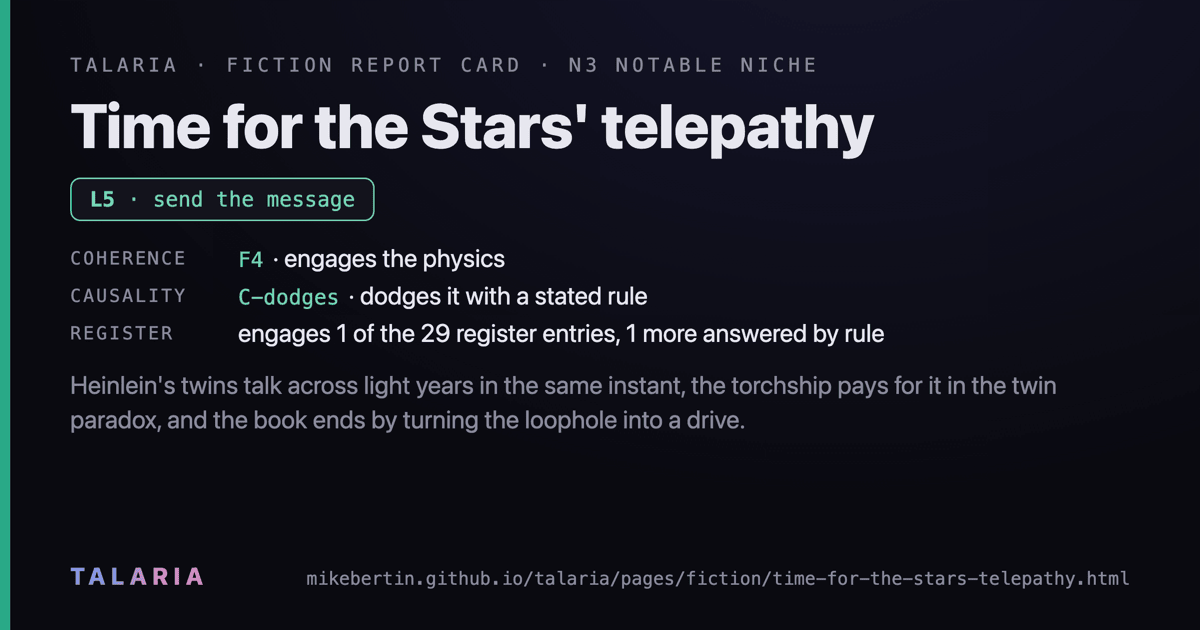
Time for the Stars' telepathy
Heinlein's twins talk across light years in the same instant, the torchship pays for it in the twin paradox, and the book ends by turning the loophole into a drive.
Kind: fiction · Loophole: L5 · Notability: N3 · Coherence: F4 · Causality: C-dodges · Last reviewed: 2026-09-12
The drive as depicted
Time for the Stars (Scribner's, August 1956) is narrated by Tom Bartlett, one of a pair of identical twins recruited by the Long Range Foundation because some twins can talk to each other by telepathy, and telepathy has been measured to be faster than light [HIGH] S1. The measurement is given in chapter II: a twin sent to Ganymede while the other stayed in Buenos Aires, with simultaneous radio and telepathic messages, and "The telepathic message always beat the radio message by about forty minutes."; the signal was as strong at half a billion miles as at home and "doesn't pay attention to the inverse-square law either" [HIGH] S1. Tom ships out on the torchship Lewis and Clark, the "Elsie", a mass-converter vessel whose torch "spits the mass out as radiation at the speed of light", boosting at 124 percent of a gravity to reach about five percent of c in two weeks and "the better part of a year" to approach light speed [HIGH] S1 (chs. VI, VIII, XIII). The twins are the ship's radio.
Chapter VIII, "Relativity", is where the book argues with physics. Dr Babcock, the ship's relativist, has the twins tick against a metronome to measure the lag of the link with sound-speed and feedback delays removed, and says the aim is to find out what the word "simultaneous" means; since Einstein, "'simultaneous' and 'simultaneity' have been dirty words to physicists", "We chucked the very concept, denied that it had meaning", and then the mind readers came along and kicked it over [HIGH] S1. O'Toole's result is that the twins are "still doing it in nothing flat", with measured time negative as often as positive and never larger than the observational error [HIGH] S1. Babcock states the Lorentz time formula in words, notes that the mass increase is already used in the torch, and says that time dilation itself is unproven until now [HIGH] S1. Chapter XI, "Slippage", charges the cost: at 99 percent of c the ratio is seven to one, at peak two weeks aboard are ten years at home, and telepathy may be instantaneous but "brains are flesh and blood, and thinking takes time" [HIGH] S1. By chapter XIII seventy-odd Greenwich years have passed against less than four for Tom, and his telepathic partner is Vicky, his great-grandniece [HIGH] S1.
Then the loophole becomes a drive. Chapter XIII cites a monograph on "Certain Aspects of Irrelevance", holding that what the telepaths do is irrelevant to space-time; chapter XVI, "Just a Mathematical Abstraction", has the Foundation ship Serendipity reach Beta Ceti, sixty-three light years out, twenty-nine days after notice, fit a "null-field generator" to the Elsie, and explain that the telepaths' proof that "'simultaneity' was an admissible concept" led to the theory: "An irrelevant ship, of course. One that is faster than light." [HIGH] S1. The book ends with Tom home and marrying Vicky [HIGH] S3.
Origin and lineage
Robert A. Heinlein published the novel with Scribner's in 1956 as one of his juveniles [HIGH] S3. The structure is the twin paradox of special relativity, which Wikipedia traces to Langevin's 1911 thought experiment, and Patterson's biography records that the twins were the seed of the book [MED] S3. The torchship is Heinlein's recurring total-conversion drive [HIGH] S1. No real proposal for instantaneous signalling is named; telepathy is the premise. The book's physicist argues explicitly against relativity's rejection of absolute simultaneity, and chapter XIII says the concept of simultaneity "was forcing a complete new look at physics" [HIGH] S1. No statement by Heinlein outside the novel on this choice was found; his letters in Grumbles from the Grave mention only finishing and cutting the book [MED] S1. Panshin's Heinlein in Dimension notes that the FTL ending made the book impossible to serialise [MED] S3. The book's descendants are the ansibles, but neither Le Guin nor Card cites Heinlein, and no influence is asserted here.
Which loophole, and why
L5, send the message, with an L6 ship alongside and a jump to FTL travel in the last two chapters. The telepathic link is the pure case of the class: a channel with no carrier, asserted and measured to be simultaneous. The physics cousin is the entanglement radio, the one real candidate for a carrierless instantaneous correlation, and the cousin's bill is exact: any locally readable signal needs nonlinear quantum mechanics, and an instantaneous signal with no fixed frame is the antitelephone. Heinlein's answer is the register's CAU-4 escape, taken openly: Babcock's argument is that simultaneity is real after all, which is to say that there is a frame in which the twins' ticks coincide. The Lorentz-violating frameworks dossier prices that hatch: special relativity stops being the whole story, and something must pick the frame. The book pays that price in full by rewriting physics, and the null-field ship is the receipt. That ship is a second loophole, L3 or L4 by its description, and is not scored here.
The rules it keeps
- The torchship obeys relativity. The Lorentz formula is stated, the ratios are computed at each speed, the years at home are counted, and Tom never comes home to the Earth he left [HIGH] S1.
- Telepathy is measured, not asserted. The Ganymede experiment and Babcock's tick tests are lag measurements with named error bars [HIGH] S1.
- The consequence is followed. If simultaneity is real, physics has been wrong to discard it; the book says so through Babcock and then builds the null-field drive on the new theory, which is the right shape for the inference even though the theory is left blank [HIGH] S1.
- The link has a cost of its own. Slippage: the twins' subjective rates diverge with the clocks, and conversation becomes hard [HIGH] S1.
F4: the work names a real constraint, the relativity of simultaneity, argues with it in the physicist's own voice, and pays for the ship in the currency that constraint sets.
What it ignores
The message to the past. Babcock's absolute simultaneity needs a frame, and the two ends of the link are in relative motion at 99 percent of c for years; in the register's terms that is the antitelephone unless the frame is specified, and the book never says whose "now" the telepathy uses. C-dodges rather than C-silent, because a stated rule, that the link is genuinely simultaneous and physics must accommodate it, is the preferred-frame escape in all but name. The null-field ships arrive with a name and a speed but no mechanism, and the trip times, a critic notes, do not all match the stated accelerations [LOW] S5. Never addressed as of 2026-09-12.
Constraint scoring
| Constraint | Verdict | Note |
|---|---|---|
| CAU-1 | SILENT | One twin on a torchship at 99 percent of c, one at home, an instantaneous link between them for years: the two-transmitter configuration, with no mention of a reply preceding a question |
| CAU-2 | N/A | No geometry; a signal, not a closed curve of the metric |
| CAU-3 | N/A | No wormhole or warp bubble; the relativistic leg is present without a device |
| CAU-4 | RULE | Babcock's assertion in ch. VIII that simultaneity is real and physics wrong to discard it is the preferred-frame escape stated as a rule; the book pays the price the register names by rewriting physics into "irrelevance" in chs. XIII and XVI |
| CAU-5 | N/A | Telepathy names no quantum correlation; the theorem's premises are absent, though the wish is the entanglement radio's |
| ENE-1 | N/A | No stress-energy |
| ENE-2 | N/A | No gravitational time advance; the ship is sublight and the link is carrierless |
| ENE-3 | N/A | No negative energy |
| ENE-4 | N/A | Warp-class |
| ENE-5 | N/A | Warp-class |
| ENE-6 | N/A | Casimir not invoked |
| ENE-7 | N/A | No topology or shortcut for the link; the null-field ships are not explained enough to score |
| CON-1 | N/A | No horizon; the torchship's crew fly it |
| CON-2 | N/A | Nothing laid along the route; the link needs only the twins |
| CON-3 | N/A | No tube |
| STA-1 | N/A | No bubble |
| STA-2 | N/A | No throat |
| STA-3 | N/A | No chronology horizon |
| HAZ-1 | N/A | Nothing swept up |
| HAZ-2 | N/A | No horizon |
| HAZ-3 | N/A | No throat |
| LOR-1 | ENGAGES | The Lorentz formula is stated by the ship's relativist, the ratios are tracked chapter by chapter, and the twin paradox is the book's structure: Pat ages to death while Tom stays young enough to marry his great-grandniece |
| LOR-2 | N/A | No tachyon |
| LOR-3 | N/A | The link is not a wave; the Ganymede test compares it against radio and finds no lag at all |
| LOR-4 | N/A | Neither Scharnhorst nor OPERA |
| WRP-1 | N/A | Not a warp drive |
| WRP-2 | N/A | Not a warp shell |
| WRP-3 | N/A | Not in the warp class |
| MAN-1 | N/A | The telepathic link invokes no other space; the null-field ships make space "a mathematical abstraction", too little to score |
Sources
- S1 Heinlein, R. A., Time for the Stars (Scribner's, 1956). Chapters II, VI, VIII, XI, XIII and XVI read from an unauthorised online reprint and cross-checked in wording against Open Library search-inside snippets of the Gollancz 1973, VGSF 1991, Tor 2007 and Ace editions.
- S1 Heinlein, R. A., Grumbles from the Grave (Ballantine, 1989), letters of December 1955 on completing the book. Snippets.
- S2 Patterson, W. H., Robert A. Heinlein: In Dialogue with His Century, vol. 2 (Tor, 2014), on the twins as the book's origin. Snippet only.
- S3 Panshin, A., Heinlein in Dimension (1968), section on 1956, at panshin.com. Read.
- S3 Wikipedia, "Time for the Stars"; ISFDB title record. Read.
- S3 Brown, A., "Of Relatives and Relativity", Reactor, 14 May 2024; Walton, J., "The Identical Twin Paradox", Reactor, 26 October 2009. Read.
- S5 Nicoll, J. D., review, on the trip times and accelerations. Read.