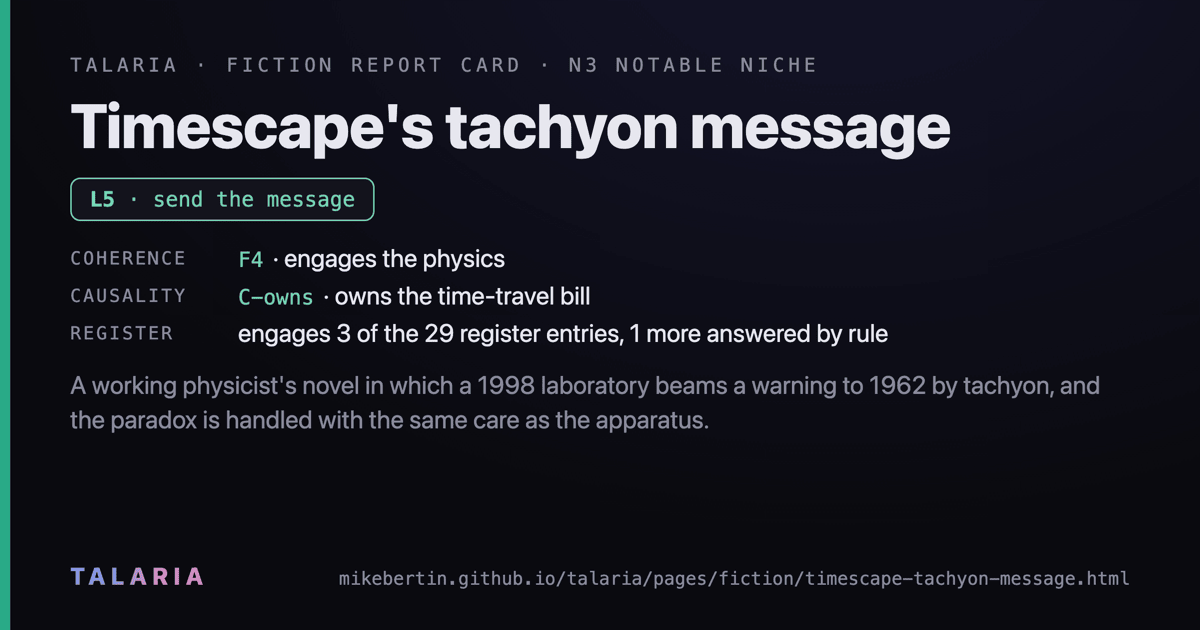
Timescape's tachyon message
A working physicist's novel in which a 1998 laboratory beams a warning to 1962 by tachyon, and the paradox is handled with the same care as the apparatus.
Kind: fiction · Loophole: L5 · Notability: N3 · Coherence: F4 · Causality: C-owns · Last reviewed: 2026-09-12
The drive as depicted
Timescape (Simon and Schuster, 1980) runs on two clocks. In a 1998 Cambridge sliding into ecological collapse, John Renfrew and Gregory Markham, with the administrator Ian Peterson, aim a beam of tachyons at the position in space that the Earth occupied in 1962 and 1963, since the solar system has moved in the interval; the message is Morse code, describing the chemistry of the algal blooms that are killing the oceans [HIGH] S3. In La Jolla in 1962 the young physicist Gordon Bernstein finds structured noise in a nuclear-resonance experiment on indium antimonide, and the noise resolves into the message [HIGH] S3. The same signal is picked up at Columbia, which the author has said was a nod to Gerald Feinberg, the tachyon's inventor, who worked there [HIGH] S1. The senders deliberately garble what they transmit, in "staccato sentence fragments and jumbled letters", so as to give 1962 enough to start research without solving the problem outright, and thereby to avoid the grandfather paradox [HIGH] S3.
The physics is set out in one long conversation between Markham and Peterson in a Cambridge pub, transcribed in full by a physicist reader and quoted here from that transcript; the chapter number was not recovered [HIGH] S1. Markham starts from Wheeler and Feynman's time-symmetric description of light, in which every emission has a retarded and an advanced wave and the advanced waves normally cancel against the response of the rest of the universe. Tachyons, he says, escape the cancellation because they are not absorbed the way radio waves are; "Every theory has a hidden assumption." He names the parents: "Some guys named Feinberg and Sudarshan imagined tachyons decades ago", with imaginary mass, never brought to rest [HIGH] S1. Then the paradox. Take a switch that will be turned off by a message from the future which is only sent if the switch is on: Markham's answer is that there is no switch with two settings, the switch hangs up in the middle, and "Cause and effect mean nothing in this loop. There are only events." [HIGH] S1. The rule that follows is stated as strategy: you can change the past provided you do not try to make a paradox; if you try, the experiment hangs in the in-between state; so send enough to start research and no more [HIGH] S1. Markham is careful to call all this "an interpretation of the mathematics" [HIGH] S1.
The ending does what the pub conversation says it cannot: a paradox is made. Bernstein's published results lead, through a chain of events, to a bystander interrupting the assassination of President Kennedy, and the novel treats this as the point at which the timeline branches; contact with the original 1998 ends and that 1998 continues into collapse [HIGH] S3. Whether the text names Everett or many-worlds was not established [LOW] S3.
Origin and lineage
Gregory Benford is a plasma physicist, then at Lawrence Radiation Laboratory, Livermore, later at Irvine. The lineage runs from paper to novel and is documented in the author's own hand. Benford, Book and Newcomb, "The Tachyonic Antitelephone", Physical Review D 2, 263 (1970), received 23 June 1969, reconsiders the detection of faster-than-light particles "in relation to Tolman's paradox" and concludes that such experiments "must either yield negative results or give rise to causal contradictions" [HIGH] S1 (abstract, full text read from a scanned copy). The paper shows that the reinterpretation principle of Bilaniuk, Deshpande and Sudarshan, by which a negative-energy tachyon going backwards is a positive-energy tachyon going forwards, does not refute Tolman; that only a modulated beam carries a paradox; and that with two emitter-detector pairs at rest a reply can arrive before the question, illustrated by Shakespeare receiving Hamlet from Bacon. Its principle is that "the direction of information transfer is necessarily a relativistic invariant" [HIGH] S1. The register carries the paper as CAU-1.
Benford's essay "Old Legends" (in New Legends, ed. Bear, 1995) links the two directly: "With Bill Newcomb and David Book, I published in Physical Review a paper", "the causality problem remained", "So I framed the issue using tachyons", and "Because of Feinberg I later set part of my tachyon novel at Columbia" [HIGH] S1. His Contemporary Authors essay says the same: the underpinning of the novel "was a scientific paper on tachyons", and adds that he wrote a first approach in 1970 and a second, "Cambridge, 1:58 A.M." (Epoch, 1975), in which the novel's English setting arrived [HIGH] S1. He also records that by the late 1970s he thought tachyons unlikely, and that Feinberg was pleased that his physics "had spawned a novel" [HIGH] S1. The novel won the Nebula for 1980, the 1981 John W. Campbell Memorial Award and the BSFA Award for 1980 [HIGH] S3.
Lineage: Feinberg's tachyon, outward; Tolman's paradox to Timescape.
Which loophole, and why
L5, send the message. No one travels; a modulated tachyon beam carries text, and the destination is a place in the past. The physics cousin is Feinberg's tachyons, scored K0 in this catalogue, and the bill there is the whole of the novel's licence: a Lorentz-invariant tachyon has no fixed speed in any frame, so a modulated beam is the antitelephone of CAU-1 the moment two transmitters move relative to each other, and the field itself is an instability rather than a courier (LOR-2). Benford is the co-author of the first of those results, and the novel is built on knowing it: rather than dodge the paradox with a frame, it accepts the loop and asks what a consistent loop looks like. The second cousin is the family of retrocausal signalling proposals, because Markham's Wheeler-Feynman framing is the same absorber-theory language those proposals use.
The rules it keeps
- The signal must be aimed at where the Earth was. The transmitter targets the 1962 position of the Earth, allowing for the solar system's motion; the novel does not let the past be reached by pointing at the present [HIGH] S3.
- The carrier is a named particle with a named theory. Feinberg and Sudarshan are cited by name, the imaginary mass and the impossibility of rest are stated, and the mechanism of detection, a perturbed nuclear resonance, is a real laboratory technique [HIGH] S1.
- Paradox is priced. The stuck-switch argument is the novel's central rule: a loop that would contradict itself cannot complete, so the senders ration what they send [HIGH] S1.
- The rule is then broken, and the break has a consequence. When a paradox is forced, the story does not fudge; it splits, and the senders lose their line to the past [HIGH] S3.
That is F4 and the cleanest F4 in the L5 class: the work names the real constraint, is written by one of the people who published it, and builds both its method and its ending on the cost.
What it ignores
The mark is C-owns: the novel admits that a tachyon message is a message to the past and makes that the subject. What it leaves unargued is how the branch happens. Markham's account, which is self-consistency plus a stuck switch, does not produce a second timeline; the ending does, and the two are not reconciled on the page as far as the fetched text shows [MED] S3. The novel also does not name the second-order problem in its own author's paper, that two transmitters in relative motion make a loop without any future sender, because both ends of its channel are at rest on Earth; the fixed-endpoint escape that CAU-1 lists is taken in practice without being named. No physicist's published critique of the novel's physics was found, and the SF Encyclopedia's judgement that Benford "was the first to do this with some care" is the standing assessment [MED] S3.
Constraint scoring
| Constraint | Verdict | Note |
|---|---|---|
| CAU-1 | ENGAGES | The novel is the antitelephone written by its co-author: a modulated tachyon beam to the past, Tolman's paradox discussed by name in the pub scene, and the message rationed to avoid contradiction |
| CAU-2 | ENGAGES | Markham's stuck-switch rule is a chronology-protection argument in miniature: the loop that would close on a contradiction hangs in an intermediate state instead. The ending's branch is the alternative outcome |
| CAU-3 | N/A | No wormhole or warp bubble; the device is a beam in flat space |
| CAU-4 | RULE | Both transmitter and receiver sit on Earth, so the channel has fixed endpoints in one frame, which is one of the escape hatches the register lists; the novel takes it without naming it |
| CAU-5 | N/A | No entanglement is claimed; the carrier is a propagating particle |
| ENE-1 | N/A | No stress-energy engineering; a particle beam |
| ENE-2 | N/A | No geometry is altered; the time advance is kinematic, which the theorems do not reach |
| ENE-3 | N/A | No negative energy density to bound |
| ENE-4 | N/A | Warp-class |
| ENE-5 | N/A | Warp-class |
| ENE-6 | N/A | Casimir not invoked |
| ENE-7 | N/A | No topology, no shortcut |
| CON-1 | N/A | No horizon, nothing piloted |
| CON-2 | N/A | No route to lay; the beam is aimed, and aiming at the Earth's past position is the novel's version of the problem |
| CON-3 | N/A | No tube |
| STA-1 | N/A | No bubble |
| STA-2 | N/A | No throat |
| STA-3 | N/A | No chronology horizon of the metric, though the stuck switch plays its role |
| HAZ-1 | N/A | Nothing swept up |
| HAZ-2 | N/A | No horizon |
| HAZ-3 | N/A | No throat |
| LOR-1 | N/A | No massive body is pushed to c; the tachyon was never below it, which is the hatch LOR-1 names |
| LOR-2 | ENGAGES | Feinberg and Sudarshan are named, imaginary mass and no rest frame are stated; the novel asserts the particle the register says is an instability, and the author has said he thought it unlikely by the time he wrote |
| LOR-3 | N/A | The claim rests on a particle, not on a group velocity or a tunnelling time; the cousin dossier notes the real tachyonic field's front velocity is c |
| LOR-4 | N/A | Neither Scharnhorst nor OPERA |
| WRP-1 | N/A | Not a warp drive |
| WRP-2 | N/A | Not a warp shell |
| WRP-3 | N/A | Not in the warp class |
| MAN-1 | N/A | No other space; the beam travels through ours |
Sources
- S1 Benford, G., Timescape (Simon and Schuster, 1980; Pocket Books, 1980). The Markham and Peterson pub conversation read from a physicist's transcription (University of Regina); chapter not identified.
- S1 Benford, G. A., Book, D. L. and Newcomb, W. A., "The Tachyonic Antitelephone", Phys. Rev. D 2, 263 (1970), doi:10.1103/PhysRevD.2.263. Read in full from a scanned copy; record confirmed via Crossref.
- S1 Benford, G., "Old Legends", in New Legends, ed. G. Bear (Tor, 1995), section "Beeps". Read.
- S1 Benford, G., autobiographical essay for Contemporary Authors, via encyclopedia.com. Read.
- S3 Wikipedia, "Timescape", "Tachyonic antitelephone", "Gerald Feinberg". Read.
- S3 SF Encyclopedia, "Tachyons". Read.
- S3 sfadb, Nebula Awards 1981, John W. Campbell Memorial Award 1981, BSFA Awards 1981. Read.
- S2 Nahin, P., Time Machines, 2nd ed. (Springer, 1999), pp. 342 to 353, on tachyonic signals. Not opened; pointer only.