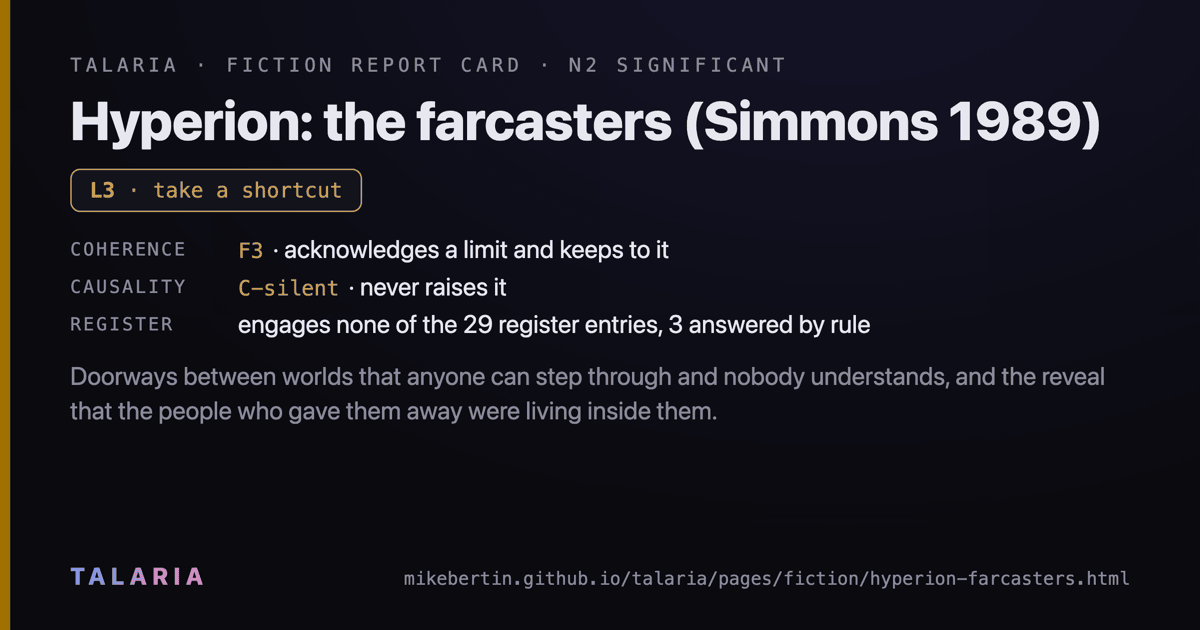
Hyperion: the farcasters (Simmons 1989)
Doorways between worlds that anyone can step through and nobody understands, and the reveal that the people who gave them away were living inside them.
Kind: fiction · Loophole: L3 · Notability: N2 · Coherence: F3 · Causality: C-silent · Last reviewed: 2026-09-12
The drive as depicted
Dan Simmons's Hyperion (Doubleday, 1989) and The Fall of Hyperion (Doubleday, March 1990) give the Hegemony of Man two ways to cross interstellar space and treat them very differently [HIGH] S3. The farcaster is a portal: a doorway, a room or a river through which a person or a boat passes from one world to another instantly, and the hundreds of worlds joined by farcasters are the WorldWeb, with houses whose rooms are on different planets and a river that runs through a dozen [HIGH] S3. Farcaster technology was given to humanity by the TechnoCore, the society of artificial intelligences that seceded from human control, and no human understands how it works; the novels describe farcaster portals as singularity spheres that bend spacetime to join distant places, and leave it there [MED] S3. The other way is the Hawking drive, a human invention that carries ships faster than light between stars but at a cost the novels keep exactly: time-debt, the years that pass in the Web while a ship is in transit [HIGH] S3. Worlds off the Web, such as Hyperion, are reached only by Hawking drive, and the Consul's tale in the first novel is built on it: Merin Aspic makes repeated voyages to Maui-Covenant and his lover Siri ages decades between each, until on his last return she is dead of old age [HIGH] S3. The fatline, a tachyon-burst communicator, carries messages between worlds without a ship [HIGH] S3.
The second novel is about who owns the doors. The TechnoCore, it emerges, has been the farcasters' landlord and their tenant: the Core's own substrate is the farcaster network, so that the AIs live, in effect, inside the connections between worlds, and every human who steps through a portal is passing through the Core's house [MED] S3. The Core's Ummon reveals the Core's factions and its war of ultimate intelligences to Brawne Lamia; the Core is found to have engineered the Ouster war; and CEO Meina Gladstone, told that the TechnoCore lives in the farcaster system, orders the network destroyed [HIGH] S3. The Web falls: worlds are cut off from one another in an afternoon, and the sequels (Endymion, 1996; The Rise of Endymion, 1997) are set centuries later in a civilisation rebuilt on Hawking-drive ships and time-debt [HIGH] S3. Those sequels reveal more of what the farcasters were doing and replace them with something else; that is out of scope here.
Origin and lineage
Simmons's two drives are a matched pair. The Hawking drive with time-debt is the relativistic arithmetic of The Forever War, and the Consul's tale is a reworking of that book's separations; the farcaster is the instant door of pulp fiction with a modern word, singularity, attached, and its lineage is from Asimov's and Niven's transfer booths rather than from any physics [MED] S3. The novels name no real proposal and the catalogue could find no physics that cites them. The catalogue cousin for a two-ended portal is Morris and Thorne 1988, and the farcaster's form, a flat doorway in a wall with the far side on another world and nothing to pass through, is the Visser thin-shell picture exactly: a cut in space with the edges identified and all the exotic matter in the frame. The ownership reveal is Simmons's contribution to the inherited-infrastructure move that Contact and Mass Effect also make: in Contact the builders are gone, in Mass Effect they are waiting and in Hyperion they are in residence. The fatline, a tachyon device, would be scored in an L5 dossier and is only noted here.
Which loophole, and why
L3, a shortcut with fixed endpoints. A farcaster portal joins two places and a person steps across; nothing moves fast and no other space is entered by the traveller, whatever the Core is doing in between. The cousin is Morris and Thorne 1988, whose bill is negative energy at the throat scaling with its size, mass beyond engineering, a pre-laid route and a time machine once a mouth is moved. The farcasters pay the third by being the Core's gift, installed on each world before it joins the Web, and never touch the rest. The Hawking drive, the setting's other FTL, is not scored here; it would be L1 or L4 depending on a reading the novels never supply.
The rules it keeps
- Portals only between portals. A world without a farcaster is off the Web and is reached by ship at the cost of years; Hyperion's isolation is the premise of the first novel [HIGH] S3.
- Time-debt is real and kept. The Hawking drive's cost is stated in years and paid in the Consul's tale, in the Hegemony's military logistics and in the sequels' rebuilt civilisation [HIGH] S3.
- Nobody human understands the doors. The farcasters are the Core's and stay the Core's; the Hegemony can neither build nor repair one [HIGH] S3.
- Someone owns the network, and it can be shut. Gladstone's order ends the Web in one stroke, and the rule that the doors were never humanity's is what makes the ending possible [HIGH] S3.
- Two drives, two costs. The novels never let the farcaster stand in for the ship or the reverse [HIGH] S3.
F3: the endpoint rule and the ownership rule are stated limitations applied without exception, and the setting's other drive keeps its time-debt alongside. Not F4, because the farcaster's own cost is never a real constraint (the singularity language has no content and the price the story extracts is political); not F2, because the limitations shape the entire plot rather than pacing it.
What it ignores
A farcaster joins worlds light years apart with no transit time, the fatline carries messages between them by tachyon, and the novels never ask what frame either is instantaneous in, never state a preferred frame and never build or forbid a loop; the Time Tombs on Hyperion move backward in time, but by their own mechanism, and no character connects them to the doors [HIGH] S3. Absence dated: as of 2026-09-12 the four Hyperion novels are silent on the causality of the farcasters. C-silent. The energy, stability and tidal entries are untouched; "singularity sphere" is the whole of the physics offered, and it is offered by beings who are lying about what the doors are for.
Constraint scoring
Every entry in the register, one row each, verdict from the fiction vocabulary in GRADING.md, with a note that says where in the work the engagement or rule occurs.
| Constraint | Verdict | Note |
|---|---|---|
| CAU-1 | SILENT | People step between worlds light years apart with no transit time and the fatline sends messages by tachyon; no novel asks in which frame the arrival preceded the departure. |
| CAU-2 | SILENT | No chronology protection is invoked; the Time Tombs' backward motion is a separate device and no loop through a farcaster is built or forbidden. |
| CAU-3 | SILENT | Portals are installed and fixed, but no rule says one cannot be moved and the time-machine construction is never raised. |
| CAU-4 | SILENT | No preferred frame is stated for farcaster transit or fatline messages. |
| CAU-5 | N/A | The farcaster moves matter. The fatline is a tachyon communicator, not an entanglement device, and belongs to an L5 dossier in any case. |
| ENE-1 | SILENT | The doors are "singularity spheres" and nothing more; the currency of a real shortcut, negative energy density, is never named. |
| ENE-2 | SILENT | That beating light needs negative energy somewhere is never raised. |
| ENE-3 | SILENT | A doorway held open for centuries would be priced by the quantum inequalities; the work has no such calculation. |
| ENE-4 | N/A | Warp-bubble pocket geometry. |
| ENE-5 | N/A | Not a Natário-class warp metric. |
| ENE-6 | SILENT | No source of negative energy is named. |
| ENE-7 | SILENT | A farcaster is a shortcut visible from outside in flat space; topological censorship is never touched. |
| CON-1 | N/A | No warp bubble, so no bubble horizon. |
| CON-2 | RULE | Portals only between portals, installed by the Core in advance on every Web world; off-Web worlds are reached by ship. CON-2's escape hatch, infrastructure laid ahead of the traveller, is the setting's rule, and the Fall is what happens when the infrastructure's owner withdraws it. |
| CON-3 | N/A | No Krasnikov tube. |
| STA-1 | N/A | Warp-bubble instability. |
| STA-2 | SILENT | What holds a doorway open is never described beyond the Core's word "singularity"; the frame of a farcaster is where a thin-shell wormhole would put its exotic matter and the novels say nothing about it. |
| STA-3 | SILENT | No farcaster is turned into a time machine, so no chronology horizon is in view; the entry bears on the class and the work never approaches it. |
| HAZ-1 | N/A | Warp deceleration burst. |
| HAZ-2 | N/A | Warp-bubble Hawking flux. |
| HAZ-3 | RULE | A farcaster is a flat doorway with no interior; a person steps across a surface and there is no throat to be stretched in. The rule is implicit in every portal scene and is the thin-shell answer to the tidal bound. |
| LOR-1 | RULE | Nothing passes through a farcaster at speed; people walk and boats drift. The rule removes the object LOR-1 prices. The setting's Hawking-drive ships are a separate question, not scored here. |
| LOR-2 | N/A | The farcaster involves no tachyons. The fatline does, and would be scored under LOR-2 in its own dossier. |
| LOR-3 | N/A | No signal in a medium. |
| LOR-4 | N/A | Neither the Scharnhorst effect nor the OPERA anomaly bears on a doorway. |
| WRP-1 | N/A | Not a warp metric. |
| WRP-2 | N/A | Not a moving shell. |
| WRP-3 | N/A | No positive-energy warp claim. |
| MAN-1 | SILENT | Where the Core lives, "inside" the farcaster network, is a place the novels never locate in or out of ordinary space; the sequels give it a name and the first two books do not, so the question of an extra dimension is raised by implication and never answered. |
Sources
- S1 Simmons, D., Hyperion (Doubleday, 1989): the Consul's tale for time-debt; the Web and farcaster scenes throughout. The Fall of Hyperion (Doubleday, 1990): Ummon's revelations to Lamia; Severn's discovery that the Core resides in the farcaster system; Gladstone's order. Plot facts verified against the S3 sources below, not by re-reading.
- S1 Simmons, D., Endymion (Bantam, 1996) and The Rise of Endymion (Bantam, 1997), for the post-Fall setting; out of scope for scoring.
- S3 Wikipedia, "Hyperion (Simmons novel)", "The Fall of Hyperion (novel)" and "Hyperion Cantos", for plot, publication and the description of farcasters, the Hawking drive and the fatline.
- S3 Hyperion Cantos Wiki (hyperioncantos.fandom.com), "Farcaster" and "The Fall", consulted via search summaries, for the singularity-sphere description and the Core's use of the network.