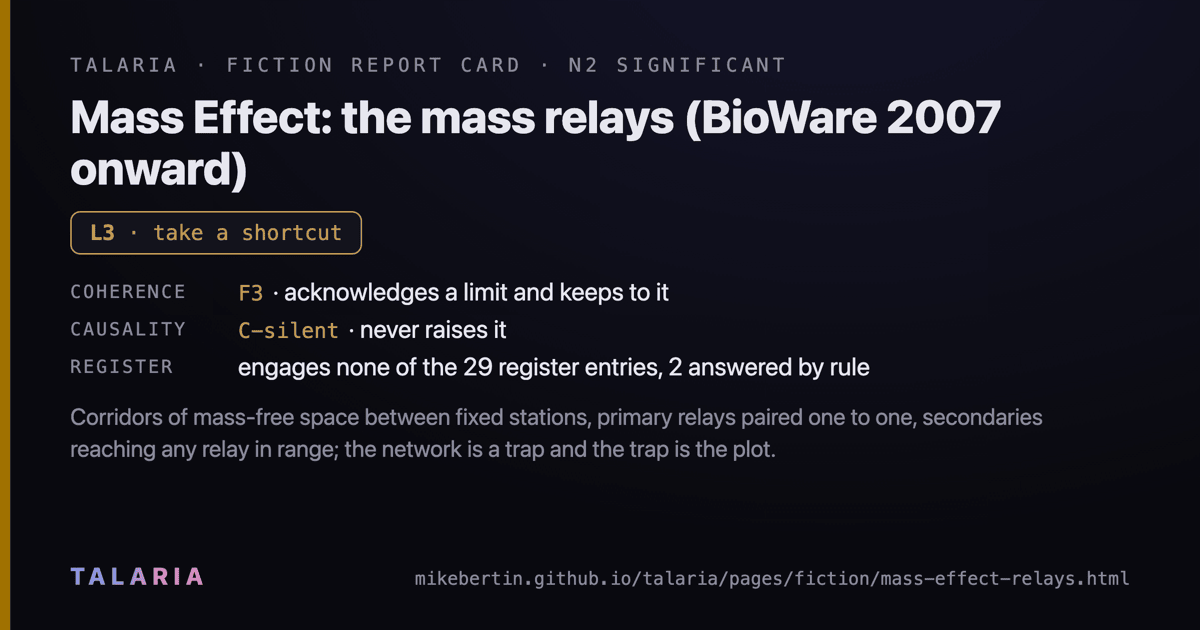
Mass Effect: the mass relays (BioWare 2007 onward)
Corridors of mass-free space between fixed stations, primary relays paired one to one, secondaries reaching any relay in range; the network is a trap and the trap is the plot.
Kind: fiction · Loophole: L3 · Notability: N2 · Coherence: F3 · Causality: C-silent · Last reviewed: 2026-09-12
The drive as depicted
Mass Effect (BioWare, released 20 November 2007) has two faster-than-light systems and documents both in its in-game Codex [HIGH] S3. Ships carry drive cores of element zero, which under current emits a field that lowers the mass of everything inside it; the Codex entry "FTL Drive" says the field effectively raises the speed of light within it and allows high-speed travel "with negligible relativistic time dilation effects" [MED] S3 (Codex text, read via a fan transcription). That is an L1 move and is scored in the catalogue's mass-effect-element-zero entry. This dossier is the other system. The Codex entry "Mass Relays" describes enormous structures scattered through the galaxy that "create corridors of virtually mass-free space", allowing instantaneous transit between locations that would take years or centuries by drive core [MED] S3. Primary relays throw a ship thousands of light years, often between spiral arms, and each is paired with exactly one other primary relay; secondary relays reach only a few hundred light years but are omnidirectional, able to send a ship to any relay within that range [MED] S3. On screen the ship approaches the relay, is caught by its field and is thrown along the corridor in a streak of blue; arrival is at the paired relay and nowhere else [HIGH] S3.
The game's plot is about who built them. The Codex attributes the relays to the Protheans, an extinct race whose ruins on Mars gave humanity the technology [MED] S3. On Virmire the Reaper Sovereign tells Shepard the truth: the Reapers built the relays and the Citadel, and left them so that each new civilisation would grow along the paths the network laid out, reach its peak on that technology and be harvested [HIGH] S3. On Ilos the Prothean virtual intelligence Vigil adds that the Citadel is itself an enormous relay through which the Reapers enter the galaxy, and that the Protheans built the Conduit, a miniature relay disguised as a statue, to reach it and sabotage the signal [HIGH] S3. The sequels keep the rules and add cases: a relay is destroyed in Mass Effect 2's "Arrival" with the loss of a system, and Mass Effect 3 ends with the network wrecked or repurposed [MED] S3.
Origin and lineage
The relays are the classic fixed-point jump network, with the primary and secondary distinction as the game's own contribution: a topology in which long hops are rigid and short hops are flexible, which shapes the galaxy map the player moves across [HIGH] S3. The "mass-free corridor" language ties the relays to the game's one idea, that mass can be lowered by a field, and so to the Codex's L1 drive rather than to any wormhole paper; no real proposal is named for either [MED] S3. The catalogue's cousins are nonetheless the wormhole of Morris and Thorne 1988 for a fixed two-ended shortcut, and, for the game's L1 side, the whole of the LOR family, since a body of lowered mass still cannot be pushed past c (LOR-1). The relays' fixed pairing is the same rule as the tramlines of the Alderson drive, and the "built by someone who wanted you to use it" reveal is the darkest version of the inherited-infrastructure move that Contact and the Expanse make benignly, and the reverse of the Hyperion farcasters, whose builders are still inside. The lineage is franchise-internal; nothing in the physics literature descends from or is cited by the game.
Which loophole, and why
L3, a shortcut with fixed endpoints, as the primary class for this dossier; the game's other move, L1 by mass reduction, has its own entry and is named here only where the Codex uses the same field language for both. A relay transit is instantaneous, from one station to another, and a ship cannot arrive anywhere a relay is not. The cousin is Morris and Thorne 1988, whose bill is negative energy at the throat scaling with its radius, mass beyond engineering, a route laid in advance and a time machine once a mouth is moved. The relays pay the third by design (the Reapers laid them), the second by scale (nobody in the galaxy can build one) and never touch the first or fourth. The "mass-free corridor" is the game's substitute for the throat: not a tunnel through geometry but a lane in which the game's mass rule is pushed to its limit.
The rules it keeps
- Relays only between relays. GRADING.md gives this as its own example of an F3 limitation; a primary relay reaches one partner and nothing else, a secondary reaches any relay in a few hundred light years [MED] S3.
- Range by class. Thousands of light years for primaries, hundreds for secondaries; the map is built on it [MED] S3.
- Nobody builds relays. Every civilisation uses the network it found; the Conduit is a Prothean copy, not an original, and the plot turns on the fact that the network's makers are its predators [HIGH] S3.
- The network is a trap. Sovereign's speech makes the relay layout itself a mechanism of control, which is a rule about infrastructure that no other work in this catalogue states so plainly [HIGH] S3.
- Destroying a relay is catastrophic. "Arrival" prices the loss of one at a star system [MED] S3.
F3: stated limitations, applied consistently across three games, with the endpoint rule and the inherited-infrastructure rule doing real work in the story. Not F4, because no real constraint is named for the relays; the Codex's physics is a field that lowers mass, and the corridor is a consequence of that invented rule rather than of anything in the register.
What it ignores
The Codex's own drive entry mentions relativistic time dilation as negligible inside a mass effect field, which shows the writers knew the word, and then never applies the harder question to either system [MED] S3. Relay transit is instantaneous over thousands of light years, comm buoys along the relay corridors carry messages at the same speed, and no game, Codex entry or dialogue asks what frame that is instantaneous in or what a moving observer would see. There is no preferred frame, no rule of simultaneity and no time loop anywhere in the trilogy [MED] S3. Absence dated: as of 2026-09-12 the franchise, including its 2021 remaster, is silent on the causality of both its FTL systems. C-silent. On the register's energy and stability entries the relays are equally silent; element zero and "mass-free" are the only words the Codex offers.
Constraint scoring
Every entry in the register, one row each, verdict from the fiction vocabulary in GRADING.md, with a note that says where in the work the engagement or rule occurs.
| Constraint | Verdict | Note |
|---|---|---|
| CAU-1 | SILENT | Instantaneous transit between relays thousands of light years apart, and instantaneous messages through comm buoys along the corridors; no Codex entry or line of dialogue asks in which frame the arrival preceded the departure. |
| CAU-2 | SILENT | No chronology protection; no time loop exists in the games. |
| CAU-3 | SILENT | Relays are fixed and enormous, but no rule says they cannot be moved and one is destroyed in "Arrival"; the time-machine construction is never raised. |
| CAU-4 | SILENT | No preferred frame is named for relay transit or for the drive core's raised light speed. |
| CAU-5 | N/A | The relays move ships. The franchise's quantum entanglement communicator (Mass Effect 2) is an entanglement radio and would be scored under CAU-5 in a communications dossier, not here. |
| ENE-1 | SILENT | The Codex prices everything in element zero and mass reduction; the currency of a real shortcut, negative energy density, is never named for the relays. |
| ENE-2 | SILENT | That beating light needs negative energy somewhere is never raised; the Codex's "mass-free corridor" is offered instead. |
| ENE-3 | SILENT | A corridor thousands of light years long, open for millennia, would be priced by the quantum inequalities; the work has no such calculation. |
| ENE-4 | N/A | Warp-bubble pocket geometry. |
| ENE-5 | N/A | Not a Natário-class warp metric. |
| ENE-6 | SILENT | No source of negative energy is named. |
| ENE-7 | SILENT | Relay corridors are shortcuts visible from outside in flat space; topological censorship is never touched. |
| CON-1 | N/A | No warp bubble, so no bubble horizon. |
| CON-2 | RULE | Relays only between relays, and the relays were laid by the Reapers; nobody reaches a system without one and nobody builds the far end. CON-2's escape hatch is the game's premise and, in Sovereign's speech, its trap. |
| CON-3 | N/A | No Krasnikov tube. |
| STA-1 | N/A | Warp-bubble instability. |
| STA-2 | SILENT | What holds a corridor open is never described beyond the words "mass-free"; the throat has no stated matter. |
| STA-3 | SILENT | No relay is turned into a time machine, so no chronology horizon is in view; the entry bears on the class and the work never approaches it. |
| HAZ-1 | N/A | Warp deceleration burst. The Codex's drive-core entry does describe catastrophic energy release if a mass effect field collapses at FTL speed, but that belongs to the L1 dossier. |
| HAZ-2 | N/A | Warp-bubble Hawking flux. |
| HAZ-3 | N/A | Nothing crosses a throat as an extended body under gravity; the ship is thrown along a corridor and the game never describes an interior to be stretched in. |
| LOR-1 | RULE | The Codex's answer is the mass-free corridor: with mass removed, the kinetic-energy barrier LOR-1 prices is removed by fiat. The rule is stated in the Codex and is the same field logic as the drive core. |
| LOR-2 | N/A | No tachyons. |
| LOR-3 | N/A | No signal in a medium. |
| LOR-4 | N/A | Neither the Scharnhorst effect nor the OPERA anomaly bears on a relay. |
| WRP-1 | N/A | Not a warp metric. |
| WRP-2 | N/A | Not a moving shell. |
| WRP-3 | N/A | No positive-energy warp claim. |
| MAN-1 | N/A | The ship never leaves the manifold; the corridor is a lane in ordinary space with the mass rule applied, and no extra dimension is invoked anywhere in the Codex. |
Sources
- S1 Mass Effect (BioWare, Microsoft Game Studios, 20 November 2007): Codex entries "Mass Relays", "FTL Drive" and "Element Zero"; the Virmire conversation with Sovereign; Vigil on Ilos. Codex text read via a fan transcription (S3), not from a running copy of the game.
- S1 Mass Effect 2 (BioWare, 2010), including the "Arrival" downloadable content; Mass Effect 3 (BioWare, 2012). Plot facts from the S3 sources below.
- S3 Wikipedia, "Mass Effect (video game)", for the Sovereign and Vigil plot points and release details.
- S3 Mass Effect Wiki (masseffect.fandom.com), "Codex/Technology" and "Mass Relay", and a GameFAQs Codex guide, for the Codex text; consulted via search summaries and a walkthrough transcription.