The Lensman inertialess drive (E. E. Smith, 1934 onward)
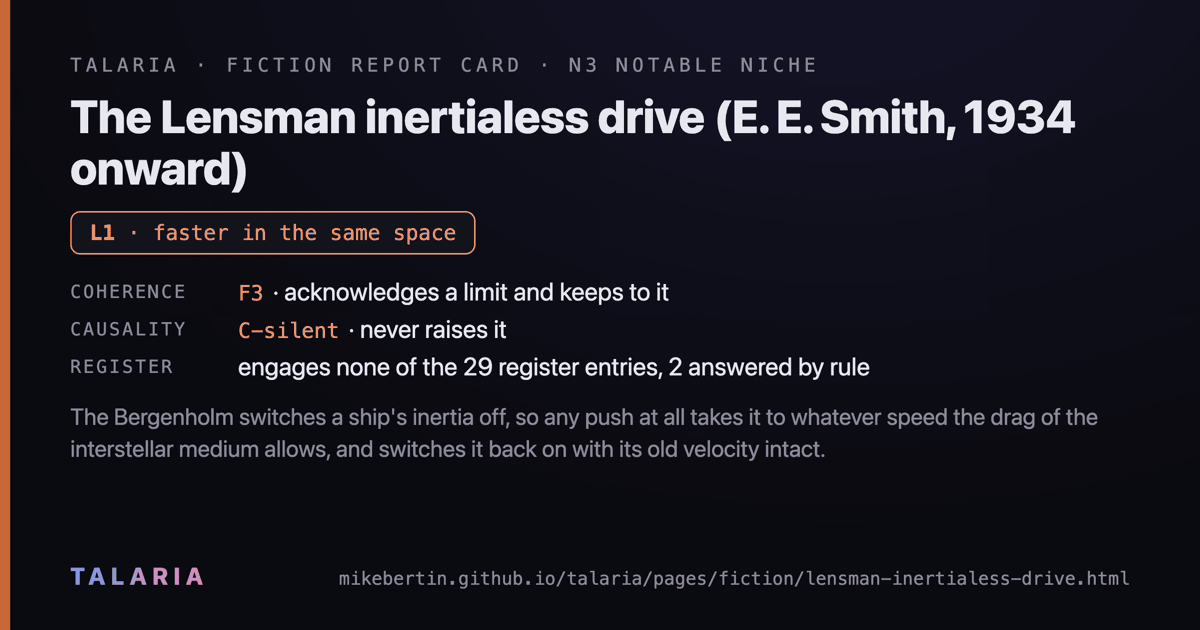
The Bergenholm switches a ship's inertia off, so any push at all takes it to whatever speed the drag of the interstellar medium allows, and switches it back on with its old velocity intact.
Kind: fiction · Loophole: L1 · Notability: N3 · Coherence: F3 · Causality: C-silent · Last reviewed: 2026-09-12
The drive as depicted
The Lensman ships fly "free" or "inert". A generator called the Bergenholm neutralises the inertia of the ship and everything in it; with inertia gone, the ship's driving blast is opposed only by the friction of whatever medium it is passing through, and the ship takes up, instantly, the speed at which drive and drag balance. Galactic Patrol states the rule in an author's footnote in Chapter 2: with the neutralisation of inertia there is "no limit whatever to the velocity of inertialess matter", and a free ship takes on the balance velocity instantaneously [HIGH] S1. In the same chapter the Britannia, capable of ten gravities of inert acceleration, crosses space at ninety parsecs an hour, which the narration calls possible only for inertialess matter driven through an almost perfect vacuum [HIGH] S1. Inert matter, the books say repeatedly, cannot even reach the speed of light; free matter has no ceiling but the medium.
The drive's second rule is the one that makes it interesting. Inertia is switched off, not destroyed, and with it the ship's momentum is stored rather than spent. When the Bergenholm is cut the ship "goes inert" and instantly resumes the velocity it had before going free, its "intrinsic velocity", whatever it has done in the meantime. So a ship cannot simply land free on a planet with a different intrinsic velocity and switch on inertia: it would tear away at its old speed. Crews must "match intrinsics" by inert manoeuvring before docking, boarding or landing inert, and Chapter 4 of Galactic Patrol has Kinnison's lifeboat land free on a strange world for speed and then blast inert to match a companion's intrinsic velocity before the two can rendezvous [HIGH] S1. When a Bergenholm fails in flight the ship drops instantly from galactic speed to near rest in space, since inert acceleration over the same interval would have been negligible [HIGH] S1. The rule is used as a weapon in Gray Lensman, where two planets driven free with opposite intrinsic velocities have their Bergenholms cut on either side of an enemy world [MED] S3.
Everything else about the setting follows from the free state: crews walk through dropshafts inertialess and collisions cannot even be felt [HIGH] S1 (First Lensman); at ninety parsecs an hour a solar system is crossed in a fraction of a second, so visual observation is impossible and detection is by "ultra-wave" instruments [HIGH] S1. Communication and detection use ultra-waves and later the Lens itself, which are faster than light and never explained; they belong to L5 and are noted here rather than scored.
Origin and lineage
The inertialess drive first appears as the Rodebush-Cleveland drive in Triplanetary (Amazing Stories, 1934; expanded as a novel in 1948), and Galactic Patrol (Astounding, September 1937 to February 1938; book 1950) gives the perfected version its name after Nels Bergenholm [MED] S3 for the serial dates, [HIGH] S1 for the Bergenholm text in the 1950 book. First Lensman (1950), written afterwards as a bridge, supplies the back-story: the original Rodebush-Cleveland free drive was a killer, and Bergenholm, who was not even an engineer, told the designers how to make it work [HIGH] S1. That is Smith's own account of why the device carries the name it does.
The drive is Smith's second attempt at the problem his own Skylark had ignored. The Skylark reached any speed by pushing; the Lensman ships reach any speed by removing the thing that resists a push. Smith names no physics and there was none to name. The nearest real idea is Mach's principle, in Sciama's later form, that inertia is the gravitational action of the rest of the universe on an accelerated body, which is the premise of Woodward's Mach effect thruster; nothing connects Smith to Mach and no influence is claimed. In fiction the inertialess drive stayed Smith's own, though the phrase "inertialess" recurs in later space opera and the intrinsic-velocity rule is the clear ancestor of every later story in which switching a drive off returns a ship to the momentum it started with.
Which loophole, and why
L1, faster in the same space. The ship is an ordinary object in ordinary space; nothing about the geometry changes, no other space is entered, no shortcut is taken. The claim is that the light-speed ceiling is a property of inertia rather than of spacetime, so that removing inertia removes the ceiling. The physics cousin is LOR-1, and it says the opposite: the ceiling is kinematic, a property of the light cone, and a body with no inertial mass is not free to move at any speed but is constrained to move at exactly c, like a photon. The nearest physics proposal, the Mach effect thruster, claims only to fluctuate a body's mass transiently by a tiny fraction, and its bill is that the most sensitive balances find vibration rather than thrust; the EM drive is the same story for reactionless thrust. Nothing in physics reduces a body's inertia to zero, and if something did, special relativity would send the body to c and no further. The mass-lowering drive of Mass Effect is the same loophole seventy years on, with a dial instead of a switch.
The rules it keeps
The books keep their rules with unusual discipline for the period, which is what earns F3 rather than F1.
- Free versus inert is binary and stated. A ship is one or the other; the transitions are instantaneous; inert ships obey ordinary mechanics and cannot reach c [HIGH] S1.
- Speed is set by the medium. Free speed is the balance of drive against drag, so ships are faster in clean vacuum and slower in atmosphere or nebulae, and the ninety-parsec figure is given as a vacuum figure [HIGH] S1.
- Intrinsic velocity is conserved. Momentum survives the free interval and reappears when inertia returns; matching intrinsics before docking, boarding or landing inert is a standing procedure across the series, costs time and is used tactically [HIGH] S1.
- Failure is mechanical. A Bergenholm can develop a "meter-jump", can quit cold and drops the ship to near rest; drives are maintained, not magic [HIGH] S1.
- Observation fails at speed. The narration says outright that a system crossed in a fraction of a second cannot be observed, and detection is delegated to faster-than-light instruments [HIGH] S1.
These are limitations with physical flavour, applied consistently, and the intrinsic-velocity rule is close to a real conservation law. They are not engagement with a real constraint, since the constraint the drive breaks, LOR-1, is never named; the series asserts that inert matter cannot reach c and then defines free matter as exempt.
What it ignores
Time. Nowhere in Triplanetary, Galactic Patrol or the later books does a free ship's clock disagree with a planet's, and nowhere does a message or a ship arrive before it left in anyone's reckoning. The galaxy runs on one clock, Patrol headquarters and the Britannia share a "now", and the ultra-wave communicators that make this possible are never examined. The register's first question, what a signal faster than light does to the order of events, is not addressed in any instalment, which is C-silent. There is not even a preferred-frame rule to point to: the single galactic time is assumed, not stated.
Constraint scoring
| Constraint | Verdict | Note |
|---|---|---|
| CAU-1 | SILENT | Free ships and ultra-wave signals both outrun light in flat space; no instalment considers the frame-dependence of their arrival order. |
| CAU-2 | SILENT | No closed causal loops are built; the books never reach the question chronology protection answers. |
| CAU-3 | N/A | No wormholes or warp bubbles; the two-device time machine is a construction on geometric drives. |
| CAU-4 | SILENT | The series assumes one galactic clock and one "now" without ever stating a preferred frame; the escape hatch is used unknowingly and never named. |
| CAU-5 | N/A | Ultra-waves and the Lens are not entanglement; nothing quantum is invoked. |
| ENE-1 | N/A | No negative energy; the drive alters the ship, not the spacetime. |
| ENE-2 | N/A | Olum's theorem prices spacetimes that deliver a signal early; the Lensman spacetime is flat. |
| ENE-3 | N/A | No negative energy density to bound. |
| ENE-4 | N/A | No bubble. |
| ENE-5 | N/A | Not a warp drive. |
| ENE-6 | N/A | No Casimir energy. |
| ENE-7 | N/A | Trivial topology. |
| CON-1 | N/A | No horizon; the pilot controls an ordinary body with inertia removed. |
| CON-2 | N/A | Nothing is laid along the route; the drive is self-contained and the first flight is as fast as any. |
| CON-3 | N/A | No tube. |
| STA-1 | N/A | No bubble to be unstable; the instability the books do depict, the Bergenholm's meter-jump, is mechanical. |
| STA-2 | N/A | No throat. |
| STA-3 | N/A | No chronology horizon. |
| HAZ-1 | RULE | The bubble-release burst does not apply, but the series has its own version of the deceleration hazard: a ship that goes inert resumes its intrinsic velocity, and matching intrinsics before contact is a standing rule (Chapter 4 of Galactic Patrol and throughout). |
| HAZ-2 | N/A | No horizon to radiate. |
| HAZ-3 | N/A | No throat tides. |
| LOR-1 | RULE | The books state that inert matter cannot reach c and then exempt free matter by definition; the exemption is a stated rule, not an engagement with why the ceiling exists. |
| LOR-2 | SILENT | A ship that starts at rest and ends above c crosses the barrier, which tachyon kinematics forbids for any particle; the crossing is instantaneous in the fiction and never examined. |
| LOR-3 | N/A | No wave in a medium; the free speed is a real transit speed of matter. |
| LOR-4 | N/A | Neither the Scharnhorst effect nor OPERA bears on a rocket. |
| WRP-1 | N/A | Not a warp drive. |
| WRP-2 | N/A | Not a shell moving inertially; the drive removes inertia rather than exploiting it. |
| WRP-3 | N/A | No positive-energy warp claim. |
| MAN-1 | N/A | Four dimensions; the "hyper-spatial tube" of the later books is a separate weapon and is not the drive. |
Sources
- S1 Smith, E. E., Galactic Patrol (Fantasy Press, 1950; serial in Astounding, 1937 to 1938). Text read at Project Gutenberg Canada, Pyramid Books 1970 edition; Chapters 2 and 4 and the Bergenholm-failure and Q-gun passages read for the drive.
- S1 Smith, E. E., First Lensman (Fantasy Press, 1950). Text read at Project Gutenberg ebook 49525; the Rodebush-Cleveland and Bergenholm passages and the inertialess dropshaft read.
- S1 Smith, E. E., Triplanetary (Fantasy Press, 1948; magazine version 1934). Project Gutenberg ebooks 20782 and 32706. Not re-read for this dossier; the Rodebush-Cleveland attribution rests on First Lensman and on secondary summaries.
- S3 Wikipedia, "Lensman series", for serial dates and publication order.
- S3 Summaries of Gray Lensman (Project Gutenberg ebook 69584) for the Jarnevon planet-smashing episode; the passage was not read directly.