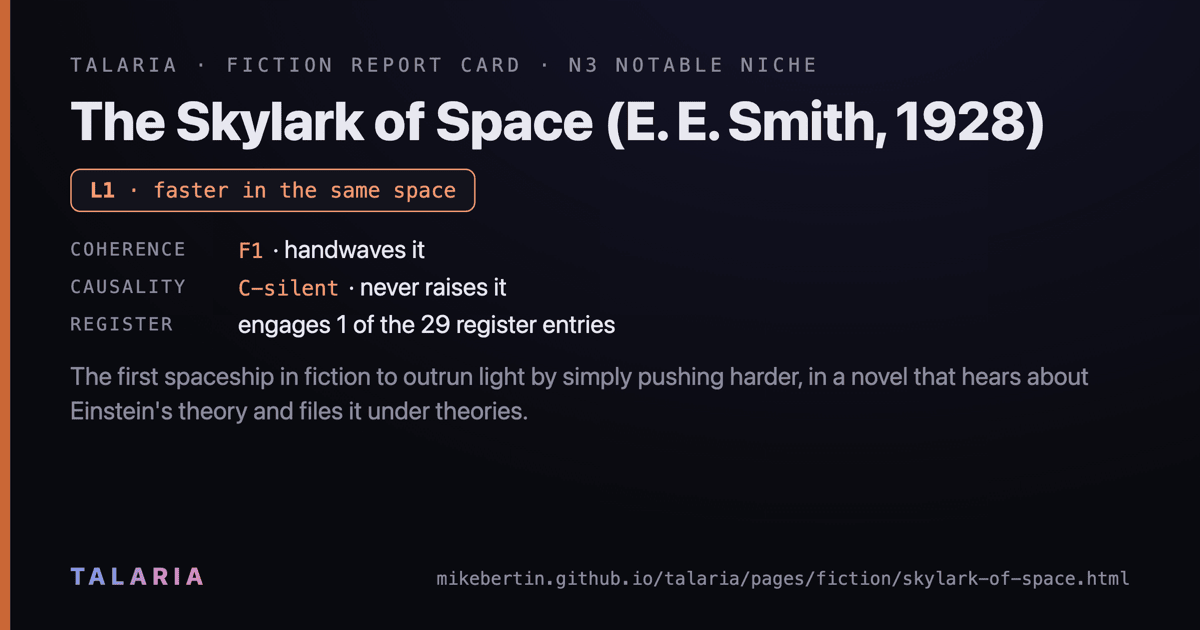
The Skylark of Space (E. E. Smith, 1928)
The first spaceship in fiction to outrun light by simply pushing harder, in a novel that hears about Einstein's theory and files it under theories.
Kind: fiction · Loophole: L1 · Notability: N3 · Coherence: F1 · Causality: C-silent · Last reviewed: 2026-09-12
The drive as depicted
The Skylark is a steel sphere driven by intra-atomic energy released from copper by a catalytic metal the chemist Richard Seaton calls "X", with a current passed through it; the discovery is made by accident in Chapter I, "The Occurrence of the Impossible" [HIGH] S1. The power plant is a copper bar mounted in the centre of the ship. The bar pushes the ship along the line of its axis, the ship accelerates for as long as copper lasts, and there is no other mechanism: no field, no bubble, no jump. Everything the book says about speed follows from that.
The novel is aware of the light barrier and says so before the ship is built. In Chapter VII Seaton tells the lawyer Crane's party that with a four-hundred-pound bar the ship could develop "not only the velocity of light, but an acceleration equal to that velocity", except for "the increase in mass at high velocities, as shown by Einstein and others", and that in open space the ship can reach any speed up to light as a limit [HIGH] S1. Two chapters later the limit is gone. DuQuesne's stolen ship has covered three hundred and fifty million miles in twenty minutes, Seaton objects that nothing can go that fast and asks about Einstein's theory, and Crane answers that a theory is a theory and a measured distance is a fact [HIGH] S1 (Chapter VIII). The exchange is the whole of the book's physics of faster-than-light travel. From then on the Skylark crosses interstellar space at a velocity the narration compares to a rifle bullet against a snail, light being the snail, still gaining twenty-six feet per second every second [HIGH] S1.
The story is a chase across the galaxy, a rescue and a war on the planet Osnome; the drive is transport, never the subject. Nothing in the novel is affected by the speed except the distance covered, and the crew notice no change in their own clocks or the ship's mass. The later Skylark books escalate the speeds and the weapons without revisiting the question.
Origin and lineage
Edward Elmer Smith wrote the first draft between 1915 and 1920 with Lee Hawkins Garby, who supplied the romantic dialogue; it was serialised in Amazing Stories from August to October 1928 and appeared as a book in 1946 with revised editions later [HIGH] S1 for the serial and Gutenberg text; the drafting history and the fact that the first instalment shared its issue with the first Buck Rogers story are secondary [MED] S3. It is generally counted the first straightforward faster-than-light spaceship in fiction and the founding text of space opera, which is why it is here at all: the Skylark set the genre's precedent of stating the light barrier and then passing it.
Smith held a doctorate in chemical engineering and his physics is of its decade: intra-atomic energy is the radium-era phrase for what became nuclear energy, and the mass increase he cites in Chapter VII is textbook special relativity. The book names no real proposal for beating light and none existed; tachyons (Feinberg 1967) were forty years away. Nothing downstream in physics descends from it. Downstream in fiction, almost everything does: Smith's own Lensman books replaced the bare push with an inertialess drive (Lensman inertialess drive), which is the first sign of a writer feeling the need for a mechanism.
Which loophole, and why
L1, faster in the same space. The ship is an ordinary object pushed by an ordinary force in ordinary space, and it exceeds c because the author says a measurement outranks a theory. There is no second move. The physics cousin is the one the register files under LOR-1: Einstein's 1905 result that a body's kinetic energy grows without bound as v approaches c, so no finite supply of copper reaches the barrier, let alone crosses it. The only physics proposal that lets a massive body live above c is the tachyon of Feinberg 1967 and the meta-relativity of Bilaniuk, Deshpande and Sudarshan, and its bill is that the object was never below c to begin with, has imaginary rest mass and, if it carried information, would be an antitelephone. The Skylark starts at rest on a Washington lawn, so even the tachyon is not available to it.
The rules it keeps
Almost none, which is the finding. The book keeps one rule with care: the ship needs copper, and every chapter counts how many bars remain, so range is a real constraint on the plot [HIGH] S1. It keeps a second rule loosely: acceleration is felt, the floor is sprung against jars, and the crew are pinned during full-power runs [HIGH] S1. It states a third rule, the relativistic mass increase, in Chapter VII and abandons it in Chapter VIII on the strength of a stopwatch reading. That is the pattern of F1: the drive works when the plot needs it to, and the one physical limit the book knows about is removed by fiat rather than by a mechanism. It is not F0, because the book is not joking; Crane's reply is meant as hard-headed empiricism.
What it ignores
Everything the register would ask. The novel never mentions time, clocks, simultaneity or frames of reference in connection with speed; the crew return to Earth having aged as their calendars say and nobody on Earth disagrees. The word "Einstein" appears twice and both times as an obstacle to be talked past [HIGH] S1. That is C-silent in its purest form: the question of what a faster-than-light ship does to the order of events is not answered because it is never raised, in this novel or in any of the three sequels.
Constraint scoring
| Constraint | Verdict | Note |
|---|---|---|
| CAU-1 | SILENT | The ship outruns light in flat space, which is exactly the signal CAU-1 prices, and the book never considers that an observer in another frame would see it arrive before it left. |
| CAU-2 | SILENT | No closed timelike curves are built or contemplated; chronology protection has nothing to protect against, and the question is not put. |
| CAU-3 | N/A | No wormholes or warp bubbles; the two-device time machine is a construction on geometric drives and the Skylark is a rocket. |
| CAU-4 | SILENT | The book has an implicit preferred frame, the frame in which stopwatch distances are "facts", but never names it or notices that it needs one. |
| CAU-5 | N/A | No entanglement or quantum signalling; the object-compass that tracks DuQuesne is a mechanical needle, not a quantum device. |
| ENE-1 | N/A | The drive uses positive energy from copper; the energy conditions price geometric shortcuts and this is not one. |
| ENE-2 | N/A | Olum's theorem is about spacetimes that deliver a signal early; the Skylark does not alter spacetime. |
| ENE-3 | N/A | No negative energy, so nothing for the quantum inequalities to bound. |
| ENE-4 | N/A | No bubble to pocket. |
| ENE-5 | N/A | Not a warp drive in the Natário class. |
| ENE-6 | N/A | No Casimir energy invoked. |
| ENE-7 | N/A | Trivial topology throughout. |
| CON-1 | N/A | No bubble wall, no horizon; the pilot's chair works because the ship is an ordinary accelerating body. |
| CON-2 | N/A | Nothing needs to be laid along the route; the first flight is the point of the book. |
| CON-3 | N/A | No tube. |
| STA-1 | N/A | No warp bubble to be unstable. |
| STA-2 | N/A | No throat. |
| STA-3 | N/A | No chronology horizon. |
| HAZ-1 | N/A | Nothing is swept up in a wall; the ship does collide with matter at speed in the sequels, but that is ordinary kinetic hazard, not the bubble-release burst HAZ-1 prices. |
| HAZ-2 | N/A | No horizon to radiate. |
| HAZ-3 | N/A | No throat tides. |
| LOR-1 | ENGAGES | Chapter VII states the relativistic mass increase and the light-speed ceiling; Chapter VIII overrides them with a measured distance. The constraint is named and then dismissed, which is engagement of a kind. |
| LOR-2 | SILENT | The ship crosses c from below, which is what tachyon kinematics forbids for any particle; the book does not raise the crossing. |
| LOR-3 | N/A | No wave in a medium; the speed claimed is a real transit speed of matter. |
| LOR-4 | N/A | Neither the Scharnhorst effect nor OPERA bears on a rocket. |
| WRP-1 | N/A | Not a warp drive. |
| WRP-2 | N/A | Not a shell of matter moving inertially in the Bobrick and Martire sense; it is a rocket. |
| WRP-3 | N/A | No positive-energy warp claim. |
| MAN-1 | N/A | Four dimensions, no bulk; the Skylark never leaves ordinary space. |
Sources
- S1 Smith, E. E. and Garby, L. H., The Skylark of Space, serialised in Amazing Stories, August to October 1928; text read at Project Gutenberg ebook 20869 (the edition credited to Smith and Garby). Chapters I, VII and VIII read for the drive and the Einstein exchange.
- S3 National Air and Space Museum, "Imagining Faster-Than-Light Travel", for the 1928 Amazing Stories context and the Buck Rogers issue.
- S3 Wikipedia, "The Skylark of Space", for the drafting dates and Garby's contribution. Not independently verified against a biography.